


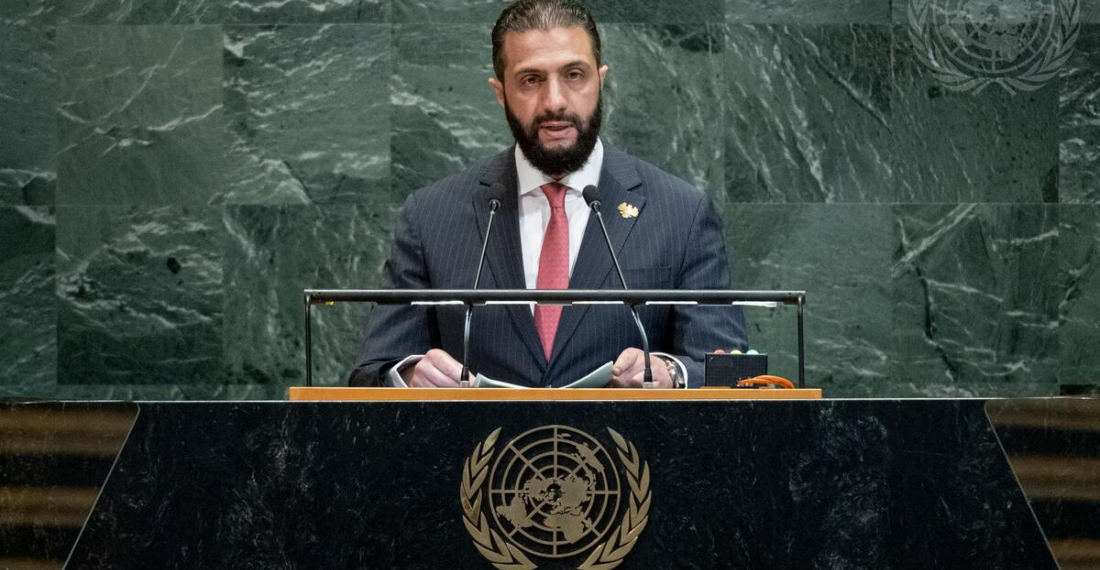
Syrian president addresses UN General Assembly for first time in nearly 60 years

Turning the page for his country, Syria’s president addressed the U.N. General Assembly on Wednesday 24 September, marking the first time any president from his country has done so in almost 60 years. As he spoke, AP reported that hundreds of people gathered in front of giant screens in Syrian cities and towns to witness the speech while waving the country’s flags. 

After six decades of dictatorship that killed 1 million people and tortured hundreds of thousands, “Syria is reclaiming its rightful place among the nations of the world,” Ahmad al-Sharaa told the international community.  Al-Sharaa became the first Syrian head of state to speak at the United Nations since Noureddine Attasi gave a speech in 1967 shortly after the Arab-Israeli war, during which Damascus lost control of the Golan Heights. Israel annexed it in 1981.

Since the Assad family came to power in Syria in 1970 in a bloodless coup that overthrew Attasi, relations with the United States have been mostly cold, as Damascus was an ally of the former Soviet Union. Over the past decades, Syrian foreign ministers represented the country at the U.N. General Assembly.

The Assad family dynasty’s autocratic 54-year rule abruptly collapsed in December, when then-President Bashar Assad  was ousted in a lightning insurgent offensive led by al-Sharaa. Assad’s fall marked a major shift in the 14-year civil war.

Al-Sharaa blasted Israel in his speech, saying that it did not stop its threats to his country since Assad’s fall and adding that its policies “contradict with the international community’s support to Syria and its people” and endanger the region.

Negotiations have been ongoing for a security deal that al-Sharaa has said he hopes will bring about a withdrawal of Israeli forces and return to a 1974 disengagement agreement. While al-Sharaa said last week that a deal could be reached in a matter of days, Israeli Prime Minister Benjamin Netanyahu on Sunday appeared to downplay the odds of a breakthrough.

Later Wednesday, according to AP, Netanyahu’s office said in a statement that negotiations are underway, adding that their conclusion “involves ensuring Israel’s interests, which include, among other things, the demilitarization of southwestern Syria and maintaining the safety and security” of the Druze religious minority in the country. 

Since assuming power, al-Sharaa has preached coexistence and sought to reassure Syria’s minority communities, but the country has been threatened by outbreaks of sectarian violence that left hundreds dead earlier this year. Gunmen affiliated with the new government were also accused of atrocities against civilians from the Druze and Alawite religious minorities in southern Syria’s Sweida province and the coastal region.

Al-Sharaa said in his speech that the Syrian state has worked on forming fact-finding missions and gave the United Nations the right to investigate the killings. “I promise to bring anyone whose hands are tainted with the blood of Syrian people to justice,” he added.

Al-Sharaa said Syria’s new authorities have destroyed the drug business that Assad used to fund his government as it was under harsh Western sanctions that, along with the war, paralysed the economy. Assad’s fall revealed industrial-scale manufacturing facilities of the amphetamine-like stimulant Captagon, also known as fenethylline, which experts say fed a $10 billion annual global trade in the highly addictive drug. Over the past months, Syrian authorities have closed Captagon factories in different parts of Syria part of their campaign to end the illegal trade. 

Al-Sharaa urged Western countries to lift the Assad-era sanctions “so that they are not a tool to shackle the Syrian people.” U.S. President Donald Trump met with al-Sharaa in Saudi Arabia in May and announced that he would lift decades of sanctions. He followed through by ordering a large swath of them lifted or waived.  However, the most stringent sanctions were imposed by Congress in 2019 and will require a congressional vote to permanently remove them.

Speaking to reporters outside the U.N. after his speech, al-Sharaa said that he hopes that the sanctions would eventually be lifted.  “Syria does not wish the pain it passed through for anyone” and feels “the suffering of war and destruction,” al-Sharaa said, expressing support for Palestinians in Gaza amid Israel’s war there. 

In Damascus, cheering crowds gathered in the central Umayyad Square to celebrate al-Sharaa’s speech. At Dag Hammarskjöld Plaza near the U.N., members of the Syrian diaspora faced off in dueling demonstrations, one in support of the new authorities in Damascus and one against. 

Pro-government demonstrators hoisted the three-starred “revolution flag” that has now become the official flag of Syria. On the other side, many lifted the five-colour Druze flag. Some shouted and cursed at each other across the barricades.

On the Druze side, Farah Taki, originally from Sweida, said her aunts there were displaced by the recent violence and she had come from Chicago to protest al-Sharaa’s visit. “It’s disgrace that New York is welcoming an ex-Qaida member at the U.N., and allowing him even to speak,” she said. The insurgent group that al-Sharaa formerly led was once affiliated with al-Qaida but later cut ties.

On the other side of the barricades, Dina Keenawari, a Syrian American originally from Damascus, had come from Florida to show her support for al-Sharaa. “We’ve lived under tyranny for the past 50 years, and now we’re turning a new chapter, and we’re looking forward,” she said. “And we’re proud of him.”
Source: commonspace.eu with AP and agencies. Photo: UN

Related articles

Editor's choice
News
Council of Europe launches new International Claims Commission for Ukraine

Council of Europe launches new International Claims Commission for Ukraine

Thirty-four countries and the European Union have signed a new convention establishing an International Claims Commission for Ukraine at a diplomatic conference co-hosted by the 46-nation Council of Europe and the Netherlands in the Hague. The diplomatic conference was attended by leaders and high-level representatives from over 50 states, including the President of Ukraine, Volodymyr Zelenskyy, the President of the Republic of Moldova, Maia Sandu, and the Prime Minister of the Netherlands, Dick Schoof.  “Today marks a major step forward in ensuring accountability for Ukraine. The International Claims Commission represents justice and hope for tens of thousands of victims—our determination that those who have suffered will not be forgotten. I call for quick ratifications so we can get the commission rapidly up and running for the people of Ukraine,” said Council of Europe Secretary General Alain Berset. Ukrainian President Volodymyr Zelenskyy said: “We expect that every mechanism for compensation from the Register of Damage and Claims Commission to the actual payments – will start working and receive strong and sufficient international support, so that people can truly feel that any kind of damage caused by the war can be compensated. This war, and Russia’s responsibility for it, MUST become a clear example – so that others learn not to choose aggression.” “Accountability is about creating the conditions for peace that endures. And therefore, accountability is a condition of security – today and for the future. But accountability is not only about Ukraine. And it is not only about one aggressor and one victim. Accountability is about Europe. About every country in Europe. It is about whether Europe, as a whole, is willing to defend its peace,” said Maia Sandu, President of the Republic of Moldova, which currently holds the Presidency of the Council of Europe’s Committee of Ministers. The Prime Minister of the Netherlands, Dick Schoof, said: “Every day Russia is deliberately bombarding homes, destroying businesses and damaging infrastructure in Ukraine. Russia must compensate Ukraine for the damage caused. That is why we have launched the International Claims Commission for Ukraine and we are honoured to host it.” The International Claims Commission will be the second part of a comprehensive compensation mechanism related to Russia’s war of aggression, building on the existing Register of Damage for Ukraine. The claims commission will be established within the framework of the Council of Europe and will also be open to other countries. The Register of Damage for Ukraine, created in 2023, collects and records compensation claims submitted by individuals, organisations and public bodies in Ukraine. Forty-four states and the European Union have so far joined the Register, which has already received 86,000 claims. The International Claims Commission will review, assess and decide upon claims submitted to the Register of Damage for Ukraine and determine the amount of compensation, if any, which is due in each case. The convention establishing the commission will enter into force once it has been ratified by 25 signatories, as long as sufficient funds have been secured to support its initial work.

Popular

Editor's choice
News
Council of Europe launches new International Claims Commission for Ukraine

Council of Europe launches new International Claims Commission for Ukraine

Thirty-four countries and the European Union have signed a new convention establishing an International Claims Commission for Ukraine at a diplomatic conference co-hosted by the 46-nation Council of Europe and the Netherlands in the Hague. The diplomatic conference was attended by leaders and high-level representatives from over 50 states, including the President of Ukraine, Volodymyr Zelenskyy, the President of the Republic of Moldova, Maia Sandu, and the Prime Minister of the Netherlands, Dick Schoof.  “Today marks a major step forward in ensuring accountability for Ukraine. The International Claims Commission represents justice and hope for tens of thousands of victims—our determination that those who have suffered will not be forgotten. I call for quick ratifications so we can get the commission rapidly up and running for the people of Ukraine,” said Council of Europe Secretary General Alain Berset. Ukrainian President Volodymyr Zelenskyy said: “We expect that every mechanism for compensation from the Register of Damage and Claims Commission to the actual payments – will start working and receive strong and sufficient international support, so that people can truly feel that any kind of damage caused by the war can be compensated. This war, and Russia’s responsibility for it, MUST become a clear example – so that others learn not to choose aggression.” “Accountability is about creating the conditions for peace that endures. And therefore, accountability is a condition of security – today and for the future. But accountability is not only about Ukraine. And it is not only about one aggressor and one victim. Accountability is about Europe. About every country in Europe. It is about whether Europe, as a whole, is willing to defend its peace,” said Maia Sandu, President of the Republic of Moldova, which currently holds the Presidency of the Council of Europe’s Committee of Ministers. The Prime Minister of the Netherlands, Dick Schoof, said: “Every day Russia is deliberately bombarding homes, destroying businesses and damaging infrastructure in Ukraine. Russia must compensate Ukraine for the damage caused. That is why we have launched the International Claims Commission for Ukraine and we are honoured to host it.” The International Claims Commission will be the second part of a comprehensive compensation mechanism related to Russia’s war of aggression, building on the existing Register of Damage for Ukraine. The claims commission will be established within the framework of the Council of Europe and will also be open to other countries. The Register of Damage for Ukraine, created in 2023, collects and records compensation claims submitted by individuals, organisations and public bodies in Ukraine. Forty-four states and the European Union have so far joined the Register, which has already received 86,000 claims. The International Claims Commission will review, assess and decide upon claims submitted to the Register of Damage for Ukraine and determine the amount of compensation, if any, which is due in each case. The convention establishing the commission will enter into force once it has been ratified by 25 signatories, as long as sufficient funds have been secured to support its initial work.

