


In the South Caucasus, a slow return to normality

The process of returning to some sort of normality following the restrictions imposed as a result of the coronavirus pandemic has started in the South Caucasus. The region is considered as having succeeded in slowing the spread of the pandemic, although risks remain.

Armenia has taken the most decisive steps to a return back, although prime minister Nikol Pashinyan that the pandemic, and some restrictions resultiung from it, may last for another year. On Monday (4 May) the Armenian government removed coronavirus-related movement restrictions from May 4, and citizens no longer have to carry the "Permitted Movement Document" while outside their homes.

However, certain restrictions are still in force; public transportation will remain suspended for now.

Virtually all restrictions on businesses have also been lifted. Restaurants and cafes are allowed to resume operations but only outdoors. Barbershops, cleaning services and similar businesses are also open.

Process manufacturing is also re-opened.

Meanwhile, authorities have defined safety rules for businesses. Employees and customers in all sectors are required to continue maintaining social distancing, frequent hand washing and sanitizing.

Staff at cafes and restaurants are required to wear face masks and gloves.

Armenia has so far reported 2507 covid-19 cases, and 39 people have died.

In Azerbaijan the special quarantine regime has been extended until 31 May, but it has been eased.

Whilst schools and education institutions will remain closed some government workers will now start going back to work.

"The activity of employees of state institutions is being restored (the number of employees of state institutions will be determined by an appropriate decision of the Cabinet of Ministers)", an official statement said.

Shops will open again and the work of hairdressers and beauty salons is resumed.

Azerbaijan has so far reported 1932 coronavirus cases, and 25 people have died.

The Georgian government is returning to normal work. The Prime Minister Giorgi Gakharia declared this on Monday morning at a meeting of the Cabinet of Ministers

As Gakharia noted, if all the recommendations issued by the Ministry of Health do not become part of the daily life of both citizens and companies and are not fulfilled, it will be difficult to talk about economic recovery.

"Today we are returning to the usual style of work, the usual mode, which is important and which allows us to manage the epidemiological situation in the country. Still, each of us needs to understand that we need to learn to manage the challenge. This is critically important. At every government meeting we will have to start with effective measures to combat the epidemic and then move on to more and more important topics such as economics and economic revival. Today we all understand that we are fighting on two fronts and we also understand that over time, every day, more and more, the issue of the second front - economic revival and recovery - comes to the fore. This issue is becoming more and more urgent, problematic and its solution should not be delayed any longer, "Gakharia said.

According to him, the government may start part of the 6-stage plan for economic opening ahead of time.The prime minister also announced that the cities of Batumi and Kutaisi, which were put on lockdown on April 15 to contain the spread of COVID-19, will reopen tomorrow. Tbilisi and Rustavi will remain on lockdown for some time, Gakharia said, adding that the restrictions may be lifted by the end of the week.

Lifting the restrictions for Batumi and Kutaisi means that vehicles will be allowed to leave or enter the cities.

However, the nationwide curfew between 9 p.m. and 6 a.m. remains in force.


Georgia has far reported 593 cases of covid-19, and 9 people have died.

source: commonspace.eu with agencies

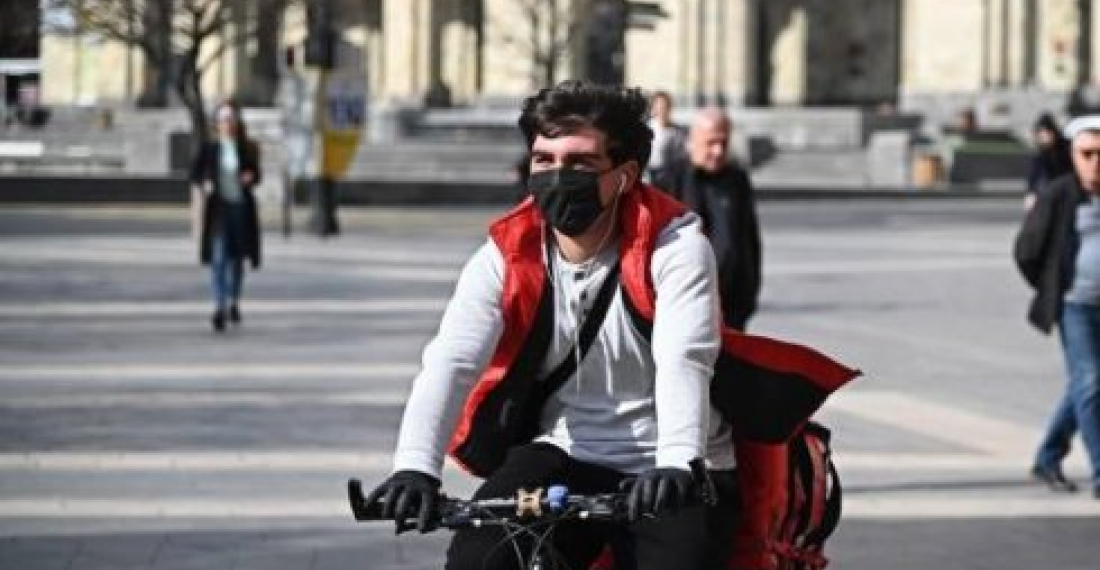
photo: A motorcyclist wearing a mask in Yerevan's Republic square (picture courtesy of Armenpress, Yerevan)


Related articles

Editor's choice
News
Borrell tells the European Parliament that the situation in Afghanistan was critical, but the EU will remain engaged

Borrell tells the European Parliament that the situation in Afghanistan was critical, but the EU will remain engaged

Borrell underlined that the European Union will make every effort to support the peace process and to remain a committed partner to the Afghan people. "Of course, we will have to take into account the evolving situation, but disengagement is not an option.  We are clear on that: there is no alternative to a negotiated political settlement, through inclusive peace talks.
Editor's choice
News
NATO Chief says war is on Europe's doorstep, and warns against complacency

NATO Chief says war is on Europe's doorstep, and warns against complacency

Russia could attack a Nato country within the next five years, the Secretary General of NATO, Mark Rutte, said in a stark new warning. "Nato's own defences can hold for now," Rutte warned in Berlin, but conflict was "next door" to Europe and he feared "too many are quietly complacent, and too many don't feel the urgency, too many believe that time is on our side. "Russia is already escalating its covert campaign against our societies," Rutte said in a speech in Germany. "We must be prepared for the scale of war our grandparents or great-grandparents endured." Earlier this month, Russia's President Vladimir Putin said his country was not planning to go to war with Europe, but it was ready "right now" if Europe wanted to - or started a war. But similar reassurances were given by Moscow in 2022, just before 200,000 Russian troops crossed the border and invaded Ukraine. Putin has accused European countries of hindering US efforts to bring peace in Ukraine - a reference to the role Ukraine's European allies have recently played in trying to change a US peace plan to end the war, whose initial draft was seen as favouring Russia. But Putin was not sincere, Nato's secretary-general said in the German capital, Berlin. Supporting Ukraine, he added, was a guarantee for European security. "Just imagine if Putin got his way; Ukraine under the boot of Russian occupation, his forces pressing against a longer border with Nato, and the significantly increased risk of an armed attack against us." Russia's economy has been on a war footing for more than three years now - its factories churn out ever more supplies of drones, missiles and artillery shells. According to a recent report by the Kiel Institute for the World Economy, Russia has been producing each month around 150 tanks, 550 infantry fighting vehicles, 120 Lancet drones and more than 50 artillery pieces. The UK, and most of its Western allies, are simply not anywhere near this point. Analysts say it would take years for Western Europe's factories to come close to matching Russia's mass-production of weapons. "Allied defence spending and production must rise rapidly, our armed forces must have what they need to keep us safe," the Nato chief said.

Popular

Editor's choice
News
NATO Chief says war is on Europe's doorstep, and warns against complacency

NATO Chief says war is on Europe's doorstep, and warns against complacency

Russia could attack a Nato country within the next five years, the Secretary General of NATO, Mark Rutte, said in a stark new warning. "Nato's own defences can hold for now," Rutte warned in Berlin, but conflict was "next door" to Europe and he feared "too many are quietly complacent, and too many don't feel the urgency, too many believe that time is on our side. "Russia is already escalating its covert campaign against our societies," Rutte said in a speech in Germany. "We must be prepared for the scale of war our grandparents or great-grandparents endured." Earlier this month, Russia's President Vladimir Putin said his country was not planning to go to war with Europe, but it was ready "right now" if Europe wanted to - or started a war. But similar reassurances were given by Moscow in 2022, just before 200,000 Russian troops crossed the border and invaded Ukraine. Putin has accused European countries of hindering US efforts to bring peace in Ukraine - a reference to the role Ukraine's European allies have recently played in trying to change a US peace plan to end the war, whose initial draft was seen as favouring Russia. But Putin was not sincere, Nato's secretary-general said in the German capital, Berlin. Supporting Ukraine, he added, was a guarantee for European security. "Just imagine if Putin got his way; Ukraine under the boot of Russian occupation, his forces pressing against a longer border with Nato, and the significantly increased risk of an armed attack against us." Russia's economy has been on a war footing for more than three years now - its factories churn out ever more supplies of drones, missiles and artillery shells. According to a recent report by the Kiel Institute for the World Economy, Russia has been producing each month around 150 tanks, 550 infantry fighting vehicles, 120 Lancet drones and more than 50 artillery pieces. The UK, and most of its Western allies, are simply not anywhere near this point. Analysts say it would take years for Western Europe's factories to come close to matching Russia's mass-production of weapons. "Allied defence spending and production must rise rapidly, our armed forces must have what they need to keep us safe," the Nato chief said.

