


Somalia fears Islamic resurgence and asks peacekeepers to slow withdrawal

Somalia's government is trying to delay the withdrawal of African peacekeepers, warning of a potential security vacuum, according to documents seen by Reuters. Neighbouring countries are concerned that resurgent al-Shabab militants could seize power. The African Union Transitional Mission in Somalia (ATMIS) is due to withdraw by 31 December, to be replaced by a smaller new force. But in a letter last month to the acting chair of the African Union Peace and Security Council, the Somali government asked for the withdrawal of half of the 4,000 troops due to leave by the end of June to be delayed until September. The letter had not been previously reported. A joint assessment by the Somali government and the AU in March, seen by Reuters, recommended adjusting the overall withdrawal timetable based on the readiness and capabilities of Somali forces. The assessment, which was mandated by the UN Security Council, warned that 'a hasty withdrawal of ATMIS personnel will contribute to a security vacuum'. Mursal Khalif, an independent member of parliament, expressed deep concern about the country's direction. The European Union and the United States, the main funders of the AU force in Somalia, have sought to reduce the peacekeeping operation because of concerns about long-term funding and sustainability, according to four diplomatic sources and a senior Ugandan official. Negotiations over a new force have been complex, with the AU initially pushing for a more robust mandate than Somalia wanted, three diplomatic sources said. A heated political dispute could lead Ethiopia to withdraw some of its most experienced troops.

The Somali presidency and prime minister's office did not respond to requests for comment. Mohamed El-Amine Souef, the AU special envoy to Somalia and head of ATMIS, said there was no definitive timeline for concluding negotiations, but stressed that all parties were committed to achieving sustainable peace and security. "The AU and the Somali government have stressed the importance of a conditions-based withdrawal to avoid a security vacuum," Souef told Reuters. The Peace and Security Council will meet later on Thursday to discuss the drawdown and the follow-up mission. As the drawdown continues, with 5,000 troops out of some 18,500 leaving last year, the Somali government has expressed confidence that the new force should not exceed 10,000 and should focus on securing key population centres. This call for a smaller force likely reflects the views of nationalists who oppose a heavy foreign presence in Somalia, said Rashid Abdi, an analyst at Sahan Research, a Nairobi-based think tank that focuses on the Horn of Africa. 

Uganda and Kenya, which contributed troops to the outgoing mission, are also concerned. Henry Okello Oryem, Uganda's State Minister for Foreign Affairs, expressed concern about the sustainability of Somali troops in a long-term military confrontation. "We don't want to get into a situation where we are on the run as we saw in Afghanistan," he told Reuters. Kenya's President William Ruto warned that a withdrawal that did not take into account conditions on the ground would allow terrorists to take over Somalia. An EU spokesman said the focus was on building internal security capacity and backed a Somali government proposal for a new mission of reduced size and scope. A US State Department spokesperson stressed that the force should be large enough to avoid a security vacuum and noted that Washington has supported all requests to modify the withdrawal timetable.



Source: commonspace.eu and Reuters with other agencies
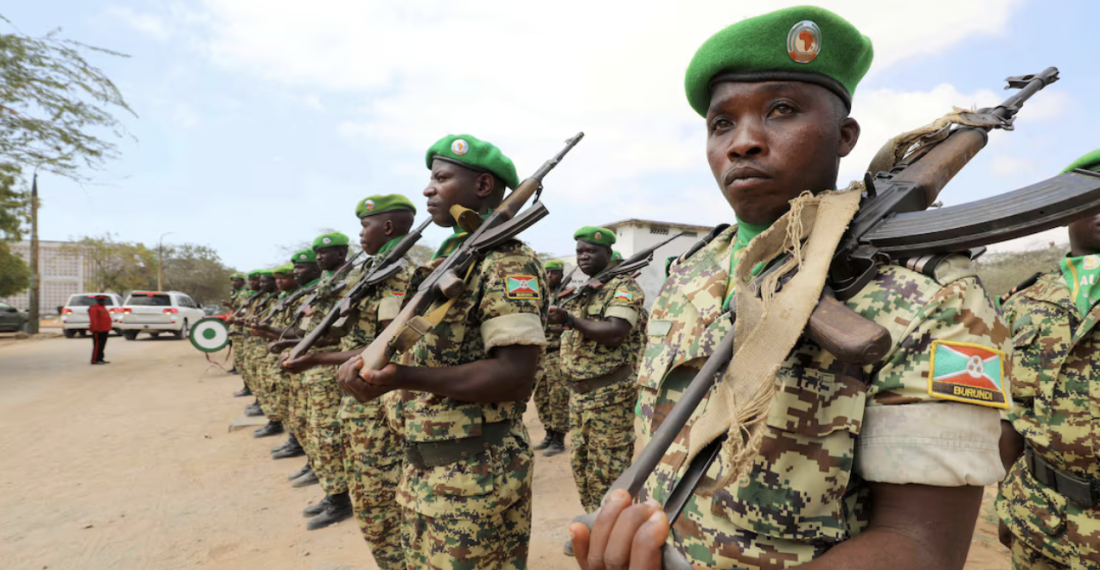
Photo: Burundian peacekeepers from the African Union Mission in Somalia (AMISOM) stand in formation during a ceremony as they prepare to leave the Jaale Siad Military Academy after being replaced by the Somali military in Mogadishu, Somalia. 28 February 2019. Reuters

Related articles

Editor's choice
News
UAE says it will withdraw from Yemen, but division emerges in Yemeni presidential council

UAE says it will withdraw from Yemen, but division emerges in Yemeni presidential council

In a move seen as an attempt to de-escalate a crises with Saudi Arabia, the United Arab Emirates, on Tuesday (30th December) announced that it was heeding a call to withdraw its troops from Southern Yemen. UAE says that its presence included counter-terrorism teams that were crucial in fighting against Islamist groups. UAE sources said that parts of Yemen not controlled by the Houthis have had Al Qaeda in the Arab Peninsula (AQAP) operatives using the territory to launch attacks on Europe, the US and Middle East. UAE teams have co-ordinated with American and British special forces and intelligence. The sources added that Emirati forces and their Yemeni allies also helped reverse Houthi gains in the south. including the liberation of Aden port. The small UAE contingent has remained in place since the UAE withdrew most of its military personnel in 2019. The leading English-language newspaper in Abu Dhabi, The National, said that the main UAE force was based at Riyan Mukalla International Airport, with access to fixed-wing aircraft and helicopters, but also operated smaller contingents in the port town Balhaf and Shabwa. "It is understood it also flew a number of drones from the airbase that were able to track terrorist movements, pass information back to its allies and assisted special forces' missions." Meanwhile a division has emerged in Yemen's presidential council after four members denounced what they called the 'unilateral decisions' by the chairman. Four of Yemen’s eight Presidential Leadership Council members on Tuesday denounced an announcement by the council’s chairman accusing him of breaching the governing agreement. Tension between Yemeni leaders has been rising for weeks, underscoring the fragility of the country's already fractured political landscape and further complicating efforts to confront the Iran-backed Houthi rebels. The latest rift took an unprecedented turn on Tuesday morning, marked by a Saudi-led coalition “limited operation” striking combat vehicles Riyadh linked to the Southern Transitional Council, which has three members in the PLC. The PLC Chairman, Rashad al Alimi, on Tuesday said that he was seeking to cancel the joint defence agreement with the UAE. “What has been issued … constitutes a clear violation of the Declaration of the Transfer of Power [agreement], which explicitly stipulates that the Presidential Leadership Council is a collective body whose decisions are taken by consensus, or by majority when consensus is not possible,” the statement by the four members said. “It does not, under any circumstances, allow for unilateral decision-making on sovereign, military, or major political matters." The statement was signed by STC chief Aidarous Al Zubaidi, Faraj Al Bahsani, Tariq Saleh and Abu Zaraa al Muharrami. (click the picture to read the full article).

Popular

Editor's choice
News
UAE says it will withdraw from Yemen, but division emerges in Yemeni presidential council

UAE says it will withdraw from Yemen, but division emerges in Yemeni presidential council

In a move seen as an attempt to de-escalate a crises with Saudi Arabia, the United Arab Emirates, on Tuesday (30th December) announced that it was heeding a call to withdraw its troops from Southern Yemen. UAE says that its presence included counter-terrorism teams that were crucial in fighting against Islamist groups. UAE sources said that parts of Yemen not controlled by the Houthis have had Al Qaeda in the Arab Peninsula (AQAP) operatives using the territory to launch attacks on Europe, the US and Middle East. UAE teams have co-ordinated with American and British special forces and intelligence. The sources added that Emirati forces and their Yemeni allies also helped reverse Houthi gains in the south. including the liberation of Aden port. The small UAE contingent has remained in place since the UAE withdrew most of its military personnel in 2019. The leading English-language newspaper in Abu Dhabi, The National, said that the main UAE force was based at Riyan Mukalla International Airport, with access to fixed-wing aircraft and helicopters, but also operated smaller contingents in the port town Balhaf and Shabwa. "It is understood it also flew a number of drones from the airbase that were able to track terrorist movements, pass information back to its allies and assisted special forces' missions." Meanwhile a division has emerged in Yemen's presidential council after four members denounced what they called the 'unilateral decisions' by the chairman. Four of Yemen’s eight Presidential Leadership Council members on Tuesday denounced an announcement by the council’s chairman accusing him of breaching the governing agreement. Tension between Yemeni leaders has been rising for weeks, underscoring the fragility of the country's already fractured political landscape and further complicating efforts to confront the Iran-backed Houthi rebels. The latest rift took an unprecedented turn on Tuesday morning, marked by a Saudi-led coalition “limited operation” striking combat vehicles Riyadh linked to the Southern Transitional Council, which has three members in the PLC. The PLC Chairman, Rashad al Alimi, on Tuesday said that he was seeking to cancel the joint defence agreement with the UAE. “What has been issued … constitutes a clear violation of the Declaration of the Transfer of Power [agreement], which explicitly stipulates that the Presidential Leadership Council is a collective body whose decisions are taken by consensus, or by majority when consensus is not possible,” the statement by the four members said. “It does not, under any circumstances, allow for unilateral decision-making on sovereign, military, or major political matters." The statement was signed by STC chief Aidarous Al Zubaidi, Faraj Al Bahsani, Tariq Saleh and Abu Zaraa al Muharrami. (click the picture to read the full article).
