


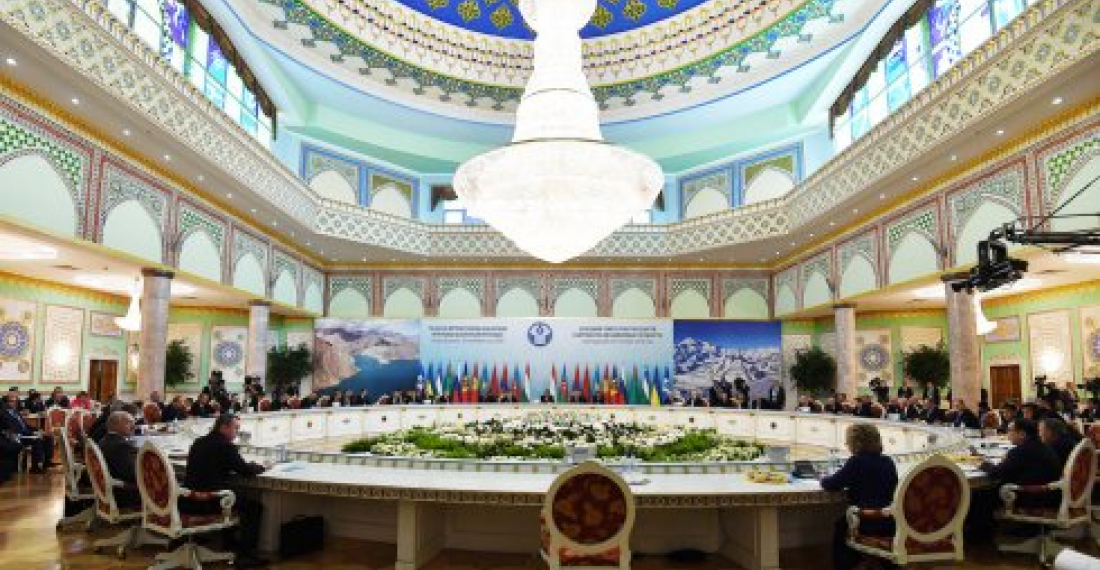
There have been a number of comments following the informal unscheduled discussion between the president of Azerbaijan Ilham Aliyev and the prime minister of Armenia, Nikol Pashinyan on the margins of the CIS summit in Dushambe on Friday (28 September).
Over the weekend both sides reported the meeting, using broadly the same language.
read more: Aliyev and Pashinyan hold unscheduled informal talks in Dushambe
There have subsequently been further comments
Azerbaijan is always ready for constructive negotiations and contacts serving the settlement of the Armenian-Azerbaijani conflict, the Deputy Head of the Foreign Policy Department of the Azerbaijani Presidential Administration Hikmat Hajiyev told Trend news agency on Monday morning (1 October). The conversation in Dushambe "started at the initiative of the Armenian Prime Minister", Hajiyev said.
"This once again shows that the format of the negotiations remains unchanged, and negotiations are conducted only between Armenia and Azerbaijan, which are parties of the conflict. Within the framework of the same format, in September, meetings between the foreign ministers of Armenia and Azerbaijan were held during the UN General Assembly in New York, and in July in Brussels. We assess this positively, and Azerbaijan is always ready for constructive negotiations and contacts serving the settlement of the Armenian-Azerbaijani conflict. This once again demonstrates Azerbaijan's commitment to the existing format," Hajiyev said.
He also commented on the strengthening the ceasefire regime on the Armenian-Azerbaijani border and the line of contact of troops.
"The Azerbaijani side has repeatedly stated that the main reason for the ceasefire violation is the illegal presence of Armenian troops in the occupied Azerbaijani territories and the continuation of military occupation. The Armenian side has always been responsible for the ceasefire violation and the aggravation of the situation. I would like to mention the large-scale military exercises conducted by the Armenian armed forces in the occupied Azerbaijani territories after the meeting of the heads of state in November 2014 in Paris, the incitement of a well-known helicopter incident, as well as Armenian armed troops' fire by heavy guns at civilians living along the contact line in April of 2016, and intentionally aggravation of the situation," Hajiyev said.
"So, the withdrawal of Armenian troops from the occupied Azerbaijani territories in accordance with the requirements of the UN Security Council's resolutions will eliminate not only military risk, but there will also be no need for a ceasefire, and there will be comprehensive opportunities for political solution of the conflict. This will ensure peace, stability and security in the region," he added.
Earlier there was a further comment by prime minister Nikol Pashinyan on the meeting: Azerbajiani President Ilham Aliyev left the impression of an educated person, he told Armenian media. "He left a positive impression. We had a normal, civilized conversation," Armenian media quoted Pashinyan as saying.
The prime minister said that an agreement was reached on regular contacts with Aliyev, but Pashinyan is not sure that the leadership of Azerbaijan will follow this agreement. "I'm not sure that the agreements will be implemented," he said.
He added that they plan to inform the co-chairs of the OSCE Minsk Group about the agreements reached between the leadership of Armenia and Azerbaijan on supporting permanent contacts between the countries.
The question of Karabakh's return to negotiation table was discussed. "We also discussed this issue. Of course, our views are different. I called the President of Artsakh Bako Sahakyan and informed him about the reached agreements. The President of Artsakh noted that the agreement is acceptable for them as well."
In the meantime there has also been a comment from the de facto authorities in the self-declared Nagorno-Karabakh Republic: "The Republic of Artsakh welcomes the agreement between Armenian Prime Minister Nikol Pashinyan and Azerbaijani President Ilham Aliyev on de-escalating the situation in the line of contact, but treats the issue with certain reservations, Davit Babayan, a spokesperson for the de facto authorities told ARMENPRESS.
"It is an interesting and commendable development if we were to give a political assessment. The three points which they agreed upon is very important. But there is a reservation here that completely trusting Aliyev or generally the Azerbaijani leadership isn't right, because they might breach any agreement in the most convenient time in the lowest way, which practice has shown. Nevertheless, let's hope that this time this agreement will give some kind of a positive effect," he said.
The spokesperson warned against expecting developments in the short term. "We should wait. We should view this agreement not within two hours or one-two days, but in the long-term," he said arguing that "Aliyev's consent on the agreement might depend on pressures from different levels against the Azerbaijani leadership".
"It is interesting that before this the Co-Chairs made a very strict statement. Certainly it was first of all addressed to Azerbaijan, because it is this very side that violates the ceasefire regime, and it is an interesting coincidence that it was the Russian President [Putin] who introduced the Armenian and Azerbaijani leaders to each other from a formal perspective. Taking into consideration that Russia is one of the OSCE Misnk Group Co-Chairing countries, it's not ruled out that Aliyev is in a very unique situation when great pressure exists against him, and has found a suitable occasion to both get to know the Armenian new leader and show himself to be a constructive side," Babayan said.
Nevertheless, Babayan noted that the situation at the line of contact is stable.
source: commonspace.eu with TREND news agency Baku, Armenpress (Yerevan) and news,am (Yerevan)



