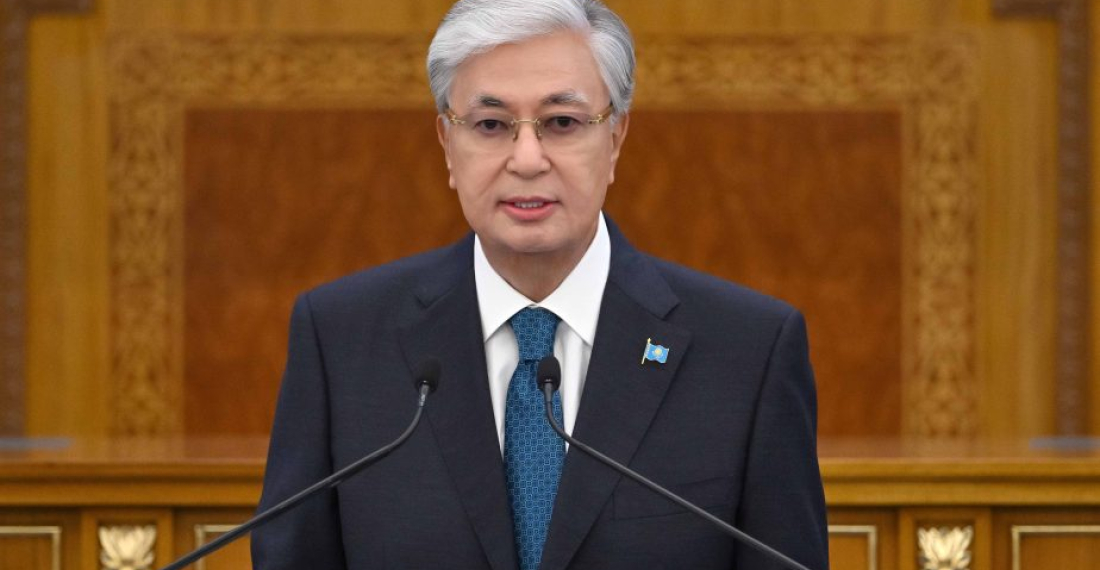
The President of Kazakhstan Kassym-Jomart Tokayev has called for drastic parliamentary reform including abolition of the Senate and a return to a unicameral legislature, mirroring the single-chamber Supreme Council of the early post-independence years. President Tokayev made the call on 8th September as he delivered his annual address to the nation before the Kazakh parliament. In his speech, Tokayev touched on topics as varied as artificial intelligence, electric scooters, inflation, nuclear power development, the scandalous behaviour of women, and the need to shift to a unicameral parliament via a future constitutional referendum.
“The world has entered a new historical era, which will obviously not be easy for all of humanity,” Tokayev said in his speech, according to The Diplomat. After charting out the world’s difficulties, a crisis in the “Western concept of multiculturalism, interethnic and interreligious harmony,” the shaking of the foundations of “national cultures and traditions” by “globalist destructive forces” and myriad migration crises, he said that “a new world order is coming.” His main mission, Tokayev said, was “to ensure stable socio-economic development and security of Kazakhstan in this turbulent, dangerous time.”
The president remarked that “thanks to the large-scale transformations carried out in recent years, our political system has become more progressive and open” but added that “there is still a lot of work to do to modernise society.” At the end of his speech, Tokayev referred to restructuring parliament as the next step in the country’s political development. He set 2027 as a probable time for a constitutional referendum.
The case for a unicameral parliament is rooted in the fact that the Senate isn’t a directly representative body. Forty of its 50 members are indirectly elected by delegates from the 17 provinces and three national cities. The remaining 10 are nominated by the president. None of the members of the Senate represent political parties. Proponents of the change argue that it will strengthen political parties.
Tokayev ascended to the presidency in 2019, following the surprise resignation of Nursultan Nazarbayev, while he was the sitting chair of the Senate. A snap presidential election was held in June 2019 that confirmed Tokayev’s control of the office. At the time, Kazakh presidential terms were five years and limited to two terms, with first president Nazarbayev exempted from the term limit.
According to the Times of Central Asia, Kazakh media and political experts were quick to weigh in on the announcement. Most agreed on two points: the Senate has long been criticised, and Tokayev remains committed to opening up major reforms to public debate. Still, the initial wave of enthusiasm quickly gave way to more cautious analyses.
Political scientist Daniyar Ashimbayev quoted by Times of Central Asia, expressed concerns on his Telegram channel about regional representation in a purely party-list system. He noted that bicameralism is not exclusive to federal states and pointed out that Kazakhstan’s diverse regions have varying interests requiring nuanced representation. According to Ashimbayev, the Senate has functioned as a “collective lobbyist” and as a “social elevator” for regional elites. Single-mandate deputies, he argued, have also served similar functions.
This critique highlights a less-discussed element of Tokayev’s reform: eliminating majority-elected deputies, a key feature of the 2022 democratic reforms. Political scientist Marat Shibutov also quoted by Times of Central Asia echoed this concern. On his Telegram channel, he pointed out that while the return of single-mandate deputies in 2022 was initially popular, their performance has since been underwhelming.
Shibutov observed that prominent single-mandate deputies submitted two to three times fewer official requests than their party-list counterparts. “Where did their activity go?” he asked rhetorically, suggesting their energy was diverted into media grandstanding and populist attacks on businesses, behavior Tokayev is unlikely to endorse. Indeed, many single-mandate deputies from the regions act as lobbyists for local elites and business interests. Tokayev’s reform appears aimed at closing these avenues of influence.
The Times of Central Asia reports that, were the abolition of the Senate and independent candidates to proceed, the leader of the majority party would likely become the most powerful figure within the legislature, centralising legislative authority. The most obvious contender for this role would be Yerlan Koshanov, leader of Amanat, Kazakhstan’s current ruling party.
Formerly known as Otan, and later Nur Otan, the party was long associated with Nazarbayev. Although Tokayev formally left the party in 2022, Amanat has remained dominant, adapting quickly to the new political reality. Koshanov, an experienced civil servant and current Chair of the Mazhilis, has built a reputation as a loyal ally of Tokayev. Before becoming speaker, he served as governor of the Karaganda region and as chief of the Presidential Administration. His leadership of Amanat positions him as the most likely figure to consolidate power in a future unicameral system.
Source: commonspace.eu with Times of Central Asia, The Diplomat and agencies. Photo: Kazakh President Kassym-Jomart Tokayev Source: The Diplomat/Akorda