


New undersea hydrogen pipeline between Spain and France to be ready 'by 2030'

The leaders of France, Portugal and Spain announced on Friday (9 December) that the undersea pipeline between Barcelona and Marseille, expected to be completed by 2030, will transport exclusively hydrogen.

Also present at the meeting in Alicante, European Commission President Ursula von der Leyen said the H2Med project "goes in the right direction" as it "has the potential to help us build a real European hydrogen backbone."

"We will produce ten million tonnes of renewable hydrogen in the EU by 2030 and we plan to import in addition another 10 million tonnes. Hydrogen will have to reach our industry. This is why we also identified a series of strategic corridors including one crossing Europe from West to East, via the Iberian Peninsula."

"This is why today I warmly welcome this agreement between France, Spain and Portugal", Von der Leyen said.

Announced at an EU summit in October, the pipeline offers an alternative to the defunct 2003 MidCat pipeline project which was to have carried gas across the Pyrenees from Spain to France. It was abandoned in 2019 over profitability issues and objections from Paris and environmentalists.

The new pipeline is estimated to cost €2.5 billion ($2.6 billion) and be able to transfer two million tonnes of hydrogen annually. The European Commission has declared the project a "project of common interest", meaning it can receive up to 50% of its cost from EU funds. In addition, the EU has unveiled a €210 billion plan, RePowerEU, to stimulate the energy transition, diversify energy sources, and enhance connections between member states.

Portugal produces the most cost-effective renewable hydrogen in the EU, and Hydrogen Europe estimates that the decarbonization of hydrogen will take $15 trillion between 2022 and 2050.
 

source: commonspace.eu with agencies
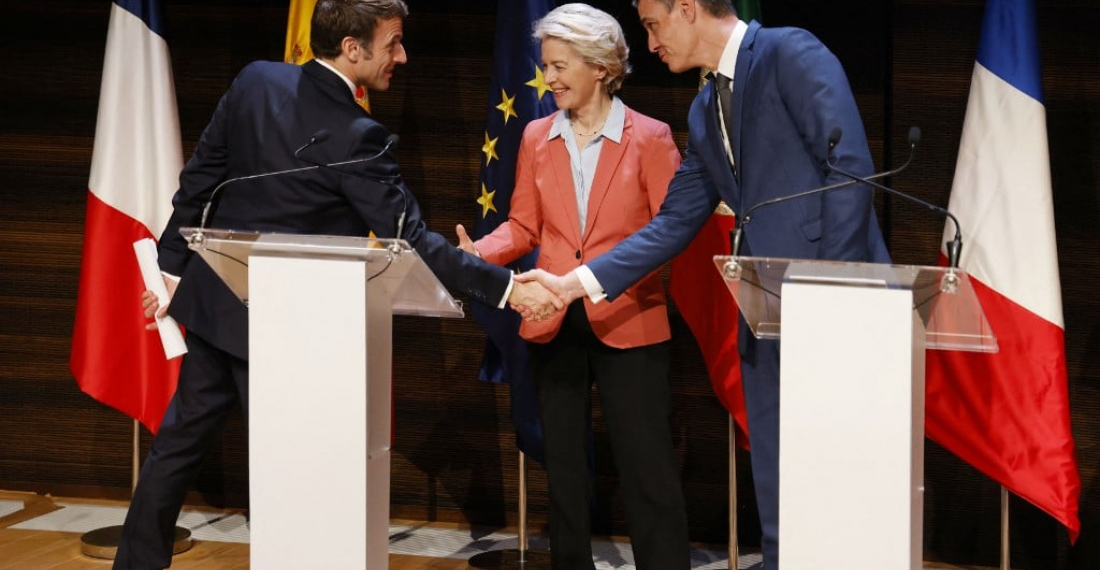
photo: France's President Emmanuel Macron, European Commission President Ursula von der Leyen and Spain's Prime Minister Pedro Sánchez exchanged handshakes at the conclusion of their meeting to discuss the H2Med underwater hydrogen pipeline project. AFP

Related articles

Popular

Editor's choice
Interview
Thursday Interview: Murad Muradov

Thursday Interview: Murad Muradov

Today, commonspace.eu starts a new regular weekly series. THURSDAY INTERVIEW, conducted by Lauri Nikulainen, will host  persons who are thinkers, opinion shapers, and implementors in their countries and spheres. We start the series with an interview with Murad Muradov, a leading person in Azerbaijan's think tank community. He is also the first co-chair of the Action Committee for a new Armenian-Azerbaijani Dialogue. Last September he made history by being the first Azerbaijani civil society activist to visit Armenia after the 44 day war, and the start of the peace process. Speaking about this visit Murad Muradov said: "My experience was largely positive. My negative expectations luckily didn’t play out. The discussions were respectful, the panel format bringing together experts from Armenia, Azerbaijan, and Turkey was particularly valuable during the NATO Rose-Roth Seminar in Yerevan, and media coverage, while varied in tone, remained largely constructive. Some media outlets though attempted to represent me as more of a government mouthpiece than an independent expert, which was totally misleading.  Overall, I see these initiatives as important steps in rebuilding trust and normalising professional engagement. The fact that soon a larger Azerbaijani civil society visits to Armenia followed, reinforces the sense that this process is moving in the right direction." (click the image to read the interview in full)

