


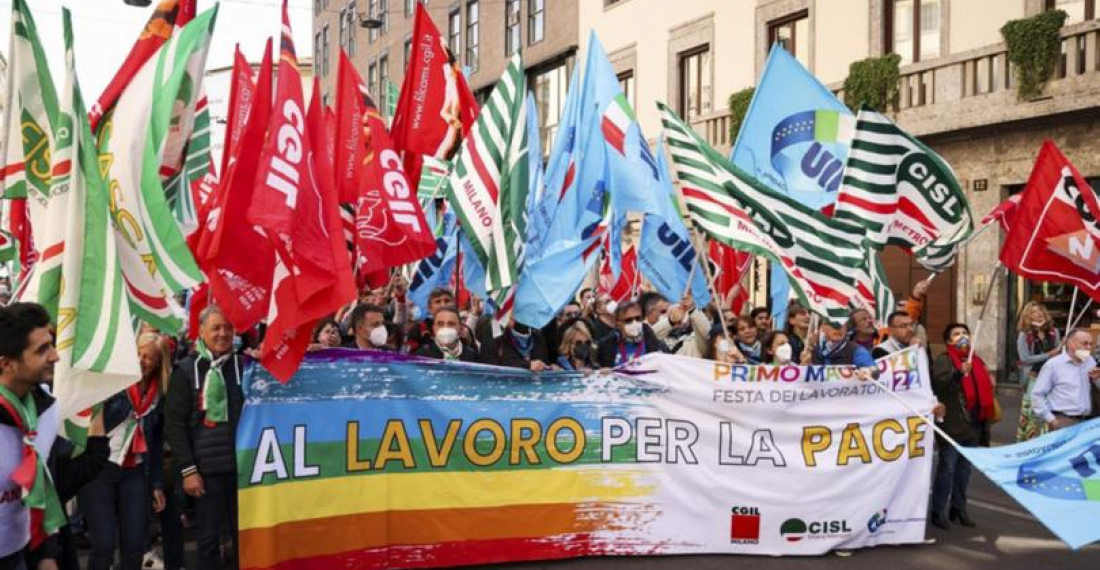
May Day rallies across the world emphasise workers struggle, peace and solidarity

Across the world hundreds of thousands of people took to the streets in towns and cities to mark International Workers Day - often referred to simply as May Day.

Citizens and trade unions in cities around Europe are taking to the streets for May Day marches, and to put out protest messages to their governments.

The marches on Sunday where notable in France where the holiday to honour workers was being used as a rallying cry against newly re-elected President Emmanuel Macron.

In Italy, after a two-year pandemic lull, an outdoor mega-concert was set for Rome with rallies and protests in cities across the country. Besides work, peace was an underlying theme with calls for an end to Russia's war in Ukraine.

Italy's three main labour unions were focusing their main rally in the hilltop town of Assisi, a frequent destination for peace protests. This year's slogan is "Working for peace".

"It's a May Day of social and civil commitment for peace and labour," said the head of Italy's CISL union, Daniela Fumarola.

Protests were planned far and wide in Europe, including in Slovakia and the Czech Republic, where students and others planned to rally in support of Ukraine as Communists, anarchists and anti-European Union groups held their own gatherings.

In France, the May Day rallies are meant to show Macron the opposition he could face in his second five-year term and to power up against his centrists before June legislative elections.

Opposition parties, notably the far left and far right, are looking to break his government's majority.

May Day is also a big day for left wing parties and organisations in Turkey, where large Mayday rallies also took place this year.

Turkish riot police detained dozens of protesters trying to reach Istanbul's main Taksim Square for May Day demonstrations against economic hardship caused by raging inflation.

The Istanbul governor's office had allowed May Day celebrations to be held in another district and deemed gatherings in all other locations as unauthorised and illegal. A statement from the Istanbul governor's office on Sunday said that 164 protesters had been detained across the city for "attempting to hold illegal demonstrations".

The holiday has it roots in demands for worker's rights. 

May 1 was chosen as International Workers Day in 1889 Congress of the Socialist International which met in Paris and established the Second International as a successor to the earlier International Workingmen's Association. They adopted a resolution for a "great international demonstration" in support of working-class demands for the eight-hour day. The date had been chosen by the American Federation of Labor to continue an earlier campaign for the eight-hour day in the United States, which had been the cause of a general strike beginning on 1 May 1886, and culminated in the Haymarket affair, which occurred in Chicago four days later. May Day subsequently became an annual event. 

The 1904 Sixth Conference of the Second International, called on "all Social Democratic Party organisations and trade unions of all countries to demonstrate energetically on the First of May for the legal establishment of the eight-hour day, for the class demands of the proletariat, and for universal peace".

source: commonspace.eu
photo: A May Day rally in the Italian city of Milan

 

Related articles

Editor's choice
News
Germany accuses Russia of cyberattacks and disinformation campaign

Germany accuses Russia of cyberattacks and disinformation campaign

The German government holds Russia responsible for a cyberattack on German air traffic control, and for targeted disinformation campaigns before the last federal election. According to the German Foreign Office in Berlin, the incidents could be clearly attributed to the Russian military intelligence service, the GRU. In response, the Russian ambassador to Berlin was summoned to the Foreign Ministry. "We have been observing a massive increase in threatening hybrid activities by Russia for some time now," a spokesperson for the Foreign Ministry stated. These range from disinformation campaigns and espionage to cyberattacks and sabotage attempts. The aim is to divide society, sow distrust, and undermine confidence in democratic institutions. The spokesperson added that with these actions, Russia is "very concretely threatening our security, not only through its war of aggression against Ukraine, but also here in Germany."  The Foreign Ministry spokesperson explained that the cyberattack on air traffic control in August 2024 was clearly attributed to the hacker collective "APT28," known as "Fancy Bear," and to the responsibility of the Russian military intelligence service, the GRU. Furthermore, it could now be "conclusively stated" that Russia had attempted "to influence and destabilize both the last Federal election and the ongoing internal affairs of the Federal Republic of Germany." There was "absolutely irrefutable evidence" for this". The so-called "Storm 1516" campaign, which has been running since 2024, is allegedly backed by "reliable information" that the Moscow-based think tank "Center for Geopolitical Expertise" is behind it. The Center is also said to be supported by Russian military intelligence. Its primary aim is to influence democratic elections in the West. (Click the image to read more).
Editor's choice
News
NATO Chief says war is on Europe's doorstep, and warns against complacency

NATO Chief says war is on Europe's doorstep, and warns against complacency

Russia could attack a NATO country within the next five years, the Secretary General of NATO, Mark Rutte, said in a stark new warning. "NATO's own defences can hold for now," Rutte warned in Berlin, but conflict was "next door" to Europe, and he feared "too many are quietly complacent, and too many don't feel the urgency, too many believe that time is on our side. "Russia is already escalating its covert campaign against our societies," Rutte said in a speech in Germany. "We must be prepared for the scale of war our grandparents or great-grandparents endured." Earlier this month, Russia's President Vladimir Putin said his country was not planning to go to war with Europe, but it was ready "right now" if Europe wanted to - or started a war. But similar reassurances were given by Moscow in 2022, just before 200,000 Russian troops crossed the border and invaded Ukraine. Putin has accused European countries of hindering US efforts to bring peace in Ukraine - a reference to the role Ukraine's European allies have recently played in trying to change a US peace plan to end the war, whose initial draft was seen as favouring Russia. But Putin was not sincere, Nato's secretary-general said in the German capital, Berlin. Supporting Ukraine, he added, was a guarantee for European security. "Just imagine if Putin got his way; Ukraine under the boot of Russian occupation, his forces pressing against a longer border with Nato, and the significantly increased risk of an armed attack against us." Russia's economy has been on a war footing for more than three years now - its factories churn out ever more supplies of drones, missiles and artillery shells. According to a recent report by the Kiel Institute for the World Economy, Russia has been producing each month around 150 tanks, 550 infantry fighting vehicles, 120 Lancet drones and more than 50 artillery pieces. The UK, and most of its Western allies, are simply not anywhere near this point. Analysts say it would take years for Western Europe's factories to come close to matching Russia's mass-production of weapons. "Allied defence spending and production must rise rapidly, our armed forces must have what they need to keep us safe," the Nato chief said.

Popular

Editor's choice
News
Germany accuses Russia of cyberattacks and disinformation campaign

Germany accuses Russia of cyberattacks and disinformation campaign

The German government holds Russia responsible for a cyberattack on German air traffic control, and for targeted disinformation campaigns before the last federal election. According to the German Foreign Office in Berlin, the incidents could be clearly attributed to the Russian military intelligence service, the GRU. In response, the Russian ambassador to Berlin was summoned to the Foreign Ministry. "We have been observing a massive increase in threatening hybrid activities by Russia for some time now," a spokesperson for the Foreign Ministry stated. These range from disinformation campaigns and espionage to cyberattacks and sabotage attempts. The aim is to divide society, sow distrust, and undermine confidence in democratic institutions. The spokesperson added that with these actions, Russia is "very concretely threatening our security, not only through its war of aggression against Ukraine, but also here in Germany."  The Foreign Ministry spokesperson explained that the cyberattack on air traffic control in August 2024 was clearly attributed to the hacker collective "APT28," known as "Fancy Bear," and to the responsibility of the Russian military intelligence service, the GRU. Furthermore, it could now be "conclusively stated" that Russia had attempted "to influence and destabilize both the last Federal election and the ongoing internal affairs of the Federal Republic of Germany." There was "absolutely irrefutable evidence" for this". The so-called "Storm 1516" campaign, which has been running since 2024, is allegedly backed by "reliable information" that the Moscow-based think tank "Center for Geopolitical Expertise" is behind it. The Center is also said to be supported by Russian military intelligence. Its primary aim is to influence democratic elections in the West. (Click the image to read more).


