

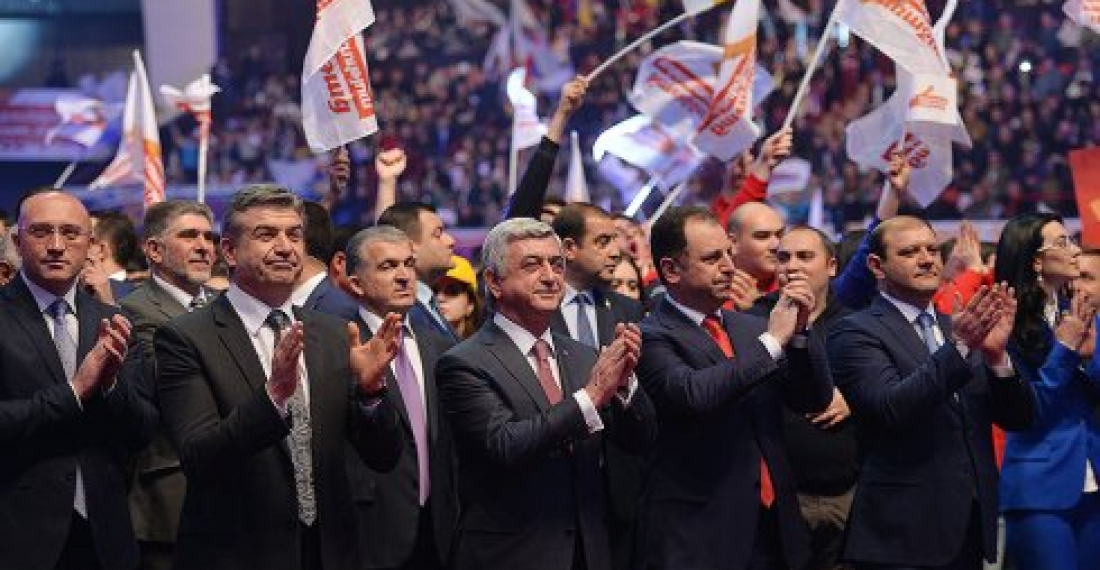
The campaign ahead of Armenia's parliamentary election came to an end on Friday (31 March) with political parties holding their last manifestations. Saturday is a "day of silence" and campaigning is not permitted. People will go to the polls on Sunday. Overall the campaign has been peaceful. Nine political parties and blocs are participating in the election.
Republican Party ends campaign with a glitzy election rally
 The last event of the campaign was a large indoor rally organised by the ruling Republican Party of Armenia, with the participation of President Serzh Sargsyan, Prime Minister Karen Karapetyan, and Defence Minister Vigen Sargsyan. President Serzh Sargsyan preferred not to make a partisan speech. "Vote for whoever you want on 2 April", he told his audience, reminding them however of the gravity of the importance of making a wise choice, and saying that he and his colleagues should be allowed to finish the job that they had started. "Each of us will choose a ballot, and it is critically important that while making that choice we understand that the ballot is also a key, a key to new weaponry and new military equipment, new defence structures and efficient troop deployment plans, a key to enforcing peace and consistent amplification of the security of the soldiers on the border", the president said in a rallying call for support of the government's Karabakh policies.
Prime Minister Karen Karapetyan told the rally that the Republican party's election platform offered groundwork for life-changing reforms. "It is very ambitious and bold, realistic and rational. The [Republicans] have the willpower to realize it," he added.
For the Communist Party, "Fatherland, Labour, Socialism"
Armenia must unconditionally normalize its relations with Turkey and Azerbaijan to open the closed borders hampering economic progress, the leader of the Communist Party said on Thursday (30 March), introducing their election platform. Tachat Sargsyan said that they developed a program "addressing the population's needs to improve the situation in the country."
 "Fatherland, labour and socialism - this is our slogan," he told reporters. The Communist leader said the party had a plan to re-establish Soviet-time industries. "In the Soviet period, the industries accounted for 68% of the gross domestic product, the profit being absolutely sufficient. If you walk in the streets of Yerevan, you will see that after [so many years'] of plunder, there are still very many buildings which the state must turn back into manufacturing units. We are obliged to normalize our relations with Turkey without any precondition. Azerbaijan no longer has claims to [seize] Nagorno-Karabakh, which is now independent. So we are obliged to unconditionally normalize our relations also with Azerbaijan," he said, stressing the importance of opening the air and land routes to promote economic development.
Dashnaktsutyun end the campaign with music
 The last election activity of the ARF Dashnaktsutyun was a musical concert in Yerevan's Liberty Square on Thursday (30 March) during which Party leaders also spoke, including Gegham Manukyan, Aghvan Vardanyan and Armen Rustamyan. ARF-D, which was a coalition partner with the Republican Party of Armenia (RPA), is contesting the elections under the motto "New beginning, just Armenia." ARD-D is one of the oldest political forces in Armenia. It was established in 1890.
Speaking at the event, Aghvan Vardanyan, said that only a free citizen can have a strong and free country and live decently. According to him, money and leverages are not the standards by which to judge a political force: it is instead measured by independence and faithfulness to principals and work.
The Party leader, Armen Rustamyan spoke about the quality and volume of changes which ARF-D had introduced into the political life of the country, and said that they can definitely be called revolutionary.
On the same day of their final rally the ARF-D published eight reasons why they say the Armenian public should vote for them. You can read them here
Gagik Tsarukyan brings a tinge of Trump to the Armenian elections
Armenia's most popular oligarch, wrestler and politician ended his party's election campaign with a promise to bring billions of dollars of investments to Armenia. "As an  acknowledgement of the people's unconditional trust and our determination to win, my colleagues have expressed readiness to invest $15 billion in Armenia," Armenian media reported Tsaukian as saying on Wednesday.
According to him, the bloc will start by implementing their 15-point election program, and focusing on attracting investments in various sectors.
Tsarukyan said that his coalition have no enemies inside the country, but only competitors. "I have instructed my team never to insult or throw mud at our opponents," he said. "We want no emnity. We just seek to change the system and make improvements."
"There is a way out, Armenians are not for sale"
Thursday also saw the final activity of the Yelk "Way out" bloc, which ended with a march in front of the Central Elections Commission. The Yelk Bloc had earlier called for the registration of the Republican Party to be cancelled following leaked information of mass use of teachers and kindergarten employees in the Republican Party campaign.

During the march Yelk Bloc supporters shouted the slogan "There is a way out. Armenians are not for sale", referring to widespread allegations of vote-buying.Yelk bloc is considered the most pro-European party in the election and has attracted many young supporters
Leader of Renaissance Party says his party will be among the top three, but opinion polls show otherwise
 Artur Baghdasaryan leader of the Renaissance Party (formerly known as the Rule of Law Party) spoke at a Press Conference on Friday expressing confidence that his party will finish in the top three positions in the elections. Baghdasaryan said that not all polls are conducted in good faith. Some organizations are conducting "deplorable" surveys and presenting results that are convenient to them, he told the media. Artur Baghdasaryan spoke about his party's election platform and the work of the party during the campaign.
Old faces, new wave - ORO shakes up Armenian politics
The alliance led by former Defence Minister Seyran Ohanian and his opposition allies rallied several thousand supporters in Yerevan on Tuesday (28 March), calling on Armenians to use the upcoming general elections to change their government. ORO emerged during the election campaign as the most vocal nemesis of the ruling party.

The leaders of the Ohanian-Raffi-Oskanian (ORO) alliance also renewed their demands for the release of Samvel Babayan, a retired army general allied to them who was arrested last week on charges of illegal arms possession. Many of their supporters held Babayan's pictures as they rallied in Yerevan's Liberty Square.
"I and my teammates are in a resolute mood," Ohanian told the crowd before it marched through the city center. "I believe that we have a strong will to give power to the people, the real master."
Another ORO leader, former Foreign Minister Vartan Oskanian, attacked President Serzh Sargsyan’s foreign policy, saying that Armenia is no longer seen as a sovereign state by world powers. Oskanian also accused the Sargsyan's administration of being ready to make disproportionate concessions to Azerbaijan in the Nagorno-Karabakh conflict.
“If peace is not just, it can never be real,” Oskanian said in his speech. He claimed that the authorities arrested Babayan, who is Karabakh’s former military commander, in order to be able to continue their “traitorous negotiations” with Baku.
Peace, Conciliation, Good Neighbourly relations
On Wednesday, the Armenian National Congress, led by former President Levon ter Petrosian held its last event in the centre of Yerevan with participants shouting "Levon"and "Peace" as they made their way through the streets of the capital.
 Deputy Chairmen of the Armenian National Congress (ANC), Levon Zurabyan and Aram Manukyan along with PPA Chairman Stepan Demirchyan led the march.
The alliance led by the ANC took the Armenian political scene by surprise by making peace in Karabakh the central theme of its election campaign. The party slogan is Peace, Conciliation and Good neighbourly relations.
Free Democrats want full membership of the EU
 The party held several events in the run up to the election, during which the foreign policy of the current government was criticised.
The party's election program has 10 points, with struggle against illegal economy high on the agenda. The Party says that 30% of the Armenian economy is shadow economy and if this was to be eliminated spending on health, education and defence can be doubled. The party supports the elimination of monopolies in the economy and the restraint of oligarchs. The party is against membership of the Eurasia Economic Union and for full membership of the EU.
source: commonspace.eu with Armenian media