Kazakhstan’s constitutional reform is entering its final and most systemic phase, where previously fragmented changes are being consolidated into a coherent model of political governance, according to a report on Qazinfrom News Agency.
At the 5th session of the Ulttyq Qurultay (National Assembly), President Kassym-Jomart Tokayev announced that the upcoming constitutional reforms are comparable in scale to adopting an entirely new Constitution. The initial plan under parliamentary reform was to amend around 40 articles of the Constitution. However, during the process it became clear that significantly more changes would be required. President Tokayev told members of the Ulttyq Qurultay.
In 2022, 33 articles of the Constitution were updated. The forthcoming amendments will be even more extensive. In essence, we are on the threshold of a step equivalent to adopting a new Constitution
The emphasis is no longer on selective institutional adjustments, but on formally securing a new configuration of power aimed at stability, continuity, and a clearer distribution of responsibility between branches of government.
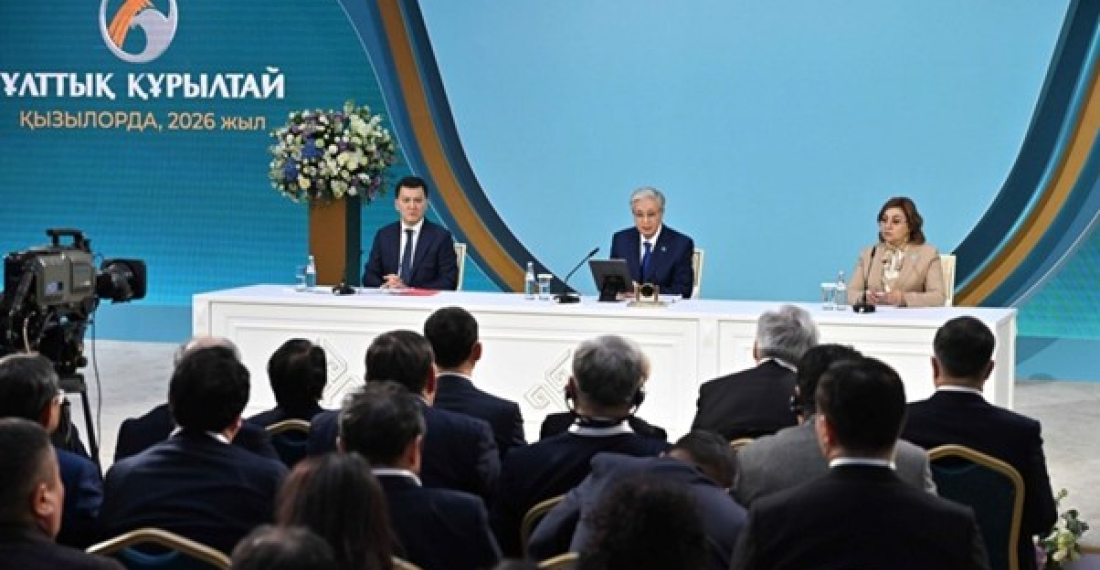
Speaking at the 5th session of the Ulttyq Qurultay (National Assembly) on January 20, 2026, the President proposed the establishment of the post of vice president with constitutional status. This initiative is presented as a logical completion of the political architecture that has been gradually constructed over recent years, designed to enhance manageability and institutional resilience.
A central element of the reform agenda concerns the transformation of the parliamentary system. The proposed shift to a unicameral parliament named “Qurultay”, elected through a proportional representation system, reflects an effort to simplify the structure of representative power while strengthening its political role.
The abolition of presidential and Assembly of the People quotas, combined with the retention of social representation quotas, as well as the expansion of parliamentary oversight powers in judicial and senior state appointments, signals a recalibration of institutional checks within the system.
This approach suggests an attempt to enhance the role of representative institutions while reducing structural complexity and bureaucratic inertia. The rejection of a bicameral model and the optimization of parliamentary procedures are framed as measures to increase legislative efficiency and political accountability.
Beyond institutional reform, the President’s address also placed strong emphasis on value-based issues, including responsible patriotism, protection of cultural traditions, the institution of marriage, civil rights, and the proper use of state symbols, underscoring their role in strengthening national identity amid ongoing political transformation. Overall, the proposed initiatives institutionalize the results of Kazakhstan’s political transformation and to establish a more stable governance framework.
Earlier, Qazinform News Agency reported that President of Kazakhstan Kassym-Jomart Tokayev proposed naming the new unicameral parliament “Qurultay” and outlined the key parameters of its institutional structure.
source: commonspace.eu with Qazinform News Agency (Astana)
photo: President of Kazakhstan Kassym-Jomart Tokayev addressing the Kazakh National Assembly on 20 January 2026