


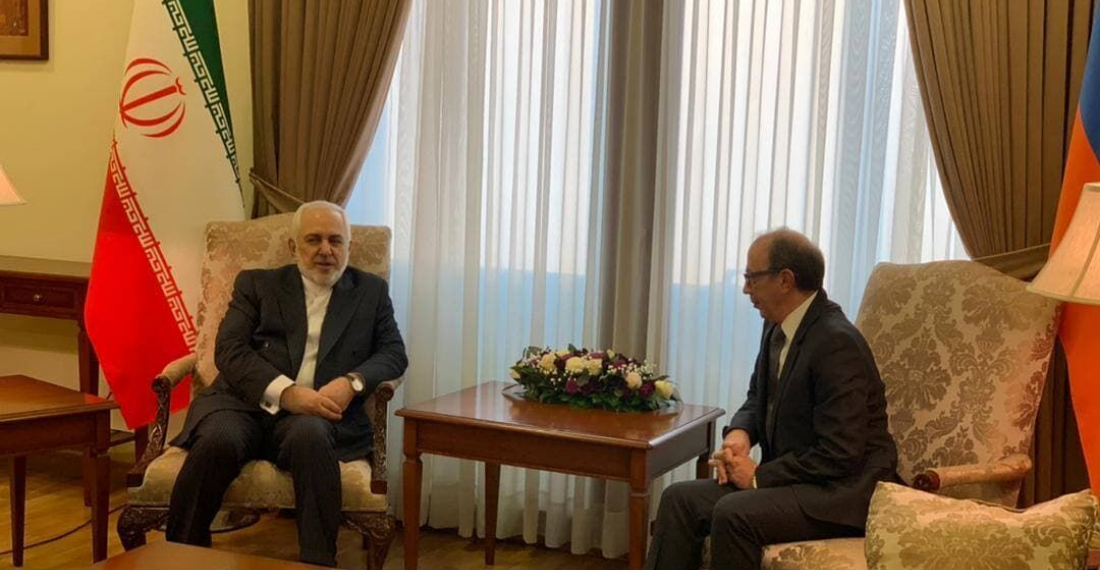
Iranian foreign minister in talks in Yerevan on South Caucasus issues

During a stop over in Yerevan as part of his regional tour Iranian Foreign Minister, Mohammed Javad Zarif on Wednesday met with Armenian prime minister Nikol Pashinyan, as well as with his Armenian counterpart Ara Ayvazyan and other senior Armenian officials 

Speaking on his arrival in Yerevan, the Iranian Foreign Minister said that cooperation between the countries of the region can bring long-term peace and stability. Zarif said, with regards to the recent conflict in the Caucasus, "After this catastrophic tragedy, in which many civilians and soldiers lost their lives, an opportunity for cooperation and confidence-building in the region has been provided."

Later, Zarif met with Armenian prime minister Nikol Pashinyan. With reference to the recent Karabakh war the Iranian foreign minister told the Armenian leader:

"Of course, you know the position of the Islamic Republic of Iran on the crisis. It is the observance of international law, the preservation of peoples, the preservation of minorities, as well as the preservation of territorial integrity, the non-use of force. Of course, you are aware of the assertion of our caring leader, which is to protect the security of the Armenians, as well as to ensure their dignified life. You know that we host our Armenian compatriots in Iran, we are always ready to serve them, we have very good and warm relations with them. Let me thank you once again for your warm welcome, as well as for giving me this opportunity to meet."

It was also announced that the Minister of Economy of Armenia is visiting Tehran on Friday to consult on increasing the level of trade relations between the two countries. The invitation comes from the Iranian Minister of Industry, Mines and Trade. The tour will include visits to several factories. 

Prior to his Armenia visit, Zarif visited Azerbaijan and Moscow. After Armenia, Zarif will follow continue his regional tour by flying to Georgia and Turkey.

In Russia, Zarif discussed bilateral relations and developments in the region, especially the situation in Nagorno-Karabakh and the future of the JCPOA agreement, with his Russian counterpart, Sergei Lavrov.

The Iranian minister's regional tour is an effort to boost friendship and economic cooperation in anticipation of a new atmosphere of global affairs.  

read more on commonspace.eu: Iran says it is ready for co-operation with Azerbaijan on regional projects

Source: commonspace.eu with various agencies. 
Picture: Iranian foreign minister Javad Zarif and Armenian foreign minister Ara Aivazian

Related articles

Editor's choice
News
Situation in South Yemen strains relations between Saudi Arabia and UAE

Situation in South Yemen strains relations between Saudi Arabia and UAE

The relations between Saudi Arabia and the United Arab Emirates (UAE) are increasingly strained as a result of the different approach of the two countries towards Yemen. Whilst both countries were initially together in resisting the Houthi take over in Yemen, the UAE subsequently focused on the South of the country, backing the Southern Movement (STC), which seeks to restore the independence of South Yemen. South Yemen became an independent country in 1967, at the end of British rule, and only unified with the north in 1990. The Saudi-led “Coalition to Support Legitimacy in Yemen” on Tuesday, 30 December, said it conducted a “limited” airstrike targeting two ships “that smuggled weapons and other military hardware into Mukalla in southern Yemen”. The ships originated in the UAE port of Furjeirah. In a statement carried by the Saudi Press Agency (SPA), the Coalition Forces spokesman, Major General Turki Al-Maliki, said that two ships coming from the port of Fujairah in the United Arab Emirates entered the Port of Mukalla in Hadramaut without obtaining official permits from the Joint Forces Command of the Coalition. He stressed the Coalition's "continued commitment to de-escalation and enforcing calm in the governorates of Hadramawt and Al-Mahra, and to prevent any military support from any country to any Yemeni faction without coordination with the legitimate Yemeni government and the Coalition. The Southern Transitional Council (STC), launched a sweeping military campaign early in December, seizing the governorates of Hadramaut along the Saudi border and the eastern governorate of Al-Mahra in Yemen’s border with Oman. The UAE-backed STC forces captured the city of Seiyun, including its international airport and the presidential palace. They also took control of the strategic PetroMasila oilfields, which account for a massive portion of Yemen’s remaining oil wealth. (click the image to read the article in full).

Popular

Editor's choice
News
Situation in South Yemen strains relations between Saudi Arabia and UAE

Situation in South Yemen strains relations between Saudi Arabia and UAE

The relations between Saudi Arabia and the United Arab Emirates (UAE) are increasingly strained as a result of the different approach of the two countries towards Yemen. Whilst both countries were initially together in resisting the Houthi take over in Yemen, the UAE subsequently focused on the South of the country, backing the Southern Movement (STC), which seeks to restore the independence of South Yemen. South Yemen became an independent country in 1967, at the end of British rule, and only unified with the north in 1990. The Saudi-led “Coalition to Support Legitimacy in Yemen” on Tuesday, 30 December, said it conducted a “limited” airstrike targeting two ships “that smuggled weapons and other military hardware into Mukalla in southern Yemen”. The ships originated in the UAE port of Furjeirah. In a statement carried by the Saudi Press Agency (SPA), the Coalition Forces spokesman, Major General Turki Al-Maliki, said that two ships coming from the port of Fujairah in the United Arab Emirates entered the Port of Mukalla in Hadramaut without obtaining official permits from the Joint Forces Command of the Coalition. He stressed the Coalition's "continued commitment to de-escalation and enforcing calm in the governorates of Hadramawt and Al-Mahra, and to prevent any military support from any country to any Yemeni faction without coordination with the legitimate Yemeni government and the Coalition. The Southern Transitional Council (STC), launched a sweeping military campaign early in December, seizing the governorates of Hadramaut along the Saudi border and the eastern governorate of Al-Mahra in Yemen’s border with Oman. The UAE-backed STC forces captured the city of Seiyun, including its international airport and the presidential palace. They also took control of the strategic PetroMasila oilfields, which account for a massive portion of Yemen’s remaining oil wealth. (click the image to read the article in full).

