


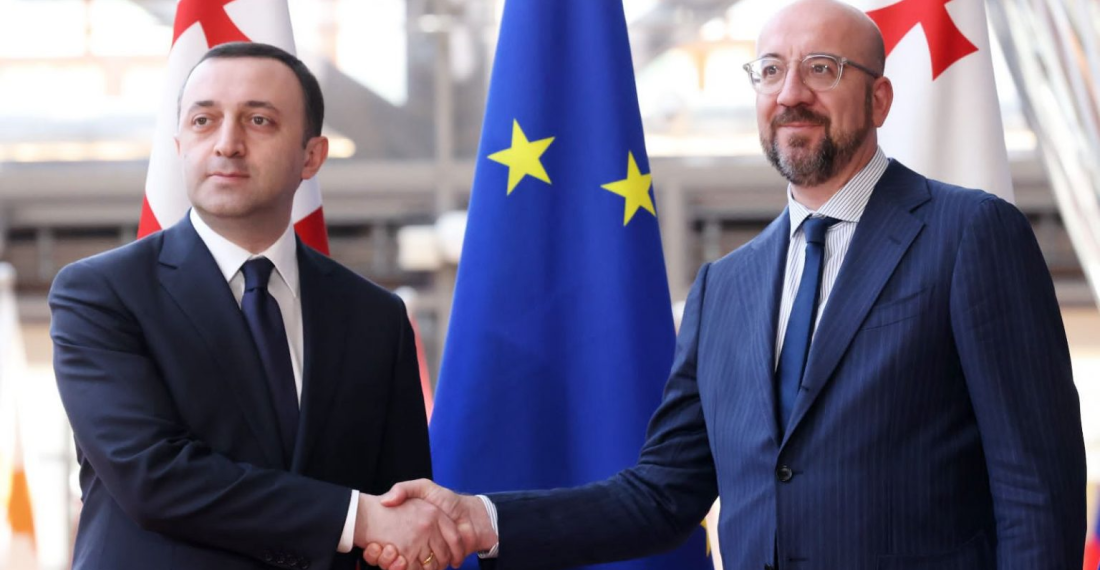
The Prime Minister of Georgia Irakli Garibashvili paid an official visit to Brussels yesterday Wednesday (14 June), in which he met with the European Council President, Charles Michel, and addressed this year’s Europalia biennial multidisciplinary arts festival, which is showcasing Georgian arts and culture.
In a statement posted on the website of the Georgian PM, it was announced that Garibashvili held a business lunch at the invitation of President Michel, in which the process of Georgia's accession to the EU was the main topic of discussion.
The rest of the statement read:
"Dignitaries reviewed the progress achieved by Georgia towards the implementation of 12 priorities defined by the European Commission. Leaders noted that recognition of the European Perspective of the country is a historic decision, thereby highlighting that granting the status of an EU Candidate Country to Georgia by the end of the year is critical, inter alia for ending the polarization in the country.
"Special attention was paid during the discussion to the security architecture in the region, along with the grave humanitarian and security position in the occupied territories of Georgia. Focus was made on the significant role of Georgia in ensuring the peace and stability in the region.
"In the given circumstances, the Prime Minister of Georgia underlined the importance of EU and its engagement in the region both in terms of peace and security on the ground, as well as for the transport, energy and infrastructure links to be deepened between Georgia and EU within the scope of the Black Sea region."
On his part, following his meeting with the Georgian PM, President Michel tweeted: "with the historic European perspective, you [Georgia] have the opportunity to chart a new trajectory for Georgia for generations. Systemic reforms, inclusiveness and transparency are now needed more than ever."
Garibashvili addresses Europalia
Prime Minister Garibashvili also addressed the Europalia arts festival, which this year features Georgian culture and arts. In his speech, he expressed his government’s readiness to "do everything" to fulfil the "dream of many generations" and "regain" the country’s place among European nations.
"Last year the EU granted Georgia its membership perspective [European perspective] which represents the biggest foreign policy achievement of Georgia’s modern history. Since this landmark decision, we have been sparing no effort to obtain the EU candidate status by the end of this year and open a completely new chapter in Georgia's Western integration", the PM said.
Citing the Georgian scientist Mikheil Muskhelishvili, Garibashvili said that "Georgia knows that it belongs to Europe. It is necessary that Georgia takes its rightful place in Europe and Western countries should welcome Georgia into their family".



