


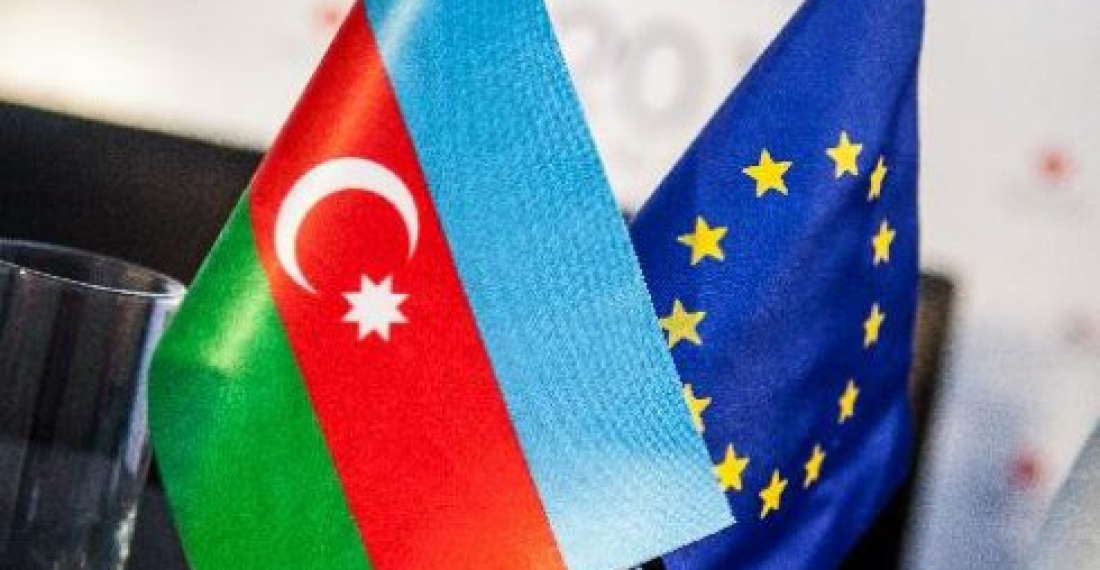
EU and Azerbaijan to start talks on comprehensive agreement

The European Union will start negotiations with Azerbaijan on a comprhensive agreement which will form a contractual arrangement between the two sides.

On Monday, (14 November 2016), the Council of the European Union adopted a mandate for the European Commission and the High Representative for Foreign Affairs and Security Policy to negotiate, on behalf of the EU and its member states, a comprehensive agreement with the Republic of Azerbaijan.

A statement by the Council said that "the new agreement should replace the 1996 partnership and cooperation agreement and should better take account of the shared objectives and challenges the EU and Azerbaijan face today. It will follow the principles endorsed in the 2015 review of the European neighbourhood policy and offer a renewed basis for political dialogue and mutually beneficial cooperation between the EU and Azerbaijan".

The decision has been welcomed by Azerbaijan. Hikmat Hajiyev, spokesman for Azerbaijan's Foreign Ministry, told reporters "the signing of a new agreement will create a substantial framework for the EU-Azerbaijan strategic cooperation to enter a new stage and bilateral ties to develop comprehensively". 

source:commonspace.eu


Related articles

Popular

Editor's choice
Interview
Thursday Interview: Murad Muradov

Thursday Interview: Murad Muradov

Today, commonspace.eu starts a new regular weekly series. THURSDAY INTERVIEW, conducted by Lauri Nikulainen, will host  persons who are thinkers, opinion shapers, and implementors in their countries and spheres. We start the series with an interview with Murad Muradov, a leading person in Azerbaijan's think tank community. He is also the first co-chair of the Action Committee for a new Armenian-Azerbaijani Dialogue. Last September he made history by being the first Azerbaijani civil society activist to visit Armenia after the 44 day war, and the start of the peace process. Speaking about this visit Murad Muradov said: "My experience was largely positive. My negative expectations luckily didn’t play out. The discussions were respectful, the panel format bringing together experts from Armenia, Azerbaijan, and Turkey was particularly valuable during the NATO Rose-Roth Seminar in Yerevan, and media coverage, while varied in tone, remained largely constructive. Some media outlets though attempted to represent me as more of a government mouthpiece than an independent expert, which was totally misleading.  Overall, I see these initiatives as important steps in rebuilding trust and normalising professional engagement. The fact that soon a larger Azerbaijani civil society visits to Armenia followed, reinforces the sense that this process is moving in the right direction." (click the image to read the interview in full)

