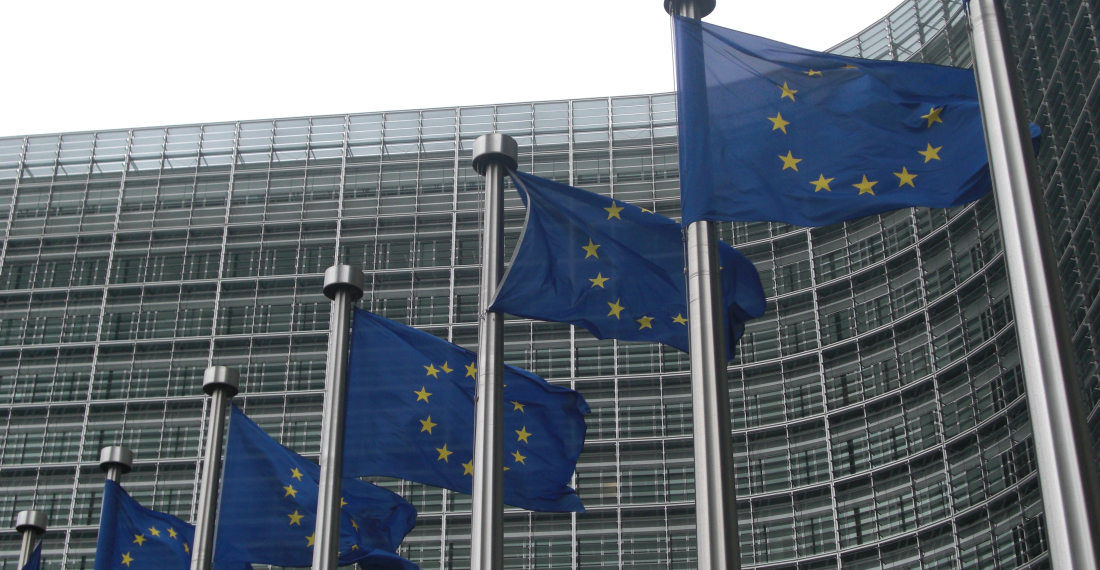
Environmentalists take the European Commission to court

Environmental campaigners announced on Tuesday (27 August) that they have taken the European Commission to court over its 2030 emissions rules. They are seeking a ruling from Europe's second highest court that would force the EU bloc to strengthen its climate policies. The case, filed at the General Court of the Court of Justice of the European Union, is being led by the non-profit organisations Climate Action Network and the Global Legal Action Network (GLAN). 

A spokesperson for the European Commission declined to comment on ongoing legal proceedings. In a written defence submitted to the court in July, the Commission asked the court to dismiss the lawsuits as inadmissible. Environmentalists argue that wealthy, historically high-emitting regions such as the EU should cut emissions faster than the rest of the world. They argue that national limits on greenhouse gas emissions in sectors such as transport and agriculture are unlawful. The campaigners claim that the limits set will not reduce Europe's emissions fast enough to meet the Paris Agreement's target of limiting global warming to 1.5 degrees Celsius (about 2.7 degrees Fahrenheit) above pre-industrial levels. The General Court of the Court of Justice of the European Union has given the case priority status, meaning it is likely to be heard in 2025. 
Source: commonspace.eu with Reuters and other agencies

Related articles

Editor's choice
News
Key European countries back Denmark in the face of Trump's continuing insistence on taking over Greenland

Key European countries back Denmark in the face of Trump's continuing insistence on taking over Greenland

 Six major European countries have declared their support to Denmark following renewed insistence by the US that it must have control over Greenland. "Greenland belongs to its people, and only Denmark and Greenland can decide on matters concerning their relations," said the leaders of the UK, France, Germany, Italy, Poland, and Spain, in a joint statement, issued on Tuesday (6 January), together with Denmark. On Sunday, Donald Trump said the US "needed" Greenland - a semi-autonomous region of fellow Nato member Denmark - for security reasons. He has refused to rule out the use of force to take control of the territory, and Danish Prime Minister Mette Frederiksen warned on Monday that an attack by the US would spell the end of Nato. The issue of Greenland's future resurfaced in the wake of the US military intervention in Venezuela, during which elite troops went in to seize the country's President Nicolás Maduro and take him to face drugs and weapons charges in New York. Following the raid, Trump said the US would "run" Venezuela for an unspecified period of time. He also said the US was returning to an 1823 policy of US supremacy in its sphere of influence in the Western hemisphere - and he warned a number of countries the US could turn its attention to them. The US military raid in Venezuela has reignited fears that the US may consider using force to secure control of Greenland. A day after the raid, Katie Miller - the wife of one of Trump's senior aides - posted on social media a map of Greenland in the colours of the American flag, alongside the word "SOON". On Monday, her husband Stephen Miller said it was "the formal position of the US government that Greenland should be part of the US". In an interview with CNN, he also said the US "is the power of Nato. For the US to secure the Arctic region, to protect and defend Nato and Nato interests, obviously Greenland should be part of the US." Asked repeatedly whether the US would rule out using force to annex it, Miller responded: "Nobody's going to fight the US over the future of Greenland." Stressing they were as keen as the US in Arctic security, the seven European signatories of Tuesday's joint statement said this must be achieved by Nato allies, including the US "collectively" - whilst "upholding the principles of the UN Charter, including sovereignty, territorial integrity and the inviolability of borders". Greenland's Prime Minister Jens-Frederik Nielsen welcomed the statement and called for "respectful dialogue". "The dialogue must take place with respect for the fact that Greenland's status is rooted in international law and the principle of territorial integrity," Nielsen said. Trump has claimed that making Greenland part of the US would serve American security interests due to its strategic location and its abundance of minerals critical to high-tech sectors. Greenland, which has a population of 57,000 people, has had extensive self-government since 1979, though defence and foreign policy remain in Danish hands. While most Greenlanders favour eventual independence from Denmark, opinion polls show overwhelming opposition to becoming part of the US.

Popular