



Monday Commentary: You heard about the G7. But have you heard about the G2?

Countries that want to work together usually establish collaborative platforms, which enable them to meet regularly, coordinate positions and, if necessary, take common action.

The G7 is one such platform.  It is made up of the seven leading industrialized countries: Canada, France, Germany, Italy, Japan, the United Kingdom, and the United States, as well as the European Union, and has been going since 1975.

For a short time (1997 – 2014), there was also a G8, which brought Russia in together with the G7. However, this was ended when Russia annexed Crimea in 2014.

There was therefore surprise when Donald Trump last month started talking of the G2.

Ahead of his meeting with the Chinese leader, Xi Jinping, on 29 October, Trump wrote on Social Media, “The G2 will be convening shortly”.

The term G2 is not new – it has been used by some American experts for the last two decades as an idea of the US and China, the new big two, sorting out the world between them.

Nobody took much notice until Donald Trump started using the term last month. Most of the world shuddered. The Chinese themselves are wary of the hegemonic undertones of the term. They think its another Trump trick, and they are probably right.

 The South China Morning Post quotes Da Wei, director of Tsinghua University’s Centre for International Security and Strategy, as saying that “China is not enthusiastic about the ‘G2’ concept and term.”

“In the past, China wasn’t keen on it … I think this attitude has not changed,” he said.

 Donald Trump has no such qualms. There is nothing that he wants more than for the Trump US to be the world’s hegemon, but he understands that on the way, he has to deal with China.

In my Monday Commentary on 5 May 2025, I wrote that China was Trump’s biggest problem.

I said that Trump knows that it will be China, not Ukraine that will define his second term as President, and it will be China, not Russia, that the US will have to deal with sooner rather than later, as a more assertive China starts (or one should say continues) to be more important, more significant, and increasingly more troublesome for the United States on the world stage. Everything that Trump does, and has done up to now, is connected to this moment. There are three issues that may well provide a casus belli for a stand-off, and possibly more, with China. Apart from Trade, the other two are Taiwan and the South China Sea. The Chinese Embassy in Washington stated defiantly in March that China “is ready to fight till the end” in “a trade war or any other type of war”.

US President Donald Trump and his Chinese counterpart, Xi Jinping, met in South Korea in October, raising hopes for a de-escalation of tensions.

Trump described the talks as "amazing", while Beijing said they had reached a consensus to resolve "major trade issues". You only need to see the videos of the moment Trump and Xi met to understand the different approaches: Trump as always loud and animated; Xi silent, and sphinx-like.

Relations have been tense since Trump began imposing new tariffs on China, prompting retaliation from Beijing. More recently, China tried to curtail the sale of rare earth products to the US.

So why is Trump talking about a G2?

Trump wants, if possible, to avoid war with China under his watch. It will be too costly and unpredictable.

Offering China the role of joint hegemon may win time, despite its risks. None of the actual problems will go away; in fact, they may be exacerbated.

In the meantime, Trump wants to show China that the US has teeth, and it will use them if necessary.

The rebranding of the Department of Defence into the Department of War may seem like an expensive and reckless act of folly. But it sends a signal. Other, more tangible actions like missile tests, withdrawal from the test ban treaty, etc, do so too.

Will there be a G2? It is highly unlikely. The Chinese have their own vision of the world in which, so far, Trump has been an irritant, rather than a problem. Their view of things is much longer than Trump’s. They will remain engaged, and they will talk. They are happy that the US president now looks at them as an equal. But they will not formalise the relationship. In the meantime, Donald Trump will continue sending contradictory signals, hoping to confuse the Chinese. It is unlikely.
source: Monday Commentary is written every week by Dr Dennis Sammut, Director of LINKS Europe and Managing Editor of commonspace.eu
photo: Secretary of War Pete Hegseth finishes the installation of a War Department plaque at the River Entrance in front of the Pentagon, Nov. 13, 2025. (picture courtesy of war.gov)

Related articles

Editor's choice
News
Uzbekistan strengthens its relations with China and US

Uzbekistan strengthens its relations with China and US

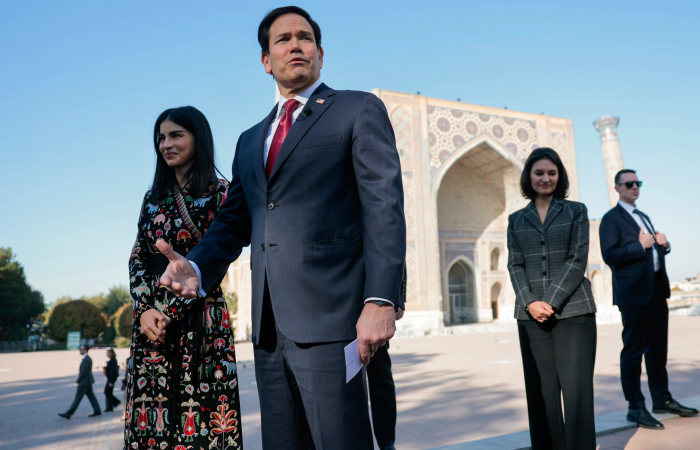
In recent days, Uzbekistan welcomed the Chinese and American governments in quick succession. During Chinese Premier Li Qiang’s visit on 17-18 October, the Uzbek presidential administration said that joint projects backed by firm agreements had reached nearly $60 billion. US Secretary of State Marco Rubio then arrived in Samarkand for C5+1 talks, accompanied at the time by American business leaders seeking contracts, particularly in critical minerals. During the visit, Uzbekistan announced 54 agreements covering trade, investment, and technology. The agreements are said to be worth a total of $12 billion, according to Uzbekistan’s Ministry of Investment, Industry and Trade. However, China still accounts for 23% of Uzbekistan’s foreign trade in January-August 2026, while US goods trade with Uzbekistan totalled at $1.05 billion in 2025, which is less than a fifteenth of the value of its trade with China. Rubio said Washington was not asking Central Asian countries to stop cooperating with other partners, but would instead compete for investment. Tashkent is likely to welcome investment from both sides, but the trade gap shows how challenging it will be if it were to decrease its dependence on Beijing. “Chinese Premier Li Qiang visited Uzbekistan on October 17–18, just ahead of United States Secretary of State Marco Rubio, who arrived in Samarkand on October 18 with a delegation of American business leaders seeking new contracts. While China already has a substantial presence in Uzbek manufacturing and energy, Washington is seeking to expand American involvement in critical minerals and technology. The visits highlight the growing competition between the world’s two largest economies for influence in Central Asia. On October 17, President Shavkat Mirziyoyev received Li Qiang. According to the Uzbek presidential administration, the portfolio of joint projects backed by firm agreements has reached nearly $60 billion. More than 6,000 joint ventures with Chinese participation have been established in Uzbekistan. (...) Construction of the China–Kyrgyzstan–Uzbekistan railway was another topic of discussion. Work officially began in December 2024. The route will cross mountainous areas of Kyrgyzstan and connect the railway networks of China and Uzbekistan. The 304-kilometer section through Kyrgyzstan alone is estimated to cost $4.7 billion and will require 50 bridges and 29 tunnels. (...) On October 19, Rubio attended talks in Samarkand under the C5+1 format, bringing together the U.S. and Kazakhstan, Kyrgyzstan, Tajikistan, Turkmenistan, and Uzbekistan. Rubio said nearly 300 American businesses were represented in Samarkand. Companies were discussing agreements potentially worth billions of dollars, with concrete announcements expected following the meetings. Among Washington’s priorities are critical minerals used in advanced technologies, including electronics and batteries.”

Popular

Editor's choice
Interview
Thursday Interview: Murad Muradov

Thursday Interview: Murad Muradov

Today, commonspace.eu starts a new regular weekly series. THURSDAY INTERVIEW, conducted by Lauri Nikulainen, will host  persons who are thinkers, opinion shapers, and implementors in their countries and spheres. We start the series with an interview with Murad Muradov, a leading person in Azerbaijan's think tank community. He is also the first co-chair of the Action Committee for a new Armenian-Azerbaijani Dialogue. Last September he made history by being the first Azerbaijani civil society activist to visit Armenia after the 44 day war, and the start of the peace process. Speaking about this visit Murad Muradov said: "My experience was largely positive. My negative expectations luckily didn’t play out. The discussions were respectful, the panel format bringing together experts from Armenia, Azerbaijan, and Turkey was particularly valuable during the NATO Rose-Roth Seminar in Yerevan, and media coverage, while varied in tone, remained largely constructive. Some media outlets though attempted to represent me as more of a government mouthpiece than an independent expert, which was totally misleading.  Overall, I see these initiatives as important steps in rebuilding trust and normalising professional engagement. The fact that soon a larger Azerbaijani civil society visits to Armenia followed, reinforces the sense that this process is moving in the right direction." (click the image to read the interview in full)

