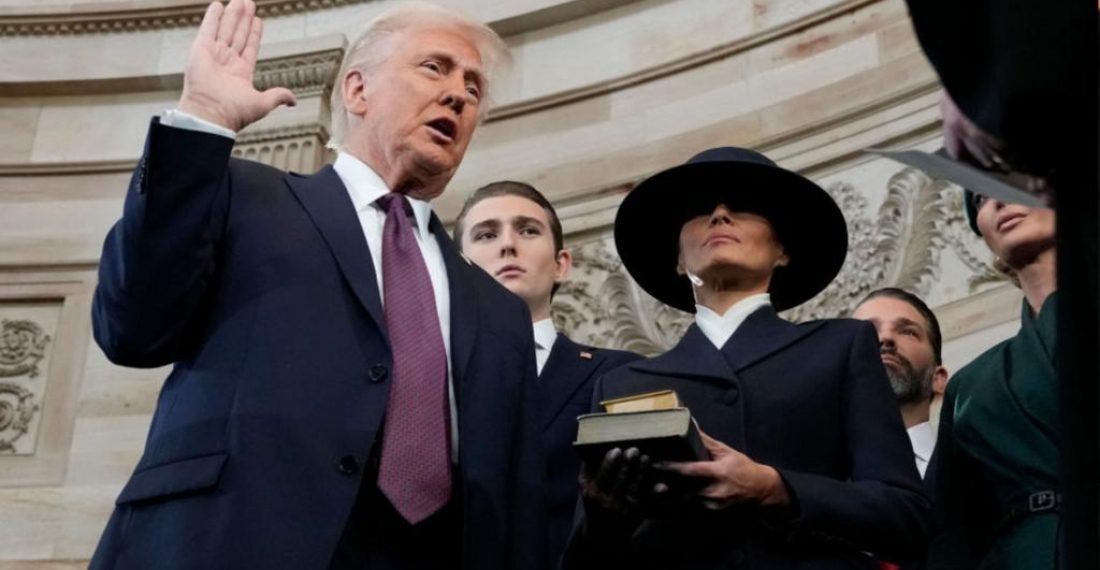
Donald Trump takes oath of office as US President, says he will save America from decline

Donald Trump aged 78 was sworn in as the 47th president of the US and pledged in his inauguration address to rescue America from what he described as years of betrayal and decline, prioritizing a crackdown on illegal immigration. Trump declared his intention to sign a number of executive actions in his first hours as president, including a number focused on border security and immigration, his top priority. Trump announced a "national emergency" at the US-Mexico border, declared drug cartels as terrorists, and will scrap government diversity programmes. His vice president, JD Vance, was sworn in just before him.

"First, I will declare a national emergency at our southern border," he said. "All illegal entry will be immediately halted and we will begin the process of returning millions and millions of criminal aliens back to the places from which they came." The speech echoed many of the themes he sounded at his first inauguration in 2017 when he spoke darkly of the "American carnage" of crime and job loss that he said had ravaged the country.

The inauguration completes a significant comeback for a political disruptor who survived two impeachment trials, a felony conviction, two assassination attempts and an indictment for attempting to overturn his 2020 election loss. Trump will be the first felon to occupy the White House after a New York jury found him guilty of falsifying business records to cover up hush money paid to a porn star.

"The journey to reclaim our republic has not been an easy one, that I can tell you," Trump said, before referring to the assassin's bullet that grazed his ear in July. "I was saved by God to make America great again." The ceremony was moved inside the Capitol due to the cold, four years after a mob of Trump supporters breached the building, a symbol of American democracy, in an unsuccessful effort to forestall Trump's loss to Democrat Joe Biden.

Biden and outgoing Vice President Kamala Harris, who lost to Trump in November, were present inside the Capitol's Rotunda, along with former Presidents Barack Obama, George W. Bush and Bill Clinton. Former Secretary of State Hillary Clinton, who lost to Trump in 2016, arrived with her husband Bill, but Obama's wife, Michelle, chose not to attend. Numerous tech executives who have sought to curry favor with the incoming administration - including the three richest men in the world, Tesla and SpaceX CEO Elon Musk, Amazon CEO Jeff Bezos and Meta CEO Mark Zuckerberg - had prominent seats on stage, next to cabinet nominees and members of Trump's family.

Trump, the first US president since the 19th century to win a second term after losing the White House, has said he would pardon on day one any of the more than 1,500 people charged in connection with the Jan. 6, 2021, attack. He skipped Biden's inauguration and has continued to claim falsely that the 2020 election he lost to Biden was rigged.

In another controversial announcement  in his inaugural speech Trump said that in "a short time from now," the name of Gulf of Mexico will be changed to "Gulf of America." 
Source: commonspace.eu with agencies Photo: BBC

Related articles

Editor's choice
News
Borrell tells the European Parliament that the situation in Afghanistan was critical, but the EU will remain engaged

Borrell tells the European Parliament that the situation in Afghanistan was critical, but the EU will remain engaged

Borrell underlined that the European Union will make every effort to support the peace process and to remain a committed partner to the Afghan people. "Of course, we will have to take into account the evolving situation, but disengagement is not an option.  We are clear on that: there is no alternative to a negotiated political settlement, through inclusive peace talks.
Editor's choice
News
NATO Chief says war is on Europe's doorstep, and warns against complacency

NATO Chief says war is on Europe's doorstep, and warns against complacency

Russia could attack a Nato country within the next five years, the Secretary General of NATO, Mark Rutte, said in a stark new warning. "Nato's own defences can hold for now," Rutte warned in Berlin, but conflict was "next door" to Europe and he feared "too many are quietly complacent, and too many don't feel the urgency, too many believe that time is on our side. "Russia is already escalating its covert campaign against our societies," Rutte said in a speech in Germany. "We must be prepared for the scale of war our grandparents or great-grandparents endured." Earlier this month, Russia's President Vladimir Putin said his country was not planning to go to war with Europe, but it was ready "right now" if Europe wanted to - or started a war. But similar reassurances were given by Moscow in 2022, just before 200,000 Russian troops crossed the border and invaded Ukraine. Putin has accused European countries of hindering US efforts to bring peace in Ukraine - a reference to the role Ukraine's European allies have recently played in trying to change a US peace plan to end the war, whose initial draft was seen as favouring Russia. But Putin was not sincere, Nato's secretary-general said in the German capital, Berlin. Supporting Ukraine, he added, was a guarantee for European security. "Just imagine if Putin got his way; Ukraine under the boot of Russian occupation, his forces pressing against a longer border with Nato, and the significantly increased risk of an armed attack against us." Russia's economy has been on a war footing for more than three years now - its factories churn out ever more supplies of drones, missiles and artillery shells. According to a recent report by the Kiel Institute for the World Economy, Russia has been producing each month around 150 tanks, 550 infantry fighting vehicles, 120 Lancet drones and more than 50 artillery pieces. The UK, and most of its Western allies, are simply not anywhere near this point. Analysts say it would take years for Western Europe's factories to come close to matching Russia's mass-production of weapons. "Allied defence spending and production must rise rapidly, our armed forces must have what they need to keep us safe," the Nato chief said.

Popular

Editor's choice
News
NATO Chief says war is on Europe's doorstep, and warns against complacency

NATO Chief says war is on Europe's doorstep, and warns against complacency

Russia could attack a Nato country within the next five years, the Secretary General of NATO, Mark Rutte, said in a stark new warning. "Nato's own defences can hold for now," Rutte warned in Berlin, but conflict was "next door" to Europe and he feared "too many are quietly complacent, and too many don't feel the urgency, too many believe that time is on our side. "Russia is already escalating its covert campaign against our societies," Rutte said in a speech in Germany. "We must be prepared for the scale of war our grandparents or great-grandparents endured." Earlier this month, Russia's President Vladimir Putin said his country was not planning to go to war with Europe, but it was ready "right now" if Europe wanted to - or started a war. But similar reassurances were given by Moscow in 2022, just before 200,000 Russian troops crossed the border and invaded Ukraine. Putin has accused European countries of hindering US efforts to bring peace in Ukraine - a reference to the role Ukraine's European allies have recently played in trying to change a US peace plan to end the war, whose initial draft was seen as favouring Russia. But Putin was not sincere, Nato's secretary-general said in the German capital, Berlin. Supporting Ukraine, he added, was a guarantee for European security. "Just imagine if Putin got his way; Ukraine under the boot of Russian occupation, his forces pressing against a longer border with Nato, and the significantly increased risk of an armed attack against us." Russia's economy has been on a war footing for more than three years now - its factories churn out ever more supplies of drones, missiles and artillery shells. According to a recent report by the Kiel Institute for the World Economy, Russia has been producing each month around 150 tanks, 550 infantry fighting vehicles, 120 Lancet drones and more than 50 artillery pieces. The UK, and most of its Western allies, are simply not anywhere near this point. Analysts say it would take years for Western Europe's factories to come close to matching Russia's mass-production of weapons. "Allied defence spending and production must rise rapidly, our armed forces must have what they need to keep us safe," the Nato chief said.