


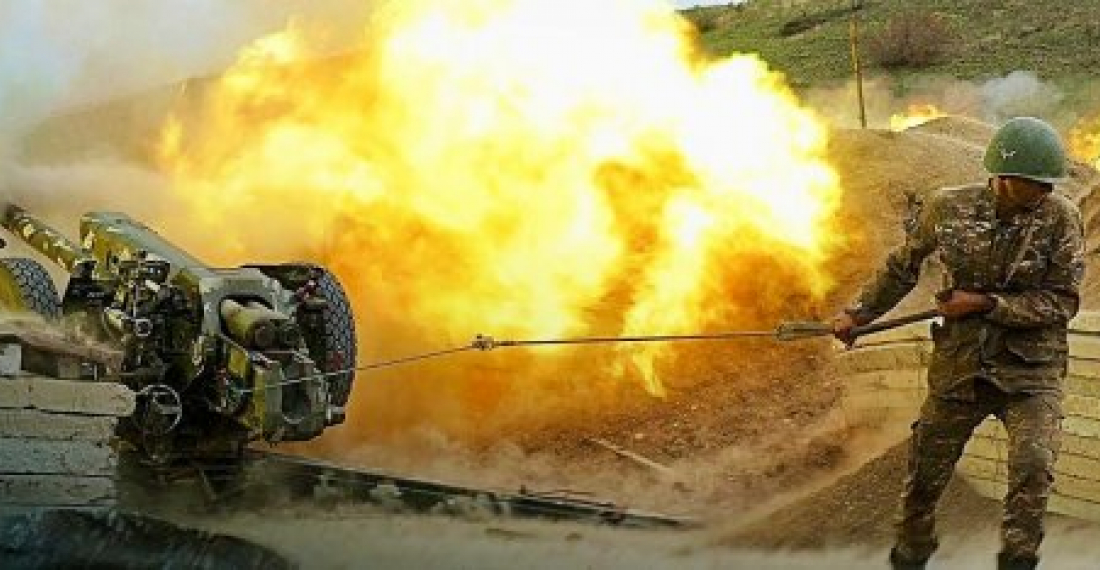
Diplomatic activity over Karabakh intensifies, but not all fighting has stopped yet.

Updated at 1730 CEST (1930 Baku and Yerevan)

Diplomatic efforts to secure a cease fire in the ongoing fighting between Armenian and Azerbaijani forces in the South Caucasus have continued throughout the day.

The OSCE MInsk Group co-chair (diplomats representing France, Russia and the United States) have issued a statement on Tuesday evening (13 October) , expressing alarm at the current situation. The statement said,

The Co-Chairs note with alarm the continuing violence in the Nagorno-Karabakh conflict. The Co-Chairs call on Azerbaijani President Ilham Aliyev and Armenian Prime Minister Nikol Pashinyan to take immediate steps to execute in full the obligations of the sides according to the October 10 Moscow statement, in order to prevent catastrophic consequences for the region.

The Co-Chairs reiterate that civilian casualties are unacceptable under any circumstances. The Co-Chairs call on the sides to implement the humanitarian ceasefire immediately to allow the return of remains, prisoners of war, and detainees, and appeal to the sides to agree urgently upon a ceasefire verification mechanism.

Following conversations with Armenian Foreign Minister Zohrab Mnatsakanyan and Azerbaijani Foreign Minister Jeyhun Bayramov, the Co-Chairs are working with the sides on the substantive issues of the Nagorno-Karabakh political settlement process in order to reach a negotiated solution.

In the meantime, the European Externa Action Service has released a read out of the telephone conversation held yesterday evening between EU High Representative Josep Borrell and Russian Foreign Minister Sergey Lavrov. It said

"On Nagorno-Karabakh, the High Representative thanked Minister Lavrov for his efforts in negotiating the 10 October ceasefire agreement between Armenia and Azerbaijan and stressed the need for this ceasefire to be strictly observed, for all hostilities to cease immediately and for a de-escalation of tensions, including rhetoric. The loss of life and the toll on the civilian population on both sides are unacceptable. The High Representative expressed the European Union's full support to the efforts of the OSCE Minsk Group Co-Chairs and reiterated that in his contacts with the Foreign Ministers of Armenia and Azerbaijan, he had called on both sides to urgently re-engage in meaningful negotiations without preconditions. The European Union stands ready to contribute to their efforts.

High Representative Borrell also informed Minister Lavrov of the agreement among EU Foreign Ministers to continue the current approach to EU-Russia relations, whereby the full implementation of the Minsk agreements remains key. He called on Russia to fully implement the Minsk agreements. As illustrated by the phone call, the High Representative reiterated that the European Union wishes to maintain open channels of communication with Russia and to enhance cooperation on issues of mutual interest. The European Union will continue to defend its interests and values, including respect for international law and fundamental rights."

Source: commonspace.eu with the European External Action Service press service and osce.org

__________________

Diplomatic activity to try to end hostilities between Armenians and Azerbaijanis in the South Caucasus intensified on Monday (12 October) with many international players putting pressure on the sides in the conflict to respect the humanitarian cease fire agreed in Moscow on Saturday morning.

Despite this both sides continue to report cease fire violations, especially in the southern sector of the Nagorno-Karabakh conflict zone.

On the diplomatic front, Armenian foreign minister Zohrab Mnatsaknyan was in Moscow on an earlier scheduled visit, during which he also met with foreign minister Sergei Lavrov.

There continues to be intensive diplomatic contacts between Russia and Turkey. Lavrov spoke with his Turkish counterpart, Melut Cavisoglu on Saturday. Lavrov says that Turkey has supported the cease fire, and Russia's effort

On Monday Karabakh was also discussed in a telephone conversation between the Russian Defence Minister Sergei Shoigu and his Turkish counterpart, Hulusi Akar  

Also on Monday, Turkey's president, Recip Tayip Erdogan spoke on the phone with the president of the European Council, Charles Michel.

Turkish media said Erdogan urged the EU to take a "consistent stance" on Azerbaijan's territorial integrity, according to a statement by Turkey's Communications Directorate. Erdoğan added that Armenia had endangered Europe's energy supplies by attacking the Azerbaijani city of Ganja along with the Tovuz region, where natural gas and oil pipelines and transportation lines are located.

On its part the EU has been considering the situation in the South Caucasus during a meeting of the Foreign Affairs Council, which groups together the foreign ministers of the 27 member states. 

Speaking in Luxembourg at the press conference after the event, EU High Representative Josep Borrell said that the Ministers heard from the French Foreign Ministers - France being one of the co-chair of the OSCE Minsk process - of the efforts to stop hostilities and return to negotiations. The Ministers discussed how the EU could provide tangible support for the cease-fire agreed on 10 October. The Ministers stressed the importance that the cease fire is respected. The Ministers also called on all regional players to contribute to end the armed confrontation and towards peace.

On Tuesday, the foreign minister of Sweden, Ann Linde, will pay a one day working visit to Turkey to meet Turkish officials. Sweden takes over the chairmanship of the OSCE at the end of this year and has stepped up its preparations given ongoing problems within the OSCE structures and increasing tensions within the OSCE area. Nagorno-Karabakh is likely to be one of the main issues the Swedish chairmanship will have to deal with during its term in 2021.

source: commonspace.eu with agencies

Related articles

Editor's choice
News
Council of Europe launches new International Claims Commission for Ukraine

Council of Europe launches new International Claims Commission for Ukraine

Thirty-four countries and the European Union have signed a new convention establishing an International Claims Commission for Ukraine at a diplomatic conference co-hosted by the 46-nation Council of Europe and the Netherlands in the Hague. The diplomatic conference was attended by leaders and high-level representatives from over 50 states, including the President of Ukraine, Volodymyr Zelenskyy, the President of the Republic of Moldova, Maia Sandu, and the Prime Minister of the Netherlands, Dick Schoof.  “Today marks a major step forward in ensuring accountability for Ukraine. The International Claims Commission represents justice and hope for tens of thousands of victims—our determination that those who have suffered will not be forgotten. I call for quick ratifications so we can get the commission rapidly up and running for the people of Ukraine,” said Council of Europe Secretary General Alain Berset. Ukrainian President Volodymyr Zelenskyy said: “We expect that every mechanism for compensation from the Register of Damage and Claims Commission to the actual payments – will start working and receive strong and sufficient international support, so that people can truly feel that any kind of damage caused by the war can be compensated. This war, and Russia’s responsibility for it, MUST become a clear example – so that others learn not to choose aggression.” “Accountability is about creating the conditions for peace that endures. And therefore, accountability is a condition of security – today and for the future. But accountability is not only about Ukraine. And it is not only about one aggressor and one victim. Accountability is about Europe. About every country in Europe. It is about whether Europe, as a whole, is willing to defend its peace,” said Maia Sandu, President of the Republic of Moldova, which currently holds the Presidency of the Council of Europe’s Committee of Ministers. The Prime Minister of the Netherlands, Dick Schoof, said: “Every day Russia is deliberately bombarding homes, destroying businesses and damaging infrastructure in Ukraine. Russia must compensate Ukraine for the damage caused. That is why we have launched the International Claims Commission for Ukraine and we are honoured to host it.” The International Claims Commission will be the second part of a comprehensive compensation mechanism related to Russia’s war of aggression, building on the existing Register of Damage for Ukraine. The claims commission will be established within the framework of the Council of Europe and will also be open to other countries. The Register of Damage for Ukraine, created in 2023, collects and records compensation claims submitted by individuals, organisations and public bodies in Ukraine. Forty-four states and the European Union have so far joined the Register, which has already received 86,000 claims. The International Claims Commission will review, assess and decide upon claims submitted to the Register of Damage for Ukraine and determine the amount of compensation, if any, which is due in each case. The convention establishing the commission will enter into force once it has been ratified by 25 signatories, as long as sufficient funds have been secured to support its initial work.

Popular

Editor's choice
News
Council of Europe launches new International Claims Commission for Ukraine

Council of Europe launches new International Claims Commission for Ukraine

Thirty-four countries and the European Union have signed a new convention establishing an International Claims Commission for Ukraine at a diplomatic conference co-hosted by the 46-nation Council of Europe and the Netherlands in the Hague. The diplomatic conference was attended by leaders and high-level representatives from over 50 states, including the President of Ukraine, Volodymyr Zelenskyy, the President of the Republic of Moldova, Maia Sandu, and the Prime Minister of the Netherlands, Dick Schoof.  “Today marks a major step forward in ensuring accountability for Ukraine. The International Claims Commission represents justice and hope for tens of thousands of victims—our determination that those who have suffered will not be forgotten. I call for quick ratifications so we can get the commission rapidly up and running for the people of Ukraine,” said Council of Europe Secretary General Alain Berset. Ukrainian President Volodymyr Zelenskyy said: “We expect that every mechanism for compensation from the Register of Damage and Claims Commission to the actual payments – will start working and receive strong and sufficient international support, so that people can truly feel that any kind of damage caused by the war can be compensated. This war, and Russia’s responsibility for it, MUST become a clear example – so that others learn not to choose aggression.” “Accountability is about creating the conditions for peace that endures. And therefore, accountability is a condition of security – today and for the future. But accountability is not only about Ukraine. And it is not only about one aggressor and one victim. Accountability is about Europe. About every country in Europe. It is about whether Europe, as a whole, is willing to defend its peace,” said Maia Sandu, President of the Republic of Moldova, which currently holds the Presidency of the Council of Europe’s Committee of Ministers. The Prime Minister of the Netherlands, Dick Schoof, said: “Every day Russia is deliberately bombarding homes, destroying businesses and damaging infrastructure in Ukraine. Russia must compensate Ukraine for the damage caused. That is why we have launched the International Claims Commission for Ukraine and we are honoured to host it.” The International Claims Commission will be the second part of a comprehensive compensation mechanism related to Russia’s war of aggression, building on the existing Register of Damage for Ukraine. The claims commission will be established within the framework of the Council of Europe and will also be open to other countries. The Register of Damage for Ukraine, created in 2023, collects and records compensation claims submitted by individuals, organisations and public bodies in Ukraine. Forty-four states and the European Union have so far joined the Register, which has already received 86,000 claims. The International Claims Commission will review, assess and decide upon claims submitted to the Register of Damage for Ukraine and determine the amount of compensation, if any, which is due in each case. The convention establishing the commission will enter into force once it has been ratified by 25 signatories, as long as sufficient funds have been secured to support its initial work.

