Ann Linde holds talks with Lavrov on European Security

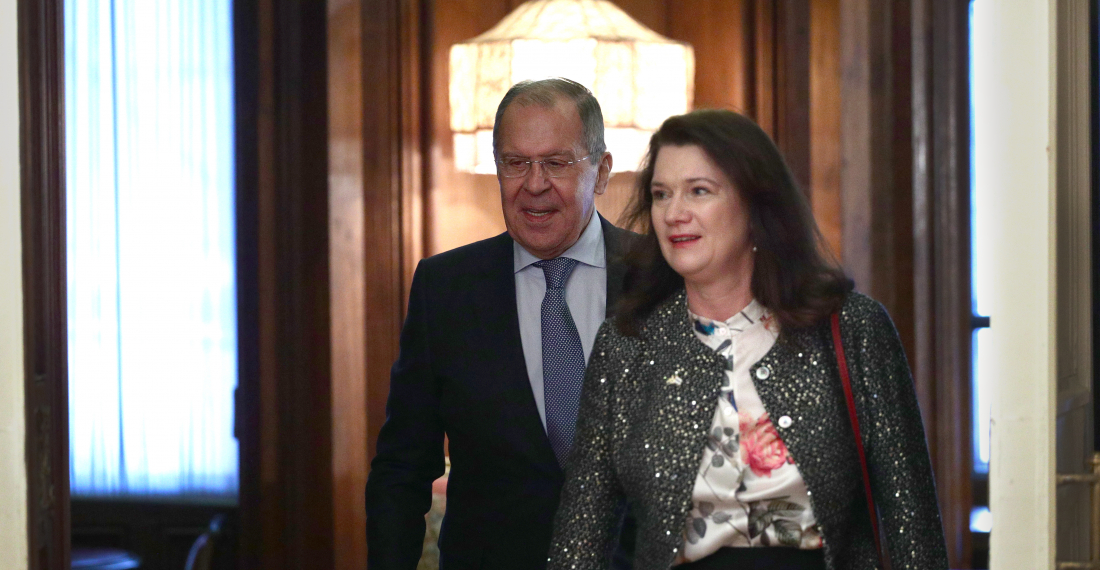
Swedish Foreign Minister Ann Linde has held talks in Moscow with Russian foreign minister Sergei Lavrov. Linde is in Moscow in her capacity as chairperson-in-office of the Organisation for Security and Co-operation in Europe (OSCE).

Sweden is trying to use its one year chairmanship of the organisation to bring back focus to the OSCE after a difficult period last year, and a growing sense that the organisation was drifting away from its original mandate on European security.

Russia is central to this process, since it is seen as being at odds with the Helsinki Final Act - the OSCE's milestone document -  in both its internal policies, as well as in its relations with its neighbours.

A statement on the website of the Russian foreign ministry ahead of the meeting stated:

During the talks, it is planned to discuss the current tasks of the OSCE in three dimensions - military-political, economic-environmental and humanitarian - and the work plans of the Organization in 2021. In particular, an exchange of views will take place on the state of the European security architecture and the erosion of international legal instruments for building confidence, the interaction of the participating States within the framework of the OSCE Forum for Security Co-operation, on the "structured dialogue" on security challenges and threats going on since 2017, its contributing to the restoration of confidence and de-escalation of tensions in the Euro-Atlantic area.

In the meantime, Ann Linde has tweeted:

Visiting #Russia in my capacity as @OSCE Chairperson-in-Office. On the agenda: Our common security, based on international law and the joint principles and commitments of the Organization. @mfa_russia #OSCE2021SWE pic.twitter.com/ZN3n7y95A9

— Ann Linde (@AnnLinde) February 2, 2021
Source: commonspace.eu with agencies
photo: Russian Foreign Minister Lavrov with Swedish Minister Ann Linde in Moscow on 2 February 2021 (picture courtesy of the press service of the Russian foreign ministry)

Related articles

Editor's choice
News
Situation in South Yemen strains relations between Saudi Arabia and UAE

Situation in South Yemen strains relations between Saudi Arabia and UAE

The relations between Saudi Arabia and the United Arab Emirates (UAE) are increasingly strained as a result of the different approach of the two countries towards Yemen. Whilst both countries were initially together in resisting the Houthi take over in Yemen, the UAE subsequently focused on the South of the country, backing the Southern Movement (STC), which seeks to restore the independence of South Yemen. South Yemen became an independent country in 1967, at the end of British rule, and only unified with the north in 1990. The Saudi-led “Coalition to Support Legitimacy in Yemen” on Tuesday, 30 December, said it conducted a “limited” airstrike targeting two ships “that smuggled weapons and other military hardware into Mukalla in southern Yemen”. The ships originated in the UAE port of Furjeirah. In a statement carried by the Saudi Press Agency (SPA), the Coalition Forces spokesman, Major General Turki Al-Maliki, said that two ships coming from the port of Fujairah in the United Arab Emirates entered the Port of Mukalla in Hadramaut without obtaining official permits from the Joint Forces Command of the Coalition. He stressed the Coalition's "continued commitment to de-escalation and enforcing calm in the governorates of Hadramawt and Al-Mahra, and to prevent any military support from any country to any Yemeni faction without coordination with the legitimate Yemeni government and the Coalition. The Southern Transitional Council (STC), launched a sweeping military campaign early in December, seizing the governorates of Hadramaut along the Saudi border and the eastern governorate of Al-Mahra in Yemen’s border with Oman. The UAE-backed STC forces captured the city of Seiyun, including its international airport and the presidential palace. They also took control of the strategic PetroMasila oilfields, which account for a massive portion of Yemen’s remaining oil wealth. (click the image to read the article in full).

Popular

Editor's choice
News
Situation in South Yemen strains relations between Saudi Arabia and UAE

Situation in South Yemen strains relations between Saudi Arabia and UAE

The relations between Saudi Arabia and the United Arab Emirates (UAE) are increasingly strained as a result of the different approach of the two countries towards Yemen. Whilst both countries were initially together in resisting the Houthi take over in Yemen, the UAE subsequently focused on the South of the country, backing the Southern Movement (STC), which seeks to restore the independence of South Yemen. South Yemen became an independent country in 1967, at the end of British rule, and only unified with the north in 1990. The Saudi-led “Coalition to Support Legitimacy in Yemen” on Tuesday, 30 December, said it conducted a “limited” airstrike targeting two ships “that smuggled weapons and other military hardware into Mukalla in southern Yemen”. The ships originated in the UAE port of Furjeirah. In a statement carried by the Saudi Press Agency (SPA), the Coalition Forces spokesman, Major General Turki Al-Maliki, said that two ships coming from the port of Fujairah in the United Arab Emirates entered the Port of Mukalla in Hadramaut without obtaining official permits from the Joint Forces Command of the Coalition. He stressed the Coalition's "continued commitment to de-escalation and enforcing calm in the governorates of Hadramawt and Al-Mahra, and to prevent any military support from any country to any Yemeni faction without coordination with the legitimate Yemeni government and the Coalition. The Southern Transitional Council (STC), launched a sweeping military campaign early in December, seizing the governorates of Hadramaut along the Saudi border and the eastern governorate of Al-Mahra in Yemen’s border with Oman. The UAE-backed STC forces captured the city of Seiyun, including its international airport and the presidential palace. They also took control of the strategic PetroMasila oilfields, which account for a massive portion of Yemen’s remaining oil wealth. (click the image to read the article in full).