


New stage of Azerbaijan and EU cooperation

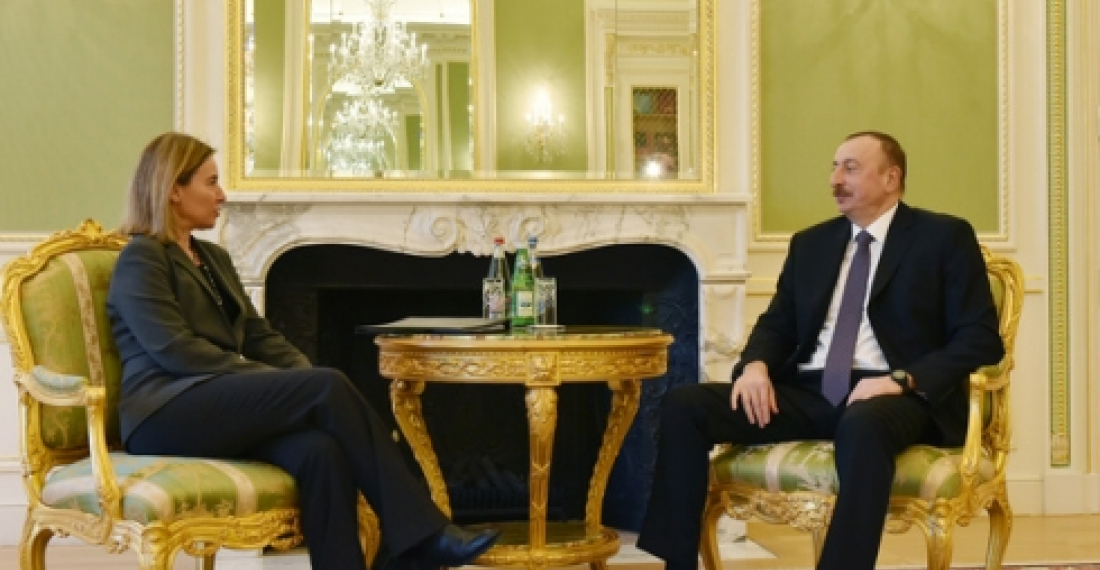
High Representative of the European Union for Foreign Affairs and Security Policy and Vice-President of the European Commission Federica Mogherini visited the Republic of Azerbaijan on February 29.

EU High Representative held an expanded meeting with the President of Azerbaijan Ilham Aliyev and the Azerbaijani Foreign Minister Elmar Mammadyarov.

At a press conference after a meeting with Azerbaijani Foreign Minister Federica Mogherini said "The European Union supports the territorial integrity, sovereignty and independence of Azerbaijan."

She noted the unacceptability of the "status quo" in the Nagorno-Karabakh conflict: "We do not recognize the independence of Nagorno Karabakh. The settlement of this conflict remains a priority for us. We are ready to support the co-chairs. The EU supports the continuation of the peace talks, and we do not see a military solution to the conflict. Parties should refrain from statements and actions that impede the peace process. The EU will support activities aimed at peace. We will intensify the work with special envoy Helbert Salber. We will our best to bring together the conflict parties."

Azerbaijani FM Elmar Mammadyarov told a press conference following his meeting with Federica Mogherini that "Azerbaijan has presented to the EU a strategic cooperation project. We have had discussions over this matter."

Elmar Mammadyarov said that during the meeting they discussed the preliminary steps to be taken for the work on the agreement project.

As for the Nagorno-Karabakh conflict Mammadyarov said that "Azerbaijan is seeking to achieve a solution to this conflict soon. We don't believe this conflict is a frozen one. The European Union, along with the Minsk Group, is supposed to give an impetus so that we can move this conflict."

Later EU High Representative held an expanded meeting with Ilham Aliyev.

President Ilham Aliyev thanked Federica Mogherini for attending the closing ceremony of the second Ministerial Meeting of the Southern Gas Corridor Advisory Council in Baku.

The head of state said Azerbaijan-EU cooperation was at an important stage now, stressing the importance of defining future plans of this collaboration.

The head of state also emphasized the importance of his discussions on future cooperation plans with EU Commissioner for the European Neighbourhood Policy and Enlargement Negotiations Johannes Hahn when they recently met in Munich.

President Ilham Aliyev expressed his hope that Azerbaijan and the EU would elaborate a cooperation format for establishing long-term and fruitful partnership that would cover various fields.

President Ilham Aliyev also emphasized the importance of conflict resolution, political reforms, economic cooperation, energy security, especially financial security in the region.

High Representative of the EU, Vice-President of the European Commission Federica Mogherini expressed gratitude for high-level organization of the Meeting of the Southern Gas Corridor Advisory Council. Federica Mogherini described this as a good indicator of cooperation between Azerbaijan and the EU. She said cooperation between Azerbaijan and the EU would be continued in a new format, adding there was a firm legal base for this.

They also discussed the current state and prospects of negotiations to solve the Armenia-Azerbaijan Nagorno-Karabakh conflict, and exchanged views on other issues of cooperation.

The meeting then continued in a one-on-one format.

source: commonspace.eu with president.az, mfa.gov.az


Related articles

Editor's choice
News
Borrell tells the European Parliament that the situation in Afghanistan was critical, but the EU will remain engaged

Borrell tells the European Parliament that the situation in Afghanistan was critical, but the EU will remain engaged

Borrell underlined that the European Union will make every effort to support the peace process and to remain a committed partner to the Afghan people. "Of course, we will have to take into account the evolving situation, but disengagement is not an option.  We are clear on that: there is no alternative to a negotiated political settlement, through inclusive peace talks.
Editor's choice
News
Pope's visit to Türkiye and Lebanon has a strong ecumenical character, and places interreligious dialogue at its centre

Pope's visit to Türkiye and Lebanon has a strong ecumenical character, and places interreligious dialogue at its centre

Pope Leo XIV has begun the first overseas trip of his pontificate, a six-day visit to Türkiye and Lebanon, which started yesterday (27 November) and ends on Tuesday (2 December). According to Vatican Radio, the visit "carries a strong ecumenical character and places interreligious dialogue at its centre. It will also be a moment of closeness to Christian communities and local populations across the region".   During nearly a week in the region, Pope Leo XIV will meet civil and religious authorities, visit mosques and ancient churches, pray at Beirut’s port in memory of the victims of the 2020 explosion, and hold private meetings with Presidents Recep Tayyip Erdoğan and Joseph Aoun.   A highlight of the visit will be a visit to Nicaea, where the Pope will mark the anniversary of the Council of Nicaea. Christians of many traditions recognise the Council of Nicaea as a foundation of shared faith. One of the most anticipated moments will be the Pope’s encounter with Lebanese youth in Bkerké, at the Maronite Patriarchate, a meeting expected to carry strong messages of hope in the Jubilee Year. A central event will be the ecumenical celebration in İznik, where the Pope and Ecumenical Patriarch Bartholomew will walk together toward the ruins of the Basilica of St Neophytos. The prayer, held before icons of Christ and the Council, will conclude with the lighting of a candle—a symbolic gesture of unity. The journey will also highlight interreligious engagement.   Memorable moments are expected throughout the trip: a wreath at Atatürk’s mausoleum, prayer inside the Blue Mosque, Mass at Istanbul’s Volkswagen Arena, the planting of a cedar at the presidential palace in Beirut, and prayer at the tomb of St Charbel in Lebanon. The Vatican said that "Pope Leo XIV’s pilgrimage to Türkiye and Lebanon aims to offer a voice of peace, unity, and hope at the heart of the Middle East."

Popular

Editor's choice
News
Pope's visit to Türkiye and Lebanon has a strong ecumenical character, and places interreligious dialogue at its centre

Pope's visit to Türkiye and Lebanon has a strong ecumenical character, and places interreligious dialogue at its centre

Pope Leo XIV has begun the first overseas trip of his pontificate, a six-day visit to Türkiye and Lebanon, which started yesterday (27 November) and ends on Tuesday (2 December). According to Vatican Radio, the visit "carries a strong ecumenical character and places interreligious dialogue at its centre. It will also be a moment of closeness to Christian communities and local populations across the region".   During nearly a week in the region, Pope Leo XIV will meet civil and religious authorities, visit mosques and ancient churches, pray at Beirut’s port in memory of the victims of the 2020 explosion, and hold private meetings with Presidents Recep Tayyip Erdoğan and Joseph Aoun.   A highlight of the visit will be a visit to Nicaea, where the Pope will mark the anniversary of the Council of Nicaea. Christians of many traditions recognise the Council of Nicaea as a foundation of shared faith. One of the most anticipated moments will be the Pope’s encounter with Lebanese youth in Bkerké, at the Maronite Patriarchate, a meeting expected to carry strong messages of hope in the Jubilee Year. A central event will be the ecumenical celebration in İznik, where the Pope and Ecumenical Patriarch Bartholomew will walk together toward the ruins of the Basilica of St Neophytos. The prayer, held before icons of Christ and the Council, will conclude with the lighting of a candle—a symbolic gesture of unity. The journey will also highlight interreligious engagement.   Memorable moments are expected throughout the trip: a wreath at Atatürk’s mausoleum, prayer inside the Blue Mosque, Mass at Istanbul’s Volkswagen Arena, the planting of a cedar at the presidential palace in Beirut, and prayer at the tomb of St Charbel in Lebanon. The Vatican said that "Pope Leo XIV’s pilgrimage to Türkiye and Lebanon aims to offer a voice of peace, unity, and hope at the heart of the Middle East."

