


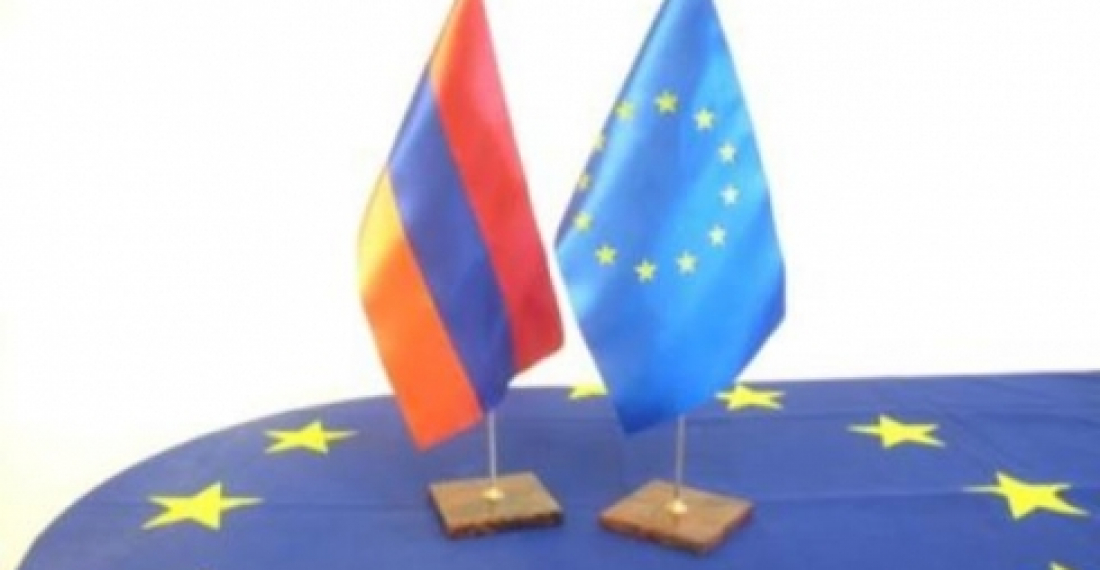
New EU-Armenia legally-binding agreement will cover 28 spheres.

Armenia and the European Union will shortly start negotiations on a new agreement which will replace the current Partnership and Co-operation Agreement. On 12 October 2015 the Foreign Affairs Council of the European Union authorised the European Commission and the High Representative to open negotiations on a new, legally binding and overarching agreement with Armenia, and adopted the corresponding negotiating mandate. The new agreement will replace the current Partnership and Co-operation Agreement between Armenia and the EU which came into force in 1999.

A statement by the European External Action Service a few days later said that the EU is committed to further develop and strengthen comprehensive cooperation with Armenia in all areas of mutual interest within the Eastern Partnership framework.

The official launching of negotiations is envisaged to take place before the end of the year.

Speaking in Yerevan on Wednesday (21 October), the Deputy Minister of Economy of Armenia, Garegin Melkonyan said that the agreement will cover twenty eight spheres. According to Deputy Minister Melkonyan, quoted by the Armenpress news agency, a number of provisions in the current Partnership and Co-operation Agreement in the economic sphere will now be excluded. These relate mainly to tariffs and free trade of certain goods. Melkonyan said that since Armenia was now a member of the Eurasian Economic Union (EEU) it could not negotiate separetely preferential arrangements with another economic bloc.

Armenia was close to signing an Association Agreement with the European Union in 2013, but at the last moment decided instead to join the Russia-led Eurasian Economic Union (EEU). Since then both sides have been exploring ways in which they could formalise the co-operation between them since after Armenia accession to the EEU the Partnership and Co-operation agreement had become in many respects obsolete.

Observers in Brussels say that the EU insisted that any new agreement had to have a legal basis and not simply be a political declaration. However this new agreement will be nothing like the Association Agreement that was negotiated up to September 2013 and should not be seen as a substitute to it.

Negotiations of a new agreement are likely to take between one to two years, as long as there are no complications.

source: commonspace.eu with Armenpress and the Press Service of the EEAS


Related articles

Editor's choice
News
Borrell tells the European Parliament that the situation in Afghanistan was critical, but the EU will remain engaged

Borrell tells the European Parliament that the situation in Afghanistan was critical, but the EU will remain engaged

Borrell underlined that the European Union will make every effort to support the peace process and to remain a committed partner to the Afghan people. "Of course, we will have to take into account the evolving situation, but disengagement is not an option.  We are clear on that: there is no alternative to a negotiated political settlement, through inclusive peace talks.
Editor's choice
News
Pope's visit to Türkiye and Lebanon has a strong ecumenical character, and places interreligious dialogue at its centre

Pope's visit to Türkiye and Lebanon has a strong ecumenical character, and places interreligious dialogue at its centre

Pope Leo XIV has begun the first overseas trip of his pontificate, a six-day visit to Türkiye and Lebanon, which started yesterday (27 November) and ends on Tuesday (2 December). According to Vatican Radio, the visit "carries a strong ecumenical character and places interreligious dialogue at its centre. It will also be a moment of closeness to Christian communities and local populations across the region".   During nearly a week in the region, Pope Leo XIV will meet civil and religious authorities, visit mosques and ancient churches, pray at Beirut’s port in memory of the victims of the 2020 explosion, and hold private meetings with Presidents Recep Tayyip Erdoğan and Joseph Aoun.   A highlight of the visit will be a visit to Nicaea, where the Pope will mark the anniversary of the Council of Nicaea. Christians of many traditions recognise the Council of Nicaea as a foundation of shared faith. One of the most anticipated moments will be the Pope’s encounter with Lebanese youth in Bkerké, at the Maronite Patriarchate, a meeting expected to carry strong messages of hope in the Jubilee Year. A central event will be the ecumenical celebration in İznik, where the Pope and Ecumenical Patriarch Bartholomew will walk together toward the ruins of the Basilica of St Neophytos. The prayer, held before icons of Christ and the Council, will conclude with the lighting of a candle—a symbolic gesture of unity. The journey will also highlight interreligious engagement.   Memorable moments are expected throughout the trip: a wreath at Atatürk’s mausoleum, prayer inside the Blue Mosque, Mass at Istanbul’s Volkswagen Arena, the planting of a cedar at the presidential palace in Beirut, and prayer at the tomb of St Charbel in Lebanon. The Vatican said that "Pope Leo XIV’s pilgrimage to Türkiye and Lebanon aims to offer a voice of peace, unity, and hope at the heart of the Middle East."

Popular

Editor's choice
News
Pope's visit to Türkiye and Lebanon has a strong ecumenical character, and places interreligious dialogue at its centre

Pope's visit to Türkiye and Lebanon has a strong ecumenical character, and places interreligious dialogue at its centre

Pope Leo XIV has begun the first overseas trip of his pontificate, a six-day visit to Türkiye and Lebanon, which started yesterday (27 November) and ends on Tuesday (2 December). According to Vatican Radio, the visit "carries a strong ecumenical character and places interreligious dialogue at its centre. It will also be a moment of closeness to Christian communities and local populations across the region".   During nearly a week in the region, Pope Leo XIV will meet civil and religious authorities, visit mosques and ancient churches, pray at Beirut’s port in memory of the victims of the 2020 explosion, and hold private meetings with Presidents Recep Tayyip Erdoğan and Joseph Aoun.   A highlight of the visit will be a visit to Nicaea, where the Pope will mark the anniversary of the Council of Nicaea. Christians of many traditions recognise the Council of Nicaea as a foundation of shared faith. One of the most anticipated moments will be the Pope’s encounter with Lebanese youth in Bkerké, at the Maronite Patriarchate, a meeting expected to carry strong messages of hope in the Jubilee Year. A central event will be the ecumenical celebration in İznik, where the Pope and Ecumenical Patriarch Bartholomew will walk together toward the ruins of the Basilica of St Neophytos. The prayer, held before icons of Christ and the Council, will conclude with the lighting of a candle—a symbolic gesture of unity. The journey will also highlight interreligious engagement.   Memorable moments are expected throughout the trip: a wreath at Atatürk’s mausoleum, prayer inside the Blue Mosque, Mass at Istanbul’s Volkswagen Arena, the planting of a cedar at the presidential palace in Beirut, and prayer at the tomb of St Charbel in Lebanon. The Vatican said that "Pope Leo XIV’s pilgrimage to Türkiye and Lebanon aims to offer a voice of peace, unity, and hope at the heart of the Middle East."

