


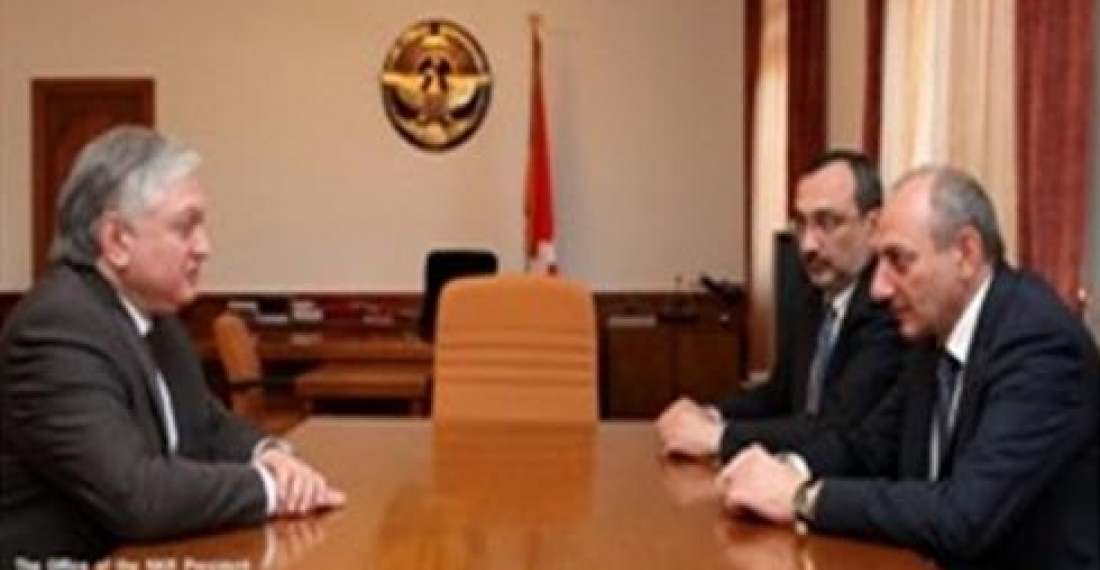
Nalbandian in Stepanakert to brief NKR leaders.

The Foreign Minister of Armenia Eduard Nalbandian was this week in Stepanakert to breif the leadership of the self declared Nagorno-Karabakh Republic about the state of play in the negotiations on the future of the territory and ancillary issues. Nalbandian met with the President and other senior officials in the territory.

Commonspace.eu political editor said that the visit and the consultations are not just a formality:

"Despite the fact that there are strong links between the political elites in Yerevan and Stepanakert, and there is also a huge dependence of the self-declared Nagorno-Karabakh Republic on Armenian financial, military and political support, the Armenian government needs to be seen keeping the Karabakh Armenian authorities fully briefed of what is going on in the negotiations. 

In these negotiations the Armenian Government has assumed the role of speaking for the Armenians living in Nagorno-Karabakh, although from time to time there have been calls for the Stepanakert authorities to be represented directly in the negotiations. Armenian officials however insist that any agreement between Armenia and Azerbaijan will always have to be subject to the approval of the Stepanakert authorities. This has always remained an ambiguous issue both publicly and within the secretive negotiations conducted in the framework of the OSCE Minsk Group. It is yet another asspect of the Karabakh peace process that has been shelved, with the danger that it will haunt any future progress in the negotiations.

For the moment however, it looks unimportant since the whole negotiating process is in any case stalled. There is a danger of an escalation of the military situation if the de facto NKR authoirities decide to open Stepanakert Airport and this would also have been on the agenda of the discussions this week. Nalbandian's visit was however primarily necessary more as a reassurance to the Armenians of Nagorno-Karabakh, and important also for domestic consumption in Armenia itself.

How to involve the Stepanakert authorities in the peace negotiations however remains a crucial issue, still to be resolved."

source: commonspace.eu

photo: Armenian Foreign Minister Eduard Nalbandian meeting the President of the self declared Nagorno-Karabakh Republic in Stepanakert on 2 May 2013.
Related articles

Editor's choice
News
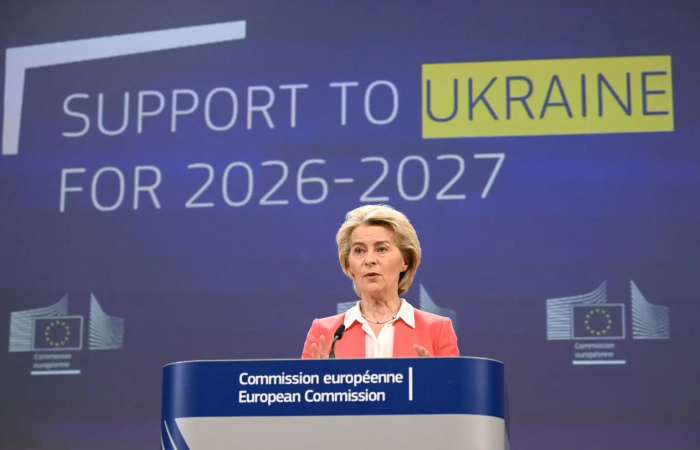
European leaders set out their plan for Ukraine

European leaders set out their plan for Ukraine

The leaders of Germany, Denmark, Finland, France, Italy, Netherlands, Norway, Poland, Sweden, and United Kingdom, together with the President of the European Council, and the President of the European Commission, o  Monday (15 December) issued a statement, outlining their plan for Ukraine. In their statement, Chancellor Merz, Prime Minister Frederiksen, President Stubb, President Macron, Prime Minister Meloni, Prime Minister Schoof, Prime Minister Støre, Prime Minister Tusk, Prime Minister Kristersson, Prime Minister Starmer, as well as President Costa and President von der Leyen spoke about "Peace for Ukraine". The Leaders welcomed significant progress on President Trump’s efforts to secure a just and lasting peace in Ukraine. They also welcomed the close work between President Zelenskyy’s and President Trump’s teams as well as European teams over the recent days and weeks. They agreed to work together with President Trump and President Zelenskyy to get to a lasting peace which preserves Ukrainian sovereignty and European security. Leaders appreciated the strong convergence between the United States, Ukraine and Europe. Leaders agreed that ensuring the security, sovereignty, and prosperity of Ukraine was integral for wider Euro-Atlantic security. They were clear that Ukraine and its people deserved a prosperous, independent, and sovereign future, free from fear of future Russian aggression. Both the US and European leaders committed to work together to provide robust security guarantees and economic recovery support measures for Ukraine in the context of an agreement on ending the war. This would include commitments to: Provide sustained and significant support to Ukraine to build its armed forces, which should remain at a peacetime level of 800,000 to be able to deter conflict and defend Ukraine’s territory. A European-led ‘multinational force Ukraine’ made up from contributions from willing nations within the framework of the Coalition of the Willing and supported by the US. It will assist in the regeneration of Ukraine’s forces, in securing Ukraine’s skies, and in supporting safer seas, including through operating inside Ukraine. (Click the image to read the statement in full).

Popular

