Our live blog on the coronavirus pandemic and its impact on the world is on every day from 1200-1600 Central European Summer Time (equivalent to 1400-1800 in Tbilisi and Dubai).
This blog is compiled by our team of journalists and researchers based in The Hague in the Netherlands and in Tbilisi, Georgia, working with partners and associates in a number of different countries. You can also follow us on twitter @commonspaceEU. We are happy to hear from you wherever you are. Please send us your comments, stories and suggestions by email to editor@commonspace.eu
This live blog has been running daily since 19 March. You can read earlier blogs here
__________________________________________________________________________________________________________________________________
Sunday, 19 April 2020
1600 CEST (18.00 Tbilisi/Dubai)
We are now pausing this blog for today. We will be back tomorrow Monday at 12 noon CEST equivalent to 14.00 hours in Tbilisi and Dubai.
Till then from our team in The Hague in the Netherlands and in Tbilisi Georgia, a good evening
Stay Safe! Stay Healthy! Stay Happy!

1555 CEST (1755 Tbilisi/Dubai)
We wish those of you who are celebrating Easter this Sunday, a very Happy Easter

_____________________________________________________________________________
1545 CEST (1745 Tbilsi/Dubai)
Our last update is from Belgium, where the capital of Europe is situated and where the number of deaths from coronavirus is now higher than those recorded in China and in Iran
This, from our colleaguy Maximiliaan van Lange
 Belgium
The Belgian Federal Public Health Service reported on Sunday (19 April) that the number of patients with Covid-19 in Intensive Care fell by 38 to 1,081 patients. In the past 24 hours, 230 deaths have been reported in Belgium as a result of Covid-19.
In Belgium, reports are sometimes communicated to the Belgian authorities with a delay, which means that the actual number of deaths may be higher, and the figures do not necessarily say anything about the last 24 hours. A total of 5,683 people died from Covid-19 in the country. The government insists it is more transparent in reporting cases and deaths in the country than others.
_______________________________________________________
1530 CEST (1730 Tbilisi/Dubai)
 Amazing, unique, Istanbul
Look at it whichever way you like, Istanbul remains one of the world's most amazing cities.
The Bosphorus, the history, the Churches, the Mosques, the Kebab shops (and these days the shoping malls) - they make it so very special. But most of all it is the people. And today Istanbul is empty as this very dramatic video by BBC shows. Istanbul without people - still beautiful, but....
watch it here
_____________________________________________________________
1500 CEST (1700 Tbilisi/Dubai)
Another update from Noman, this time from Lebanon
 Lebanon
Lebanese Health Minister, Hamad Hasan, says the country will begin mass #COVID19 testing next week with the capacity of 1500 tests per day which will include random testing.
"The results today are good, and we are proceeding according to the plan and taking great care so that there is no excessive optimism," the Minister said.
Last week, the government allocated $797 million to cover the costs of the coronavirus outbreak.
The Pandemic has worsened the country's economic, financial and social crises. Lebanon has confirmed 673 coronavirus infections, 21 deaths and 99 recoveries.
__________________________________________________________________________
1430 CEST (1630 Tbilisi /Dubai)
We now have some updates from across the South Caucasus collated by Noman Ahmed of the commonspace research team
 Azerbaijan
The Cabinet has extended the special quarantine regime until May 4. The Cabinet, however, says that as the situation becomes under control, some restrictions can be eased.
Supplies and quarantine zones are established all over the country. Social measures were also enacted to help the Labor force yesterday.
Abkhazia
De facto acting president of Abkhazia Valeriy Bganba, declared that a state of emergency with a curfew has been extended in Abkhazia until May. However, some regulations were relaxed. The authorities will allow agricultural markets to function for three days in a week starting from tomorrow.
_________________________________________________________________
1350 CEST (1550 Tbilisi/Dubai)
We now shift our attention away from the Orthodox world to another faith. Muslims around the world will later this month start the fasting in the Holy month of Ramadan. Here too we find that there are controversies in the way traditon is adapting to the current challenges.
 Saudi Arabia
's top religious body has urged Muslims around the world not to congregate for prayer during the holy month of Ramadan in order to curb the spread of coronavirus.
The Council of Senior Scholars said Muslims should "avoid gatherings, because they are the main cause of the spread of infection", the state-run Saudi Press Agency reports.
Sunni-majority Saudi Arabia has closed its mosques, including the world's holiest - the Grand Mosque in Mecca - as part of measures to try to stop people catching the virus.
 Iran
Meanwhile the Supreme Leader of Shia-ruled Iran, Ayatollah Khamenei, has said Muslims are not required to fast during Ramadan - one of its obligations - if doing so poses a threat to their health.
____________________________________________________
1330 CEST (1530 Tbilisi/Dubai)
In the ongoing controversy in Georgia about Church traditions and current social distancing restrictions, there has been considerable admiration expressed at the position of the Metropolitan Archbishop Grigol of Poti, who decided to hold Church services in his diocese without congregation. Metropolitan Grigol is considered one of the enlightened minds in the Georgian Orthodox Church. Speaking at the Easter service yesterday Metropolitan Grigol said that "Its is hard and most painful for us is when we are not with our people at this moment, but it is done because of our people and so God can bless their health. Let them accept their obedience as our blessing". All Churches in the city rang their bells at midnight to mark Easter.

_____________________________________________________________________
1315 CEST (1515 Tbilisi/Dubai)
 Russia
 is one of the countries celebrating Orthodox Easter today.
There was a special message from President Vladimir Putin to the Russian people
The president said that the situation with the novel coronavirus spread in Russia is under full control and all levels of authorities are carrying out a concerted effort, Russian President Vladimir Putin said in his televised address to Orthodox Christians on occasion of Easter.
"All levels of authorities are working rhythmically, in an organized way and responsibly. The situation is under full control," Putin emphasized.
The president highlighted that Russia has all necessary resources and reserves to protect people and support economy amid the coronavirus spread. "Yes, all measures on protecting human lives and health, supporting economy require additional and major resources and reserves. We have got them. We are using them diligently and surgically, depending on the particular situation and first of all to help people and those families, which are facing a challenging situation now," Putin said.
The Russian authorities are working proactively to combat the coronavirus, he stressed. "We are carefully analyzing other countries' experience, we are actively cooperating with our foreign friends and colleagues and understand what is going on, we see risks and we know what needs to be done in any development of the situation and we do what is necessary," Putin stated.
"Our people say: trust in God and keep your powder dry. And this is what we do. But on this bright holiday of the Resurrection of Christ, I still want to say: everything will be fine with God's help," Putin said.

You may watch President Putin's Easter address (in Russian) here
Not everyone is impressed however. Bloomberg reports that Russian citizens are stockpiling cash because of the fear of the closure of banks. Since the beginning of March, citizens have already withdrawn more than 12 billion euros in cash from banks. That is more than for the whole of 2019.
read it here
____________________________________________________________
1250 CEST (1450 Tbilisi/Dubai)
In some parts of Europe there is a sense that some kind of normality is returning, not because the lockdown restrictions are being eased - there is little sign of that yet - but because people are back to challemnging their governments on different issues.
First, a report from The Netherlands by Maximiliaan van Lange of our research team
 The Netherlands
In the Netherlands, there has been a commotion on social media over the weekend about proposals for the use of a tracking application as a means of containing the spread of covid-19. The Dutch cabinet will discuss which of seven tracking applications against Covid-19 to choose from based on a report presented to the Ministry of Health, Welfare and Sport after this weekend.
However, after publishing the source code this weekend, a data leak was immediately found in one of the seven apps in which the e-mail addresses, encrypted passwords of users, and user names were visible. The ministry is now mainly focuseing on the technological and privacy aspects of the app and there is less attention paid to the actual future number of users of the tracking application. Worldwide, some countries already use a tracking application, but not always with success.
All this while experts from the Rijksinstituut voor Volksgezondheid en Milieu (RIVM) (National Institute for Public Health and the Environment) say that the Netherlands has "passed the first bump and is now on its way to calmer waters". Remarkable about the experts' statement is the fact that the word ''exit strategy'' is not used. According to the experts, that word suggests that there is a solution, and society is heading for it. It seems that is not yet the case.
The Netherlands has reported 31,589 cases of covid-19, and 3,601 deaths
.....and this from the BBC about UK covid-19 death figures in the UK are being challenged:
 UK
New data has added to growing evidence that the number of deaths linked to coronavirus in UK care homes may be far higher than those recorded so far.
The National Care Forum (NCF) estimates that more than 4,000 elderly and disabled people have died across all residential and nursing homes.
Its report comes amid calls for accurate data on virus-linked deaths.
Only 217 such care home deaths have been officially recorded in England and Wales up to 3 April.
Separately, analysis from Care England, which represents large care home providers in England, claims that there have been 7,500 more deaths in care home - from all causes - in the last two weeks than would be expected at this time of year.
______________________________________________________
1235 CEST (1435 Tbilisi/Dubai)
 A short update now from Armenia
A total of 43 new cases of the novel coronavirus were recorded in Armenia, the National Center for Disease Control and Prevention reported this morning
Overall, 1,291 cases of the novel coronavirus have been confirmed. 20 people have died of the virus.
_____________________________________________________________________
1230 CEST (1430 Tbilisi/Dubai)
One section of the population that is more vulnerable to covid-19 is that of prisoners, and those guard them. In many countries schemes have been put in place to release some prisoners early.
But how avbout those still inside. here are a couple of updates from Noman Ahmed of our research team
 Algeria
Inmates at several Algerian prisons were mobilized to make personal protective equipment. Authorities will open sewing workshops to meet the demands of the health sector. Authorities say no confirmed cases exist among the country's 58,000 inmates.
Authorities also banned visits and subjected new inmates to 14-day self-quarantine.
Algeria has 2534 total cases with 367 deaths and 894 recoveries.

 Georgia
The Easter liight was distributed to prisoners who asked for it in Georgian prisons last night.

________________________________________________
1210 CEST (1410 Tbilisi and Dubai)
Some more updates on the Orthodox Easter around the world in the age of corona.
 Egypt
The Egyptian Coptic community celebrated Easter yesterday at home. Only Clergymen and cameramen attended at Saint Mark Coptic Orthodox Cathedral to record the LIVE proceedings. The Easter Mass was aired live on several Egyptian TV channels and was also broadcast on social media pages for the Coptic Orthodox Church. The Pope of the Copts also sent his apologies for not being able to meet with officials who wanted to wish him well.
Coptic Orthodox Christians make up the majority of the 10 million Christians in Egypt, constituting almost 10% of the population.
Egypt is also getting ready for a busy week as shopping rates are expected to rise before the start of Ramadan, the fasting month, at the end of this week.
 Ukraine
Police were deployed outside hundreds of churches in Ukraine to ensure that anyone who came to stand outside a service observed regulations calling for social distancing and banning large gatherings.
A small exception was made at the Pechersk monastery in Kyiv, where police allowed worshipers to enter the church one at a time, with the next person going inside when another left. About 100 people stood outside the monastery waiting to be let in.
The monastery, a major tourist attraction because of its extensive system of caves and catacombs, was closed under quarantine; more than 90 of its monks have been identified as infected with coronavirus and at least two have died.
The monastery belongs to the Ukrainian Orthodox Church, which is loyal to to the Russian Orthodox Church and is one of two rival Orthodox denominations denominations in Ukraine. The church's leader drew criticism after suggesting that worshipers could gather outside while services were conducted rather than staying at home.
That statement increased tensions with the Orthodox Church of Ukraine, which last year was granted autocephaly by the Ecumenical Patriarch of Constantinople, Orthodoxy's prime authority, displacing the Russia-affiliated church.
Russia
All churches in greater Moscow, St Petersburg and many Russian regions have been closed since Monday, although some churches in remote regions were expected to have services with parishoners attending. There have been 42,853 cases of coronavirus infections reported in Russia so far and 361 deaths.
 Cyprus
In Cyprus, many Orthodox faithful stood on their balconies or front porches with lighted candles as clergymen officiating midnight Easter Service in empty churches chanted "Christ is Risen." Cypriots observed Easter services from their televisions at home following a government-imposed ban on worshippers attending church services that's part of a strict stay-at-home order
_________________________________________________________________
Good day and welcome to this Live Blog on commonspace.eu
It is Sunday, 19 April 2020 - 12 midday Central European Summer Time, equivalent to 14.00 hours in Tbilisi and Dubai
Orthodox communities around the world are celebrating Easter Sunday. Traditionally the peak of the celebrations are midnight church services during which the traditional fire - usually in the form of a candle - is shared out by the clergy to the congregation. The coronavirus pandemic has created controversy in many Christian Orthodox communities as to how to keep tradition whilst observing the strict health rules imposed by governments.
We look at this issue in our live blog today, starting from Georgia where the controversy has created rifts within society and tensions within the church itself. We will of course also have updates from other parts of the South Caucasus, as well as Europe, Eurasia and the Middle East.
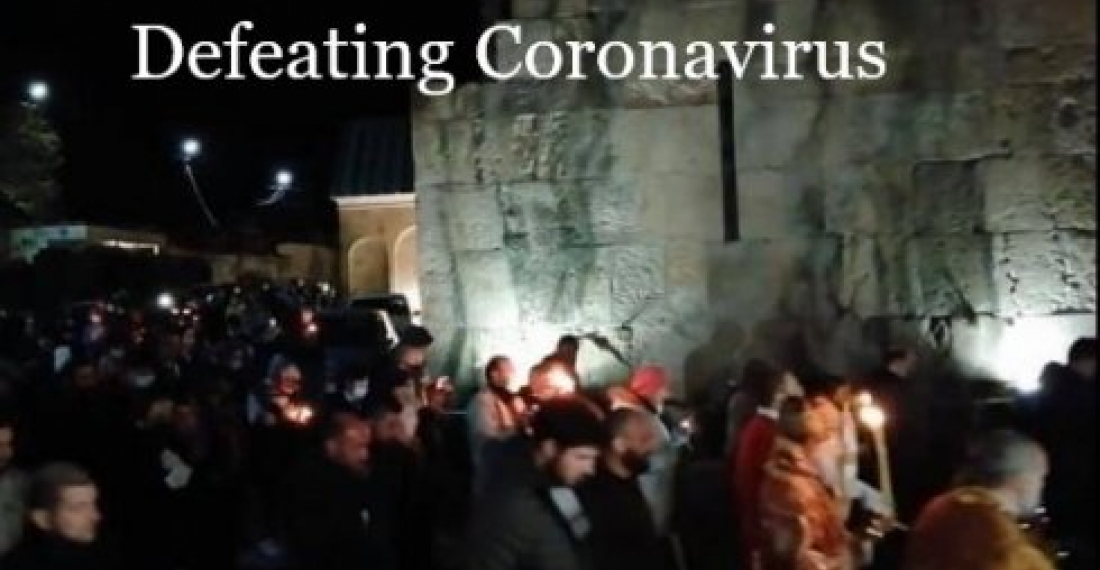
Our cover picture today is a screen grab from a scene in the Bagrat Cathedral in Kutaisi Georgia where parishoners ignored public safety rules and held the service without any social distancing. Now Georgian public health authorities have issued guidance to anyone who has attended the service to self-isolate for twelve days. In Tbilisi and in other parts of Georgia services were held with social distancing largely observed. In some dioceses, for example in Poti in Western Georgia the service was held without congregation.
(picture: screen grab from video on tabula.ge)