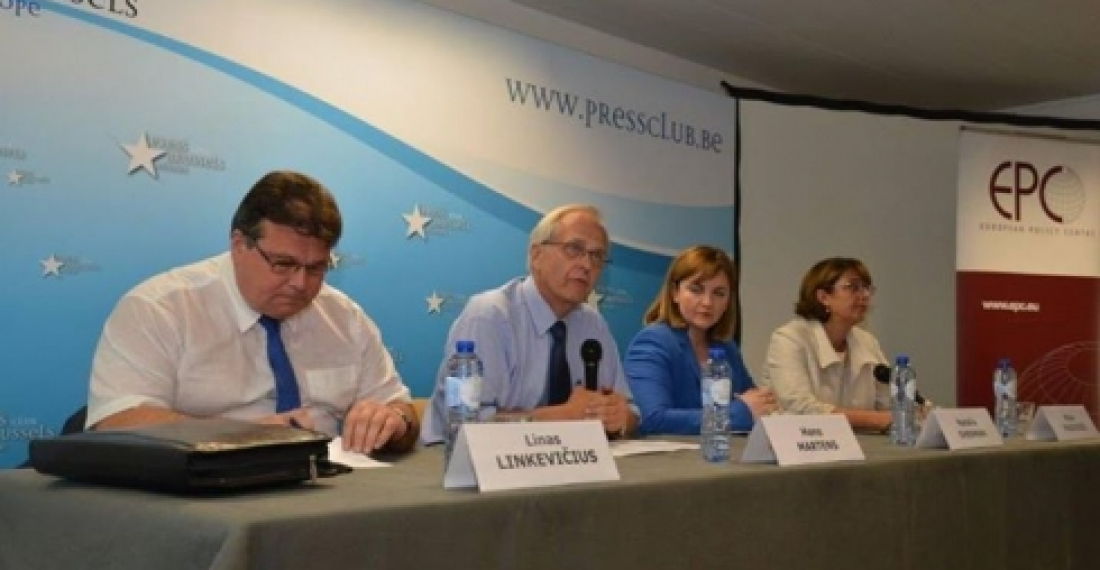
There was a wonderful moment at an event in Brussels on Monday, on the margins of the meeting of the Foreign Ministers of the European Union and the Eastern Partnership countries. The Foreign Ministers of Lithuania, (which currently holds the Presidency of the EU), Georgia and Moldova were speaking at an event organised by the European Policy Centre on progress towards the forthcoming Vilnius Summit in November. Faced with a question from the audience Lithuanian Foreign Minister Linias Linkevicius said that the European Union was not directly involved in conflict resolution processes in the South Caucasus, and could only contribute by its moral support. Promptly, the soft-spoken Georgian Foreign Minister Maia Panjikidze shyly intervened to correct Linkevicius and to remind him that the EU is deeply involved in conflict resolution in the South Caucasus. It is in fact the co-Chair of the Geneva Process dealing with the conflicts in Georgia. She was of course right.
The misperception that somehow the European Union is aloof from the process of conflict resolution in the South Caucasus is widely held in Brussels and elsewhere, and Linkevicius was simply reflecting it. Its origin is the absence of the EU from the OSCE Minsk Process that is dealing with the conflict over Nagorno-Karabakh. It is the only forum where the EU is not present, and since that particular forum is not going anywhere very fast, it does not seem that the EU is missing much.
Conflict resolution in the South Caucasus is a much bigger and wider challenge than anything currently being dealt with by the OSCE Minsk Process. The EU is as deeply involved in the process to resolve the conflicts in Georgia as could be. The resolution of the conflict between Armenia and Azerbaijan over Nagorno-Karabakh requires a much more comprehensive approach than what is being considered by the Minsk Process, although that element is also important and essential.
Now with the three countries of the South Caucasus engaged in different ways in developing their relations with the EU institutionally and through bilateral agreements the EU has become by default a key player in all the issues that affect the three countries. The absence of the European Union from the Minsk Process is the exception not the rule - an exception that becomes increasingly an anachronism - neither understandable nor acceptable. If conflict erupts in the region again, as it did in Georgia in 2008 the EU will have even less luxury to be detached than it did in that situation and everybody will be looking for its leadership and its contribution - not least in the capitals of the twenty-eight member states.
It is clear that there is now a need for the EU institutions to up their game with regards to how they manage their involvement with the conflicts in the Caucasus region but first they should stop denying the reality. The EU is deeply involved in conflict resolution in the South Caucasus and should not be shy to say it.
This is an editorial comment by Commonspace.eu.
photo: The Foreign Ministers of Lithuania, Moldova and Georgia speaking in Brussels on 22 July 2013 (picture courtesy of the European Policy Centre).