Theme

Diplomacy

Editor's choice
News
Council of Europe launches new International Claims Commission for Ukraine

Council of Europe launches new International Claims Commission for Ukraine

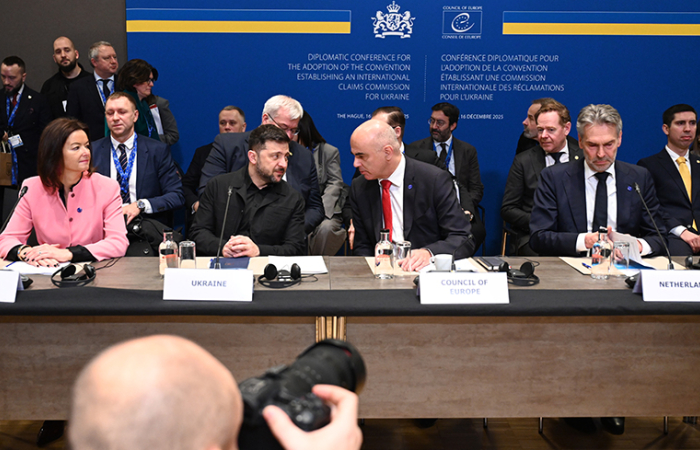
Thirty-four countries and the European Union have signed a new convention establishing an International Claims Commission for Ukraine at a diplomatic conference co-hosted by the 46-nation Council of Europe and the Netherlands in the Hague. The diplomatic conference was attended by leaders and high-level representatives from over 50 states, including the President of Ukraine, Volodymyr Zelenskyy, the President of the Republic of Moldova, Maia Sandu, and the Prime Minister of the Netherlands, Dick Schoof.  “Today marks a major step forward in ensuring accountability for Ukraine. The International Claims Commission represents justice and hope for tens of thousands of victims—our determination that those who have suffered will not be forgotten. I call for quick ratifications so we can get the commission rapidly up and running for the people of Ukraine,” said Council of Europe Secretary General Alain Berset. Ukrainian President Volodymyr Zelenskyy said: “We expect that every mechanism for compensation from the Register of Damage and Claims Commission to the actual payments – will start working and receive strong and sufficient international support, so that people can truly feel that any kind of damage caused by the war can be compensated. This war, and Russia’s responsibility for it, MUST become a clear example – so that others learn not to choose aggression.” “Accountability is about creating the conditions for peace that endures. And therefore, accountability is a condition of security – today and for the future. But accountability is not only about Ukraine. And it is not only about one aggressor and one victim. Accountability is about Europe. About every country in Europe. It is about whether Europe, as a whole, is willing to defend its peace,” said Maia Sandu, President of the Republic of Moldova, which currently holds the Presidency of the Council of Europe’s Committee of Ministers. The Prime Minister of the Netherlands, Dick Schoof, said: “Every day Russia is deliberately bombarding homes, destroying businesses and damaging infrastructure in Ukraine. Russia must compensate Ukraine for the damage caused. That is why we have launched the International Claims Commission for Ukraine and we are honoured to host it.” The International Claims Commission will be the second part of a comprehensive compensation mechanism related to Russia’s war of aggression, building on the existing Register of Damage for Ukraine. The claims commission will be established within the framework of the Council of Europe and will also be open to other countries. The Register of Damage for Ukraine, created in 2023, collects and records compensation claims submitted by individuals, organisations and public bodies in Ukraine. Forty-four states and the European Union have so far joined the Register, which has already received 86,000 claims. The International Claims Commission will review, assess and decide upon claims submitted to the Register of Damage for Ukraine and determine the amount of compensation, if any, which is due in each case. The convention establishing the commission will enter into force once it has been ratified by 25 signatories, as long as sufficient funds have been secured to support its initial work.

Filter archive

Publication date
Editor's choice
News
Progress made in talks between Turkey and NATO candidate countries Finland and Sweden

Progress made in talks between Turkey and NATO candidate countries Finland and Sweden

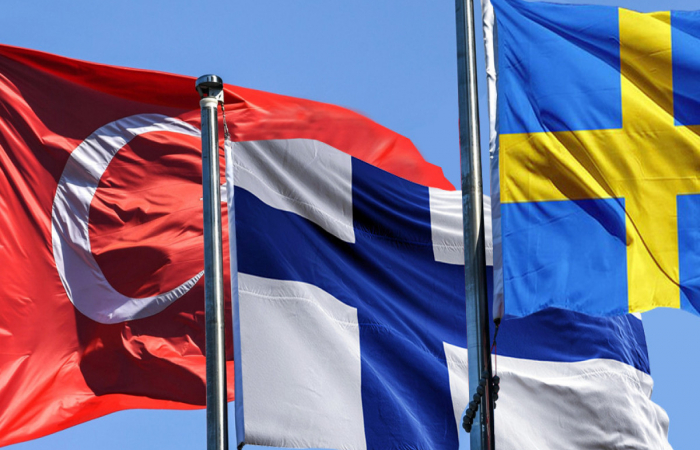
Finland and Sweden reiterated on Friday that they will cooperate with Turkey in the fight against terrorism during their first trilateral meeting since the NATO Madrid summit when the mechanism for consultation was created as part of the process leading to membership in NATO for the two previously neutral Scandinavian countries. The meeting was held in Helsinki. According to a statement from the office of Turkey's Presidential Spokesperson, Ibrahim Kalin's, Finland and Sweden reiterated their commitment to show full solidarity and cooperation with Turkey in the fight against all forms and manifestations of terrorism, pledging to fully support Turkey against all threats to its national security. “It was agreed to intensify cooperation at the technical level among the relevant institutions in order to achieve concrete progress on the issues addressed within the scope of the mechanism,” the statement added. During the meeting, the fundamentals of the permanent joint mechanism were determined while developments on the realization of the commitments in the trilateral deal were reviewed as well as concrete steps to be taken in the future.
Editor's choice
News
Diplomats confident that an agreement on the Iran nuclear deal can be reached within days

Diplomats confident that an agreement on the Iran nuclear deal can be reached within days

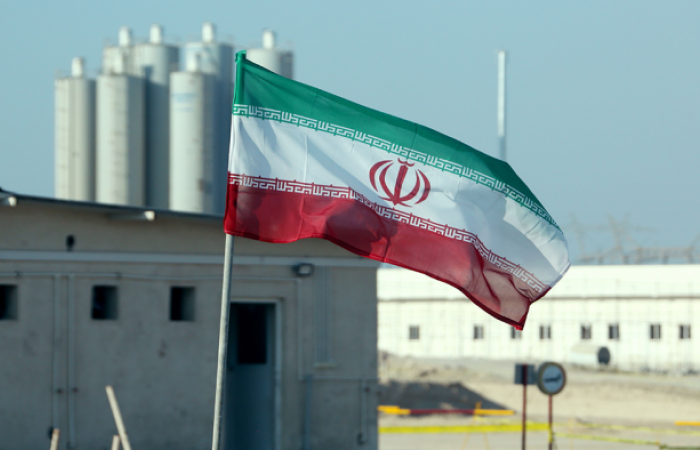
European diplomats are confident that an agreement on the Iran nuclear deal is within reach and may be achieved within days. EU High Representative for foreign and security policy, Josep Borrell said on Monday that Iran had given a “reasonable” response to the final text of a proposed new agreement, and the ball was now in the US court. Borrell suggested that a meeting to seal an agreement may take place as early as this week. Borrell said the negotiations brokered by the EU had gone as far as they could go and “this is the inflection point.” He said: “There was an Iranian response that I considered reasonable to transmit to the US. “The US has not formally replied yet. But we are waiting for their response and I hope that response will allow us to finish the negotiation — I hope so, but I can’t assure you of it.” Efforts to restore the Joint Comprehensive  Plan of Action — the 2015 agreement between world powers and Tehran aimed at curbing Iran’s nuclear program in return for the lifting of sanctions — are at a critical point after 16 months of on-off indirect talks in Vienna.  
Editor's choice
Opinion
Opinion: One step forward, two steps backward undermines the Armenia-Azerbaijan peace process

Opinion: One step forward, two steps backward undermines the Armenia-Azerbaijan peace process

"Recent developments underpinning the peace efforts are not insignificant, and were truly unimaginable a few years ago", writes Vasif Huseynov in this op-ed. Yet, the recent "series of events runs the risk of transforming the peace process into  a 'one step forward, two steps backward' ritual,  indefinitely delaying the negotiations. This  trend should be countered by all means possible. It  needs to be seriously  taken into account by the European Union  whilst exercising its efforts to bring the leaders of Armenia and Azerbaijan to  the negotiating table", he adds.
Editor's choice
News
Impasse in the dialogue between Serbia and Kosovo

Impasse in the dialogue between Serbia and Kosovo

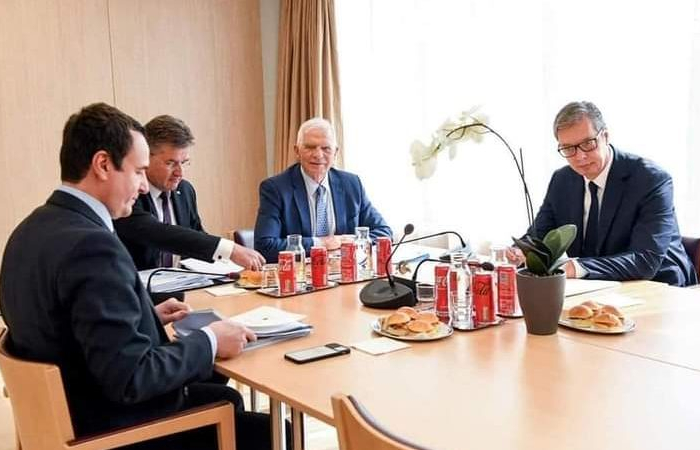
High level talks between Serbia and Kosovo, facilitated by the European Union, have failed to unblock the impasse between them.  EU High Representative Josep Borrell hosted the talks between Serbian President Aleksandar Vučić and Kosovo Prime Minister Albin Kurti in Belgrade on Thursday, 18 August. Kosovo declared independence unilaterally from Serbia in 2008, after a long period of tension with Belgrade which had already emerged during the time of Yugoslavia.  Serbia still considers Kosovo an integral part of its territory. Around a hundred countries, including most EU member states, recognise Kosovo's independence. Kosovo has a population of 1.8 million population, which is 90% ethnic Albanian. However 5% are Serbs, and it is the rights of this community that are the present stumbling block, but it is also recognised that differences are more substantial and wide-ranging. A clearly disappointed EU High Representative told the media after the event that the immediate objective of the talks had failed, but that both sides agreed to keep talking.
Editor's choice
News
The arrival of a Chinese spy ship in Sri Lanka unsettles India

The arrival of a Chinese spy ship in Sri Lanka unsettles India

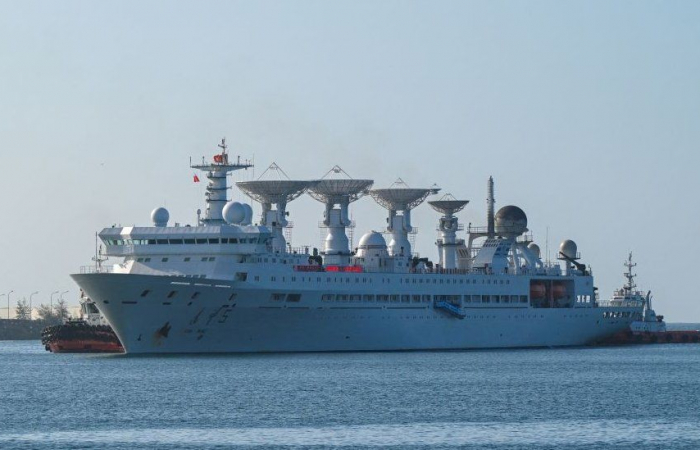
China’s satellite tracking vessel Yuan Wang 5 arrived at Sri Lanka’s southern Hambantota Port, on Tuesday (16 August) despite the concerns of both India and the United States. The vessel was earlier scheduled to dock at the Chinese managed Hambantota port on August 11 for “replenishment”, according to officials. Its arrival was postponed by five days after Sri Lankan authorities made a request to China, reportedly citing Indian security concerns. Sri Lanka's Foreign Ministry said the ship will be allowed to remain in the Chinese-run port until 22 August. Foreign security analysts quoted by Reuters describe the Yuan Wang 5 as one of China's latest generation space-tracking ships, used to monitor satellite, rocket and intercontinental ballistic missile launches. Several Indian media reports described it as a "dual-use spy ship". Shipping analytics websites call it a research and survey vessel. One report by Indian news site NDTV said the government in Delhi was concerned about "the possibility of the ship's tracking systems attempting to snoop on Indian installations while on its way to Sri Lanka". Earlier in July, an Indian foreign ministry spokesman said the government was monitoring the ship's planned visit, adding that Delhi would protect its security and economic interests.