Turkish Defence Minister pledges support to Azerbaijan in conflict with Armenia

Turkish Defence Minister, Hulusi Akar, who is currently on a visit to Azerbaijan has said that Turkey will stand with Azerbaijan in its conflict with Armenia. 

 "We stand by Azerbaijan against Armenia, which committed genocide in Khojaly in front of the whole world and occupied Nagorno-Karabakh. Azerbaijan is not alone," Akar said. The remarks were carried in a video broadcast by the Turklish Anadolu News Agency where Akar was seen reading from notes.

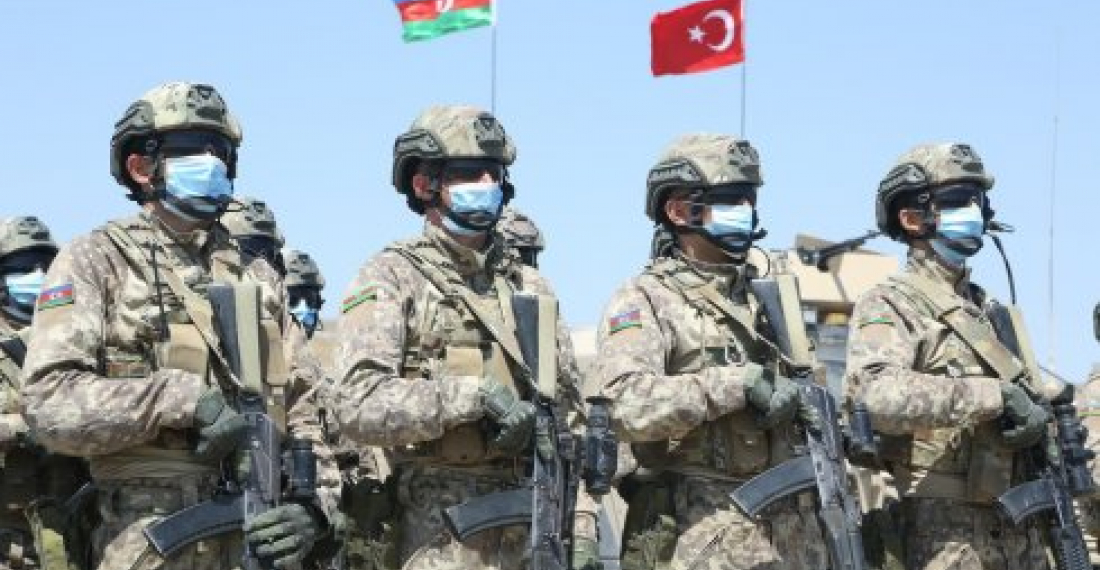
The Defence Minister arrived in Azerbaijan on Wednesday evening accompanied by senior officials of the Turkish Army, Air Force and Navy to observe the end of the first phase of military manoevres between the armies and air forces of Turkey and Azerbaijan which have been taking place in recent days.

Earlier on Thursday (13 August), the Turkish Defence Minister spoke about the significance of the military exercises.

"Azerbaijan-Turkey joint military exercises have been successfully implemented. This and subsequent exercises demonstrate to the world the common attitude of the two brotherly countries against threats and dangers.

"We once again strongly condemn the treacherous provocation committed by Armenia in the Tovuz region of Azerbaijan. We offer our condolences to the people of Azerbaijan, patience, and strength to the Armed Forces. We feel deeply the pain you are experiencing as a nation. Our strong support for Azerbaijan's rights and territorial integrity will continue as it has been so far. As Turkey, with a population of 83 million, we stand by our brothers until the end in the struggle to liberate the occupied territories of Azerbaijan," he said.

Commonspace.eu political editor siad in a comment that whilst this is not the first time that senior Turkish officials have expressed support for Azerbaijan in its dispute with Armenia over Nagorno-Karabakh, the context of these statements, the choice of words, and the emphasis being put, give them additional meaning and significance. It is clear that Turkey is now going out of its way to express its support for Azerbaijan and this at a particularly sensitive moment in the region. The statement by the Turkish Defence Minister also comes a day after Azerbaijan president Ilham Aliyev phoned Russian president Vladimir Putin to protest against Russian delivery of military supplies to Armenia, which he said had been provided since the recent border clashes in July. Aliyev claimed that 400 tons of supplies had been delivered by air via Kazakhstan and Turkmenistan airspace.

source: commonspace.eu with Anadolou News Agency, Ankara and APA, Baku.

photo: Turkish and Azerbaijani soldiers who participated in joint exercises held in August 2020 (picture courtesy of the press service of the Ministry of Defence of Azerbaijan)
Related articles

Editor's choice
News
Council of Europe launches new International Claims Commission for Ukraine

Council of Europe launches new International Claims Commission for Ukraine

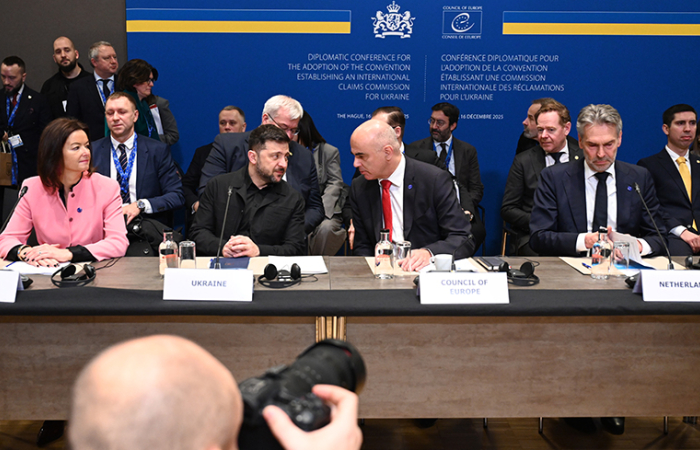
Thirty-four countries and the European Union have signed a new convention establishing an International Claims Commission for Ukraine at a diplomatic conference co-hosted by the 46-nation Council of Europe and the Netherlands in the Hague. The diplomatic conference was attended by leaders and high-level representatives from over 50 states, including the President of Ukraine, Volodymyr Zelenskyy, the President of the Republic of Moldova, Maia Sandu, and the Prime Minister of the Netherlands, Dick Schoof.  “Today marks a major step forward in ensuring accountability for Ukraine. The International Claims Commission represents justice and hope for tens of thousands of victims—our determination that those who have suffered will not be forgotten. I call for quick ratifications so we can get the commission rapidly up and running for the people of Ukraine,” said Council of Europe Secretary General Alain Berset. Ukrainian President Volodymyr Zelenskyy said: “We expect that every mechanism for compensation from the Register of Damage and Claims Commission to the actual payments – will start working and receive strong and sufficient international support, so that people can truly feel that any kind of damage caused by the war can be compensated. This war, and Russia’s responsibility for it, MUST become a clear example – so that others learn not to choose aggression.” “Accountability is about creating the conditions for peace that endures. And therefore, accountability is a condition of security – today and for the future. But accountability is not only about Ukraine. And it is not only about one aggressor and one victim. Accountability is about Europe. About every country in Europe. It is about whether Europe, as a whole, is willing to defend its peace,” said Maia Sandu, President of the Republic of Moldova, which currently holds the Presidency of the Council of Europe’s Committee of Ministers. The Prime Minister of the Netherlands, Dick Schoof, said: “Every day Russia is deliberately bombarding homes, destroying businesses and damaging infrastructure in Ukraine. Russia must compensate Ukraine for the damage caused. That is why we have launched the International Claims Commission for Ukraine and we are honoured to host it.” The International Claims Commission will be the second part of a comprehensive compensation mechanism related to Russia’s war of aggression, building on the existing Register of Damage for Ukraine. The claims commission will be established within the framework of the Council of Europe and will also be open to other countries. The Register of Damage for Ukraine, created in 2023, collects and records compensation claims submitted by individuals, organisations and public bodies in Ukraine. Forty-four states and the European Union have so far joined the Register, which has already received 86,000 claims. The International Claims Commission will review, assess and decide upon claims submitted to the Register of Damage for Ukraine and determine the amount of compensation, if any, which is due in each case. The convention establishing the commission will enter into force once it has been ratified by 25 signatories, as long as sufficient funds have been secured to support its initial work.

Popular