


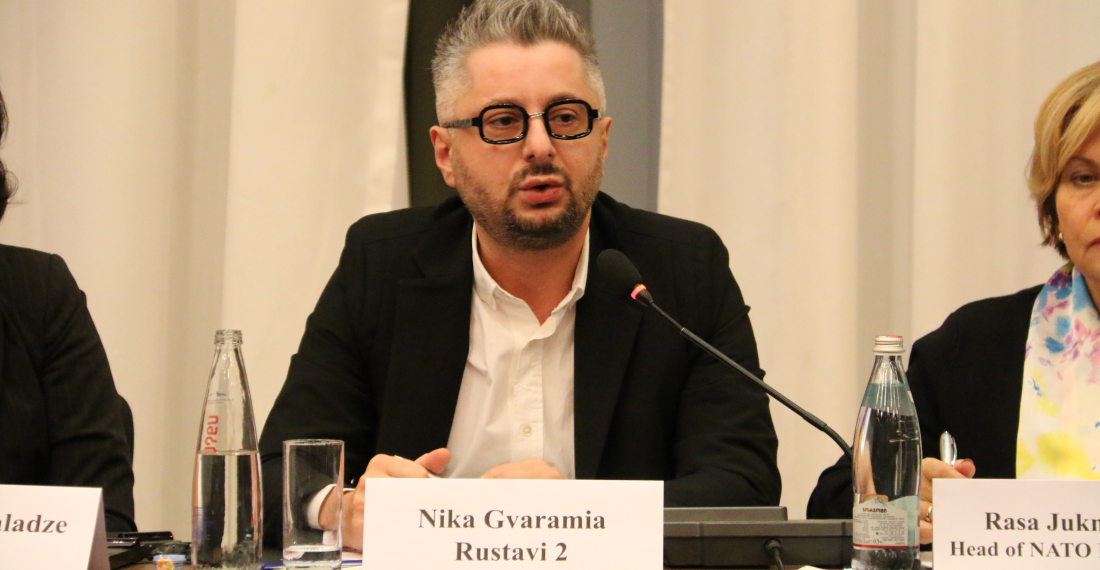
Georgian President Zourabichvili pardons Nika Gvaramia

The Georgian President Salome Zourabichvili on Thursday (22 June) pardoned Nika Gvaramia, the head of the pro-opposition TV channel Mtavari who had been convicted in a Tbilisi court for allegedly embezzling money as the director of another TV company, Rustavi 2. 

His imprisonment had widely been seen as politically motivated, with the EU and the US having previously expressed concern over his sentence. 

President Zourabichvili had recently come under increasing pressure from opposition groups and civil society to pardon Gvaramia, as she possesses the right to do so as President.

Announcing her decision on Thursday evening, President Zourabichvili declined to comment further on her reasons for issuing a pardon while also "aiming a thinly-veiled barb at those attempting to influence her", according to OC Media.

"I just want to remind you of what I also said in Brussels, that such a decision, the discretionary right of the president, is not subject to anyone’s pressure, advice, recommendation or any other type of threat […] this is the president’s decision", President Zourabichvili said.

"I made this decision after all legal steps were exhausted on 19 June, when the Supreme Court did not accept the cassation appeal. I am not going to give any explanation for this decision, because it is my discretionary right that I use today."

Pardon overturns court ruling on 19 June

Previously, on 19 June, the Supreme Court upheld the prison sentence for Nika Gvaramia. This drew a statement from the U.S. Embassy in Georgia, saying "the U.S. Embassy reiterates our deep concern about the continued imprisonment of Nika Gvaramia. The United States has raised questions and concerns regarding the case since its inception, including the timing and nature of the charges, as well as the sentence."

"Even the perception of selective or politically motivated justice puts Georgia’s European future at risk, and undermines the rule of law, constitutional protected human rights, and democracy itself."

Meanwhile, one of the 12 points on Georgia's "to-do list" from the EU in order to obtain candidate status, was to "undertake stronger efforts to guarantee a free […] media environment, notably by ensuring that criminal procedures brought against media owners fulfil the highest legal standards", believed to be a reference to the case of Nika Gvaramia.

Welcoming President Zourabichvili's decision to pardon Gvaramia, Gulnoza Said, the Committee to Protect Journalists's Program Coordinator for Europe and Central Asia said that they "are thrilled that Nika Gvaramia has been pardoned. He should never have been jailed, and his continued imprisonment stood at odds with the country’s purported commitment to press freedom."

In a statement on Twitter, Georgian Parliament Speaker Shalva Papuashvili said that Gvaramia's pardon, "does not give us much hope for solving the polarization problem: The previous two Western-brokered cases of pardon by President Zourabichvili, those concerning convicted criminals Giorgi Ugulava and Giorgi Rurua, did very little, if anything, for alleviating political polarization and mitigating the opposition’s radical ways."
source: commonspace.eu with agencies
photo: OCSE

Related articles

Editor's choice
News
Borrell tells the European Parliament that the situation in Afghanistan was critical, but the EU will remain engaged

Borrell tells the European Parliament that the situation in Afghanistan was critical, but the EU will remain engaged

Borrell underlined that the European Union will make every effort to support the peace process and to remain a committed partner to the Afghan people. "Of course, we will have to take into account the evolving situation, but disengagement is not an option.  We are clear on that: there is no alternative to a negotiated political settlement, through inclusive peace talks.
Editor's choice
News
NATO Chief says war is on Europe's doorstep, and warns against complacency

NATO Chief says war is on Europe's doorstep, and warns against complacency

Russia could attack a Nato country within the next five years, the Secretary General of NATO, Mark Rutte, said in a stark new warning. "Nato's own defences can hold for now," Rutte warned in Berlin, but conflict was "next door" to Europe and he feared "too many are quietly complacent, and too many don't feel the urgency, too many believe that time is on our side. "Russia is already escalating its covert campaign against our societies," Rutte said in a speech in Germany. "We must be prepared for the scale of war our grandparents or great-grandparents endured." Earlier this month, Russia's President Vladimir Putin said his country was not planning to go to war with Europe, but it was ready "right now" if Europe wanted to - or started a war. But similar reassurances were given by Moscow in 2022, just before 200,000 Russian troops crossed the border and invaded Ukraine. Putin has accused European countries of hindering US efforts to bring peace in Ukraine - a reference to the role Ukraine's European allies have recently played in trying to change a US peace plan to end the war, whose initial draft was seen as favouring Russia. But Putin was not sincere, Nato's secretary-general said in the German capital, Berlin. Supporting Ukraine, he added, was a guarantee for European security. "Just imagine if Putin got his way; Ukraine under the boot of Russian occupation, his forces pressing against a longer border with Nato, and the significantly increased risk of an armed attack against us." Russia's economy has been on a war footing for more than three years now - its factories churn out ever more supplies of drones, missiles and artillery shells. According to a recent report by the Kiel Institute for the World Economy, Russia has been producing each month around 150 tanks, 550 infantry fighting vehicles, 120 Lancet drones and more than 50 artillery pieces. The UK, and most of its Western allies, are simply not anywhere near this point. Analysts say it would take years for Western Europe's factories to come close to matching Russia's mass-production of weapons. "Allied defence spending and production must rise rapidly, our armed forces must have what they need to keep us safe," the Nato chief said.

Popular

Editor's choice
News
NATO Chief says war is on Europe's doorstep, and warns against complacency

NATO Chief says war is on Europe's doorstep, and warns against complacency

Russia could attack a Nato country within the next five years, the Secretary General of NATO, Mark Rutte, said in a stark new warning. "Nato's own defences can hold for now," Rutte warned in Berlin, but conflict was "next door" to Europe and he feared "too many are quietly complacent, and too many don't feel the urgency, too many believe that time is on our side. "Russia is already escalating its covert campaign against our societies," Rutte said in a speech in Germany. "We must be prepared for the scale of war our grandparents or great-grandparents endured." Earlier this month, Russia's President Vladimir Putin said his country was not planning to go to war with Europe, but it was ready "right now" if Europe wanted to - or started a war. But similar reassurances were given by Moscow in 2022, just before 200,000 Russian troops crossed the border and invaded Ukraine. Putin has accused European countries of hindering US efforts to bring peace in Ukraine - a reference to the role Ukraine's European allies have recently played in trying to change a US peace plan to end the war, whose initial draft was seen as favouring Russia. But Putin was not sincere, Nato's secretary-general said in the German capital, Berlin. Supporting Ukraine, he added, was a guarantee for European security. "Just imagine if Putin got his way; Ukraine under the boot of Russian occupation, his forces pressing against a longer border with Nato, and the significantly increased risk of an armed attack against us." Russia's economy has been on a war footing for more than three years now - its factories churn out ever more supplies of drones, missiles and artillery shells. According to a recent report by the Kiel Institute for the World Economy, Russia has been producing each month around 150 tanks, 550 infantry fighting vehicles, 120 Lancet drones and more than 50 artillery pieces. The UK, and most of its Western allies, are simply not anywhere near this point. Analysts say it would take years for Western Europe's factories to come close to matching Russia's mass-production of weapons. "Allied defence spending and production must rise rapidly, our armed forces must have what they need to keep us safe," the Nato chief said.

