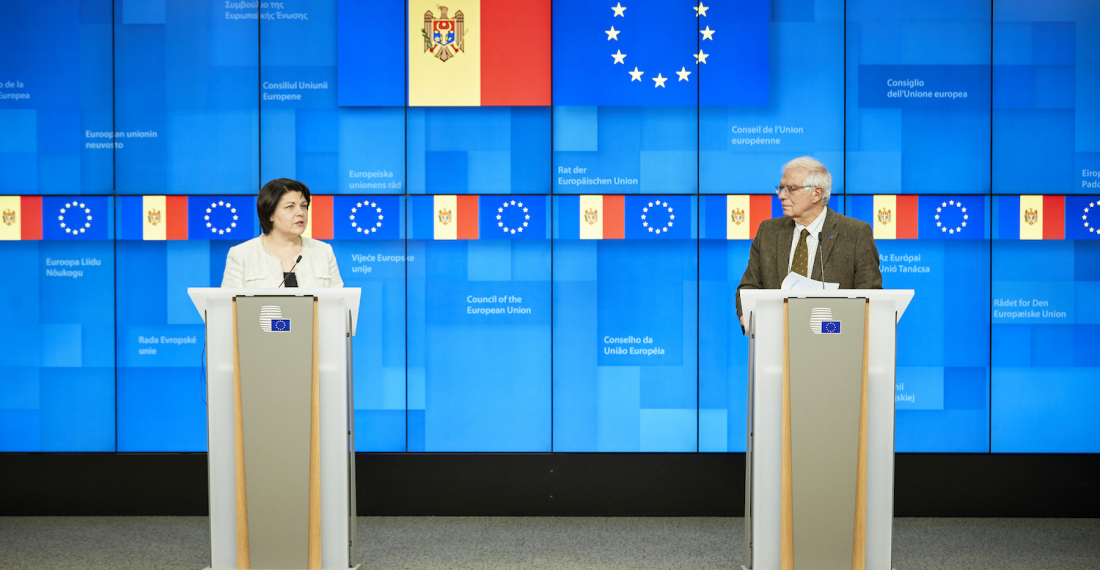
EU High Representative Josep Borrell said in Brussels on Thursday (28 October) that in Moldova the EU sees attempts by Gazprom to put political pressure in return to lower the gas prices. He said he had agreed with the Moldovan prime minister on the importance of strengthening resilience against any potential efforts by third parties to use energy as a geopolitical weapon. "Gas is a commodity. It has been bought and sold, sold and bought but it cannot be used as a geopolitical weapon", Borrell stated.
Borrell was speaking after meeting with Moldovan Prime Minister Natalia Gavrilița in Brussels where both were attending the EU-Moldova Association Council.
Borrell added,
The European Union stands ready to support Moldova to find a way out of this crisis and as an example, a first example, a first step of our support is the announcement done by the President of the Commission [Ursula von der Leyen] of a €60 million budget support programmes announced yesterday. It will enable Moldovan authorities to set up a support scheme for the most vulnerable people affected by this crisis ahead of the winter.
The second issue that we have been talking about, is reforms. We have assessed the overall progress in this regard. The clear results of the elections gave to you, Madame Prime Minister, a strong mandate to your Government to implement an ambitious anti-corruption agenda, to improve the justice system and fight poverty in line with the obligations under our Association Agreement.
I want to stress the importance of this comprehensive reform of the justice sector and welcome the first steps already taken by your Government. Here quality is more important than speed and it is always recommended to seek expertise from local as well as recognised international partners in order to rebuild trust in the justice systems.
Third, foreign and security affairs. In the presence of the Deputy Prime Minister and Minister of Foreign Affairs and European Integration, Mr Popescu, we agreed to launch a high-level political and security dialogue early next year, to have a forum for more in-depth discussion on security, on regional cooperation, as well as cooperation in the area of Common Security and Defence Policy. And the time is especially appropriate for launching such an initiative.
And fourth and last, is the issue of Transnistria. We reaffirmed our commitment to facilitate a comprehensive, peaceful and sustainable settlement process on the basis of respect for the territorial integrity and sovereignty of the Republic of Moldova, within its internationally recognised borders, with a special status for Transnistria.
All in all, I am happy to state that today’s positive and forward-looking discussions have set a good basis for our work together. It will be reflected in our updated Association Agenda. These ambitious targets will guide our work and assistance for the next seven years. I am looking forward for the conclusion of these negotiations soon.