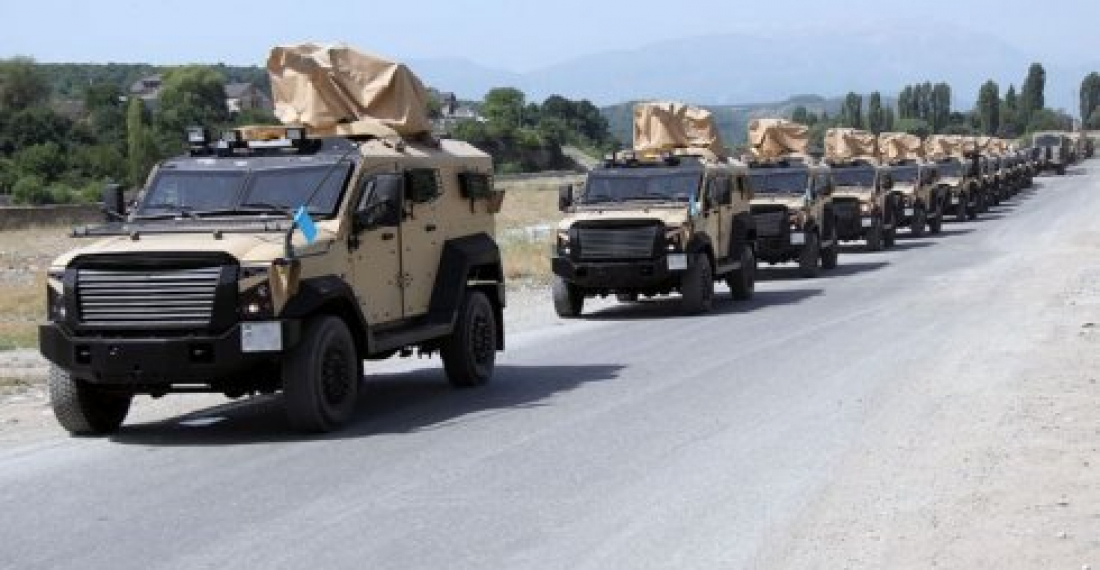
Azerbaijan has launched large-scale, cross-branch military exercises that are set to continue until Friday.
According to a press release by the Azerbaijani Ministry of Defence, the exercises will involve "up to 20,000 military personnel, up to 120 tanks and other armoured vehicles, more than 200 rocket and artillery pieces of different calibres, multiple launch rocket systems and mortars, up to 30 army [units] and front-line aviation".
There has been concern expressed in Armenia about the exercises. News.am reported that the spokesperson of the Ministry of Foreign Affairs of Armenia, Tigran Balayan, stated that the exercises are in violation of the OSCE's Vienna Document. Part 5 of the document on confidence and security-building measures obliges Azerbaijan to report the intention of any military exercises 42 days before the fact, which Balayan argues was not done. Balayan further stressed, "The Armenian side consistently raises - at the OSCE platform - the problem of Azerbaijan's violation of the arms control regimen and of the OSCE confidence and security enhancement measures, stressing that such irresponsible steps threaten the security and peace of the OSCE region".
Azerbaijan dismisses these claims and says that Armenia is illegally occupying its territory, and furthermore, it fails to report its troop deployments on these occupied territories on the pretext that they fall under the jurisdiction of the self-declared Nagorno-Karabakh Republic, which is unrecognised and not a signatory to the international arms control agreements.
This week's exercises directly follow after a skirmish between the two sides in Nakhchivan over the weekend. Armenia claims to have destroyed an Azerbaijani post when it detected engineering works being done in the area
Artsrun Hovhannisyan, spokesperson for the Armenian Defence Ministry claimed on his Facebook page that the projects were intended to strengthen Azerbaijani military positions near to the border and that the Armenian troops successfully destroyed one of the structures. One Armenian contract serviceman was reported as being slightly wounded in the clash. According to News.am Tigran Balayan stated that his Ministry had informed the Collective Security Treaty Organisation (CSTO) of the incidents. CSTO is a Russia led military alliance, of which Armenia is a member but Azerbaijan not.
According to panorama.am, on the 2nd of July, the Armenian Chief of the General Staff told the media that there "is no immediate threat of war" and that Armenia forces "are fully in control of the situation in the Nakhchivan direction". He added that they were "closely [following] the exercises and are ready for any development of the situation," also admitting, "We proceed from the fact that a war may start at any time".
Regarding this weekend's encounter in Nakhchivan, the Azerbaijani news media has reported nothing specific other than general accusations of Armenian breaks to the ceasefire. However, on Tuesday (3 July) the Azerbaijani Ministry of Defence reported the start of tactical military exercises in Nakhchivan. It was not clear if these formed part of the larger exercises reported earlier.
source: commonspace.eu
photo: Units of the Azerbaijani Army deploy ahead of large scale military exercises that started on 2 July (picture courtesy of APA, Baku)