


“Accountability is the soil in which peace can take root” – Pier Antonio Panzeri

At a landmark international event in Doha, the Chairman of the European Parliament's Sub Committee on Human Rights makes a passionate plea for a renewed sense of vigour and unity to guide the fight against impunity.

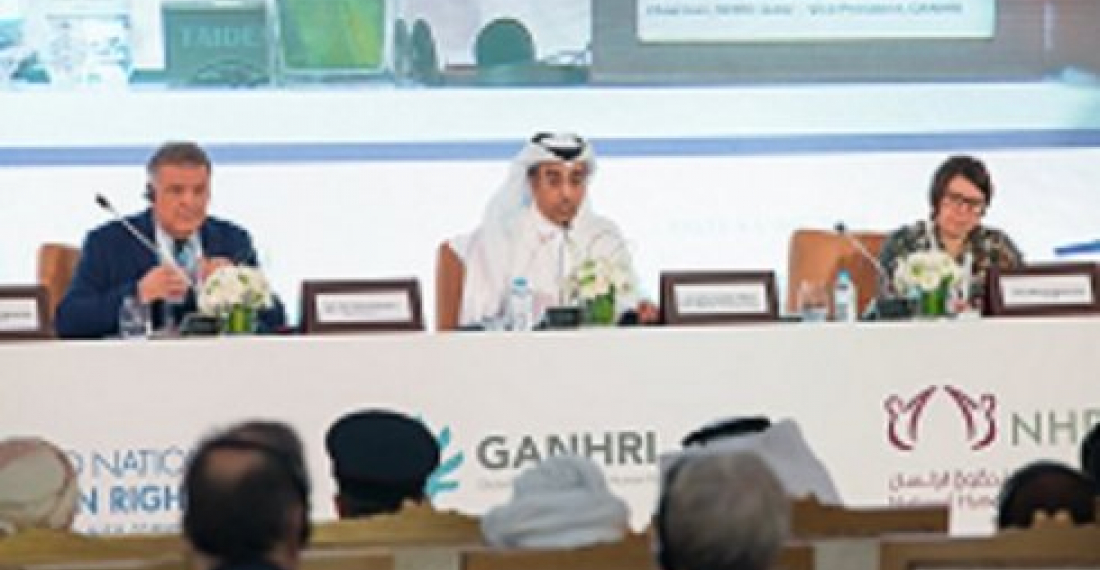
The conference "National, Regional and international mechanisms to combat impunity and ensure accountability under international law" opened in Doha on Sunday (14 April) with the participation of more than two hundred legal experts, practitioners, NGO activists and representatives of think tanks from all over the world. The Conference is organised by the Qatari National Human Rights Committee, the European Parliament, the Office of the UN High Commissioner for Human Rights, and the Global Alliance of National Human Rights Institutions.

Speaking at the opening session of the conference, Pier Antonio Panzeri, Chairman of the European Parliament's Sub Committee on Human Rights said that if the world is to continue tackling the problem of impunity for serious human rights violations it is not only essential to strongly support mechanisms designed to ensure accountability, but also to use the moment as an occasion to take stock of, and promote, the positive contributions that accountability can deliver on a societal level.

"Accountability is the soil in which peace can take root. We would do well to remember that the European Union itself is above all a peace project on an international scale, founded on core values of rule of law, democracy and human rights", Panzeri said. The speaker added that "Accountability can sow the seeds for reconciliation". He hailed the example of the truth and reconciliation Commission in South Africa. That experience "has also thought us key lessons about how societal, cultural and religious peculiarities of any one society will have impacts on the ways in which accountability is achieved. In the same spirit of compromise we must avoid a one size fits all model, whilst recognising the benefits of learning from examples where accountability has, if only partially, contributed to reconciliation", Panzeri added.

Panzeri hailed the work of the International Criminal Court, and of ad hoc International tribunals. "The greatest contribution of international justice in promoting rule of law has been to create awareness of international crimes that are a stain on the conscience of humanity, and by such lead increasingly to their prevention". Panzeri concluded by calling "for a renewed sense of vigour and unity to guide the fight against impunity in these worrying times for humanity".

The conference also heard a video message from the UN High Commissioner for Human Rights, Michelle Bachelet, who said that "societies that undergo conflicts or face authoritarian regimes must have their grievances addressed".

The conference was opened by the President of the Qatari National Human Rights Committee, Dr Ali Bin Samikh al Marri who said that it reflected the firm commitment of the Qatari Government to establish a human rights system that ensures redress for victims wherever they may be.

Among those attending the conference on Sunday was the prime minister of Qatar, Sheikh Abdulla bin Nasser bin Khalifa al Thani.

source: commonsapce.eu

photo 1: Dr Ali Bin Samikh al Marri and Mr Pier Antonio Ja Panzeri MEP

photo 2: Opening of the conference "National, Regional and international mechanisms to combat impunity and ensure accountability under international law" in Doha on Sunday (14 April)  (picture courtesy of Al Sharq newspaper, Doha).



Related articles

Editor's choice
News
Russia adds pressure on Armenia ahead of key elections; recalls Ambassador in Yerevan for consultations

Russia adds pressure on Armenia ahead of key elections; recalls Ambassador in Yerevan for consultations

Ahead of key parliamentary elections,scheduled to be held in Armenia on Sunday, 7 June, Russia continues to attempt to put pressure on the Armenian Government led by prime minister Nikol Pashinyan. On 30 May, Russia recalled its Ambassador to Yerevan for consultations. A terse statement, published on the website of the Russian Foreign Ministry, said, "The Ambassador of the Russian Federation to the Republic of Armenia , S.P. Kopyrkin, has been summoned to Moscow for consultations in connection with the steps taken by the Armenian leadership to move closer to the European Union, which are detrimental to cooperation within the EAEU." This followed a statement issued the day before, by the leaders of the Eurasian Economic Union (EAEU) that challenges the Armenian trajectory towards approximating to the European Union. Vladimir Putin is undertood to have personally pushed the other four EAEU leaders to issue the statement, which said: "Taking into account the significant risks to the economic security of the member states of the Eurasian Economic Union (hereinafter referred to as the Union) arising in connection with the preparation of the Republic of Armenia for accession to the European Union, as well as the need to prevent the associated damage to the member states of the Union: decided that the members of the Eurasian Intergovernmental Council from the Republic of Belarus, the Republic of Kazakhstan, the Kyrgyz Republic and the Russian Federation will report at the next meeting of the Supreme Eurasian Economic Council in December 2026 on the possible consequences of the suspension of the Treaty on the Eurasian Economic Union with respect to the Republic of Armenia. We share the position on the need to hold a national referendum in the Republic of Armenia as soon as possible on joining the European Union or continuing to be part of the Eurasian Economic Union."
Editor's choice
News
The leaders of the states of the Eurasian Economic Union issued a tough statement warning fellow-member state Armenia of the consequences of its desire to join the European Union.

The leaders of the states of the Eurasian Economic Union issued a tough statement warning fellow-member state Armenia of the consequences of its desire to join the European Union.

The leaders of the states of the Eurasian Economic Union (EEAS) issued a tough statement warning fellow-member state Armenia of the consequences of its desire to join the European Union. The stark, sharply worded,  warning, comes days before crucial parliamentary elections in Armenia, scheduled for 7 June. The full statement said, “We, the Presidents of the Republic of Belarus, the Republic of Kazakhstan, the Kyrgyz Republic and the Russian Federation, Taking into account the actions of the Republic of Armenia aimed at joining the European Union, including the approval in 2025 by the National Assembly of the Republic of Armenia and the signing by the President of the Republic of Armenia of the Law of the Republic of Armenia "On the Start of the Process of Accession of the Republic of Armenia to the European Union", as well as the confirmation by the European Union of the European aspirations of the Government of the Republic of Armenia, expressed in the joint declaration following the first Armenia-European Union summit, adopted on 5 May 2026, Taking into account the significant risks to the economic security of the member states of the Eurasian Economic Union (hereinafter referred to as the Union) arising in connection with the preparation of the Republic of Armenia for accession to the European Union, as well as the need to prevent the associated damage to the member states of the Union: decided that the members of the Eurasian Intergovernmental Council from the Republic of Belarus, the Republic of Kazakhstan, the Kyrgyz Republic and the Russian Federation will report at the next meeting of the Supreme Eurasian Economic Council in December 2026 on the possible consequences of the suspension of the Treaty on the Eurasian Economic Union with respect to the Republic of Armenia. We share the position on the need to hold a national referendum in the Republic of Armenia as soon as possible on joining the European Union or continuing to be part of the Eurasian Economic Union. Astana, May 29, 2026” A meeting of the Supreme Eurasian Economic Council was held in Astana, Kazakhstan, on May 29, 2026. The meeting of the Supreme Eurasian Economic Council in a restricted format was attended by Russian President Vladimir Putin, Belarusian President Alexander Lukashenko , Kazakh President Kassym-Jomart Tokayev , Kyrgyz President Sadyr Japarov , Armenian Deputy Prime Minister Mher Grigoryan, and Chairman of the Board of the Eurasian Economic Commission Bakytzhan Sagintayev. From the Russian side, the meeting was also attended by Deputy Prime Minister and member of the Council of the Eurasian Economic Commission Alexey Overchuk and Presidential Aide Yury Ushakov . The heads of delegations from EAEU observer states, including President of Uzbekistan Shavkat Mirziyoyev , Vice President of Cuba Salvador Valdés Mesa, Minister of Industry, Mines, and Trade of Iran Mohammad Atabak, and CIS Secretary General Sergei Lebedev, joined the expanded meeting . Following the meeting of the Supreme Eurasian Economic Council, a number of documents were signed .

Popular

Editor's choice
Interview
Thursday Interview: Murad Muradov

Thursday Interview: Murad Muradov

Today, commonspace.eu starts a new regular weekly series. THURSDAY INTERVIEW, conducted by Lauri Nikulainen, will host  persons who are thinkers, opinion shapers, and implementors in their countries and spheres. We start the series with an interview with Murad Muradov, a leading person in Azerbaijan's think tank community. He is also the first co-chair of the Action Committee for a new Armenian-Azerbaijani Dialogue. Last September he made history by being the first Azerbaijani civil society activist to visit Armenia after the 44 day war, and the start of the peace process. Speaking about this visit Murad Muradov said: "My experience was largely positive. My negative expectations luckily didn’t play out. The discussions were respectful, the panel format bringing together experts from Armenia, Azerbaijan, and Turkey was particularly valuable during the NATO Rose-Roth Seminar in Yerevan, and media coverage, while varied in tone, remained largely constructive. Some media outlets though attempted to represent me as more of a government mouthpiece than an independent expert, which was totally misleading.  Overall, I see these initiatives as important steps in rebuilding trust and normalising professional engagement. The fact that soon a larger Azerbaijani civil society visits to Armenia followed, reinforces the sense that this process is moving in the right direction." (click the image to read the interview in full)


