


ARMENIA AND THE EU MAKE PROGRESS AT ASSOCIATION AGREEMENT NEGOTIATIONS

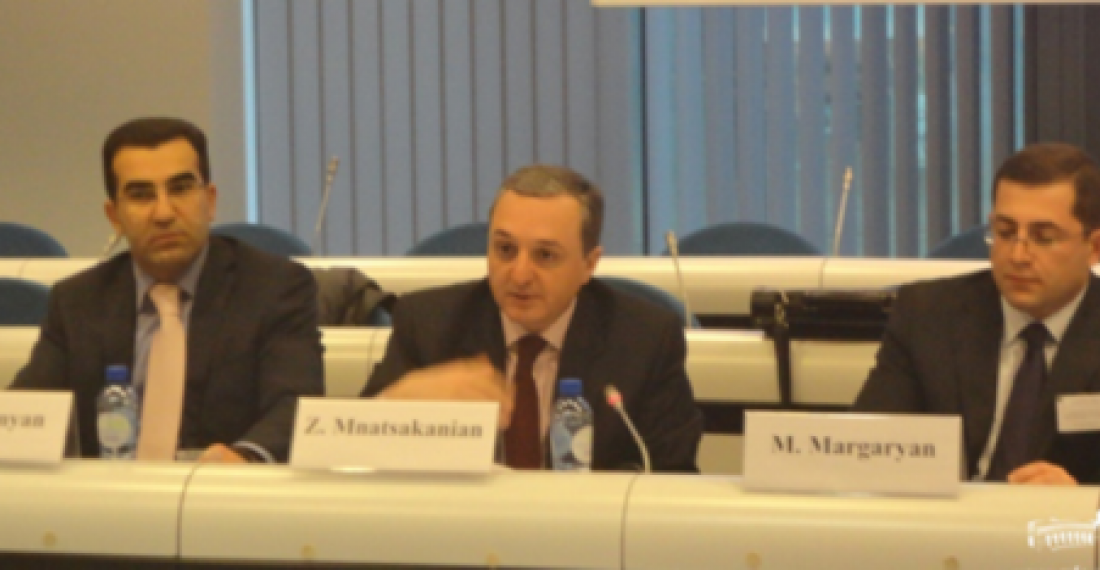
Armenia and the European Union have made progress in the negotiations of an Association Agreement that would considerably upgrade the relations between the South Cucasus country and the European Bloc. The eighth round of negotiations on the Association Agreement was held in Brussels on January 25-26. The Armenian delegation was headed by Deputy Foreign Minister, Chief Negotiator Zohrab Mnatsakanyan and the European Union Delegation was headed by Director for Eastern Europe of the European External Action Service, Gunnar Wiegand.

According to a statement of the Armenian Foreign Ministry posted on its website, "the negotiations resulted in substantial progress in terms of the main goals and principles of the future Agreement as well as on political dialogue, foreign and security policy, and cooperation in the sphere of justice". 22 chapters of the future Agreement concerning cooperation in the economic and financial spheres are already discussed and temporarily closed. The sides expressed the confidence that during the next plenary session, it will be possible to start negotiations on the chapters of the agreement concerning the establishment of a comprehensive free trade area.

During the negotiations, the sides also reached agreement to start negotiations on the visa regime facilitation for Armenian citizens in late February. The next round of negotiations is scheduled to be held in Yerevan in late March.

Armenia has recently been giving particular attention to its relations with the European Union. Prime Minister Tigran Sargsyan visited Brussels on three ocassions last year for negotiations with EU officials. The EU is seeking to sign Association Agreements with all the three South Caucasus countries, and sees this as the next step in the development of its relations with the region


source: commonspace.eu with the Press Service of the Armenian Foreign Ministry

Photo: The Armenian Delegation at the 8th round of the negotiations of an Association Agreement with the EU in Brussels on 25-26 January 2012 (Picture courtesy of the Armenian MFA/Mediamax)


Related articles

Editor's choice
News
Situation in South Yemen strains relations between Saudi Arabia and UAE

Situation in South Yemen strains relations between Saudi Arabia and UAE

The relations between Saudi Arabia and the United Arab Emirates (UAE) are increasingly strained as a result of the different approach of the two countries towards Yemen. Whilst both countries were initially together in resisting the Houthi take over in Yemen, the UAE subsequently focused on the South of the country, backing the Southern Movement (STC), which seeks to restore the independence of South Yemen. South Yemen became an independent country in 1967, at the end of British rule, and only unified with the north in 1990. The Saudi-led “Coalition to Support Legitimacy in Yemen” on Tuesday, 30 December, said it conducted a “limited” airstrike targeting two ships “that smuggled weapons and other military hardware into Mukalla in southern Yemen”. The ships originated in the UAE port of Furjeirah. In a statement carried by the Saudi Press Agency (SPA), the Coalition Forces spokesman, Major General Turki Al-Maliki, said that two ships coming from the port of Fujairah in the United Arab Emirates entered the Port of Mukalla in Hadramaut without obtaining official permits from the Joint Forces Command of the Coalition. He stressed the Coalition's "continued commitment to de-escalation and enforcing calm in the governorates of Hadramawt and Al-Mahra, and to prevent any military support from any country to any Yemeni faction without coordination with the legitimate Yemeni government and the Coalition. The Southern Transitional Council (STC), launched a sweeping military campaign early in December, seizing the governorates of Hadramaut along the Saudi border and the eastern governorate of Al-Mahra in Yemen’s border with Oman. The UAE-backed STC forces captured the city of Seiyun, including its international airport and the presidential palace. They also took control of the strategic PetroMasila oilfields, which account for a massive portion of Yemen’s remaining oil wealth. (click the image to read the article in full).

Popular

