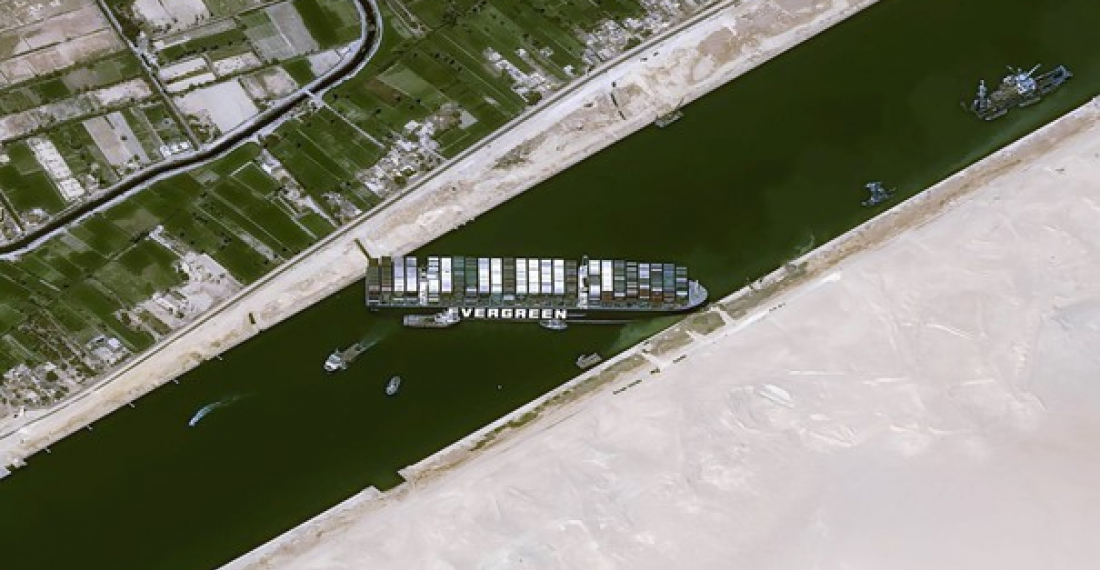
The recent blockage of the Suez Canal by the 400-metre-long 'Ever Given' container ship exposed the vulnerability of global trade routes. It reopened the debate about alternative routes, including the opening of the Northern Sea Route via northern Russia, and the Northwest Passage via northern Canada. These routes, however, are not without their problems. Maximiliaan van Lange analyses the background and current thinking in this article for commonspace.eu.
The Suez Canal has connected the Mediterranean Sea to the Red Sea since 1869 and the narrow 193-kilometre passage has become an essential route for container ships sailing from Asia to Europe and vice versa.
In light of the ongoing blockage, container ships that would normally sail via the Canal – which has a width of only 59 metres in some places, and where on many of its segments traffic is one-way – have started opting for the longer and more expensive detours via the Panama Canal or the Cape of Good Hope. In reaction to this situation, Russian officials have been pleading since Friday (26 March) for more development and investment in the Northern Sea Route along the Siberian coast. Last week, the Russian nuclear agency Rosatom promoted the Northern Sea Route as an alternative to traditional sea routes in the light of the very serious current situation in the Suez Canal.
The 'Ever Given' has prevented any maritime movement through that strategic bottleneck since it ran aground on 23 March. Among investors, this blockage is causing fears of rising oil prices, and there is also concern among European industry - dependent on timely deliveries of spare parts produced in Asia. According to a rough estimate by the British shipping daily ‘Lloyd's List’, more than eight billion euros worth of goods pass through the Suez Canal every day. For Egypt, the pressure is also high because a lot is at stake – it annually collects 4.8 billion euros in tolls for the passage. In other words, 13 million euros a day.
As rescue ships and salvage specialists work day and night to unblock the canal, beyond the blockage itself experts warn of the domino effect of the backlog of container ships all waiting to dock at the same time in the same ports after the rescue operation is completed. This has turned on its head the usual tight planning of the global trade network.
In a world where tight schedules mean the difference between profit and loss, the Northern Sea Route and Northwest Passage can offer attractive alternatives to the Suez Canal. After all, for corporations, tight schedules are an essential point in the lifeline of world trade. A much shorter Arctic sea route from Europe to Asian ports is interesting for businesses if a decent speed can be achieved in winter and new sailing schedules can be relied upon.
However, due to new safety risks and rising costs, Arctic shipping is still a riskier and more expensive venture for companies due to the lack of advanced ships needed for the routes, new insurance costs, and the cost of icebreaker escorts Furthermore, most container ships follow the shuttle model, whereby ships stop at ports between their origin and destination to make deliveries. This logistics chain requires markets, which of course do not exist in the middle of the Arctic Ocean.
Of the most significant passages through the Arctic Ocean, the Northern Sea Route – the route closest to the Russian border from the Kara Sea, across Siberia, to the Bering Strait – is likely to be the first feasible alternative for container ships. The entire route lies within Russia's exclusive economic zone (EEZ). The opening of the route could significantly reduce transport costs. According to studies, the shipping route is about 40% shorter from China to European ports than the Suez Canal. Arctic states should therefore invest more rapidly and in a more targeted way in shipbuilding research and design and in research on infrastructure development in the region. Arctic states are not the only investors in the region as China also values the geostrategic potential of the Arctic. After all, with a rapidly melting Arctic, the window of opportunity for container ships north of Russia is widening year by year.
As climate change accelerates and the Arctic Ocean shifts from year-round to purely seasonal ice cover, a transpolar passage will open up by the mid-21st century, if not sooner. Despite this development, few states are preparing for this reality, except China and Russia. The stumbling point is the complex legal frameworks that cover the Arctic – an overlap between international law and treaties and national and local legislation.
This complexity creates obstacles for business enterprises in the shipping and energy sectors. States surrounding the Arctic have to consider each other's geographical and economic interests in the region. For example, Russian President Vladimir Putin has long been promoting the sea route along the Siberian coast as a rival to the Suez Canal. For Russia, the sea route is the key to industrial development in northernmost Siberia. As a result, shipping is assumed to play a significant role in the country's future economy.
While the Arctic has traditionally been characterised by co-operation and low tension between superpowers, this has changed in recent years. A report published this year by the US Congressional Research Service (CRS) notes that while there is still significant co-operation in the region, the Arctic is increasingly seen as an area of geopolitical competition between the United States, China, and Russia. Nowhere in the world do the geopolitical challenges of the 21st century – climate change, gas and oil exploration, shipping and fishing – come together as much as in the Arctic.
This considered, a new Arctic policy for the European Union (EU) is vital to provide a necessary counterbalance to the growing competition from superpowers in, and militarisation of, the Arctic. The last EU Arctic policy was published in April 2016 – five years ago. Although the route is difficult to access now, that could change in a few decades. Geopolitically, this has enormous implications as it brings China and Russia closer together as allies, encouraging the states to develop more icebreakers – a necessary tool for navigating the region. As EU Member States are critical consumers of Arctic gas, oil, and fish, the EU must take a similarly inclusive approach – like the European Green Deal policy on climate change – which does not suggest that solving just one part of the problem is enough. The focus should be on the development of sustainable food systems and a clean industrial sector and other issues more specific to the Arctic, such as the emergence of new shipping lanes, questions about the lack of search and rescue capabilities, and co-operation with other states.