Mediators try to salvage US-Iran agreement

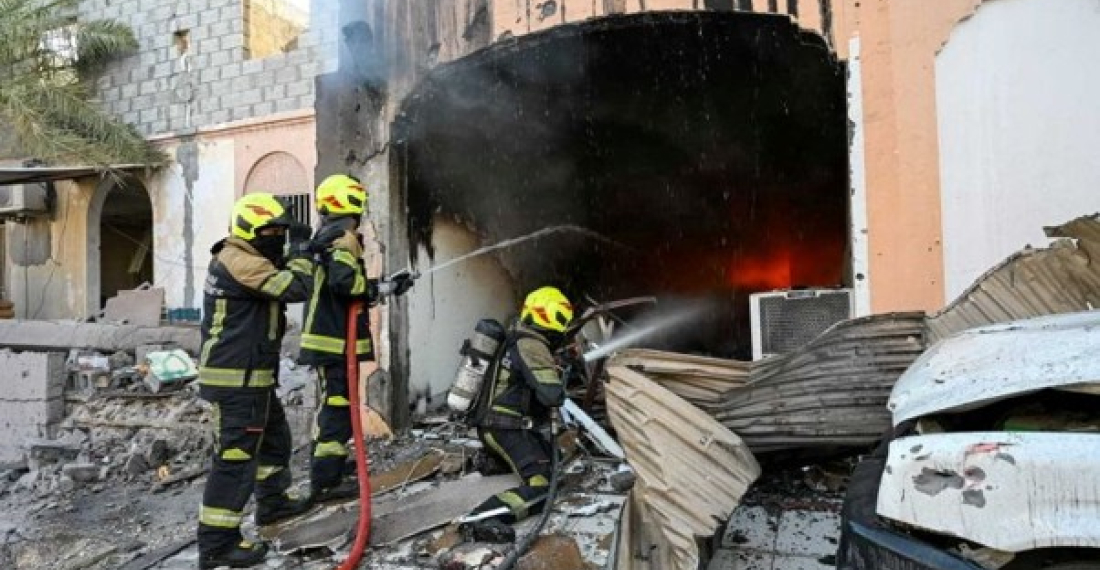
Mediators from Pakistan and Qatar have been desperately trying to salvage the US-Iran agreement, outlined in a Memorandum of Understanding, that over the last few days looked increasingly as if it was falling apart. After Iran tried to assert its control over the Strait of Hormuz, firing at ships that had ignored its claims, the US bombed targets in Iran. Iran subsequentlky bombed US military facilities in Bahrain, Kuwait, Qatar and Jordan.

But the last twelve hours have been quieter, and observers believe that the mediators - Pakistan and Qatar have persuaded the two beligerents to stop shooting and return to diplomacy. Fighting immediately impact the precarious oil market.

It was announced that the US Strategic Petroleum Reserve has hit its lowest level since 1983, due to growing tensions with Iran and global supply concerns.

President Trump acknowledged to reporters on Wednesday that any time the US strikes Iran, oil prices jump. And they did.

The reserve fell by 6.2 million barrels in the week ending July 3 to 319.5 million barrels – its lowest level since the Reagan administration.

In the Gulf, there is increasing concern on  the fragility of the US-Iran agreement.Zeidon Alkinani, founding director of the Arab Perspectives Institute, says Gulf states are conducting efforts to ensure diplomacy ends the US war on Iran as soon as possible.

“In the long term, we might be seeing different schools of thought and imagining a future relationship with Iran, a future relationship with the US, or imagining new transnational alliances from the regional perspective,” Alkinani told Al Jazeera.

Considerations would include how to achieve more deterrence for Iranian and Israeli expansionism, and how to curb too much reliance on the United States, he added.

“Others might want to continue things as they were to ensure that the conflicts were to end,” said Alkinani.

source: commonspace.eu, with BBC (London) and Al Jazeera (Doha), and agencies

Related articles

Editor's choice
News
NATO ANKARA SUMMIT DECLARATION

NATO ANKARA SUMMIT DECLARATION

TEXT OF NATO ANKARA SUMMIT DECLARATION: "We, the Heads of State and Government of the North Atlantic Alliance, have gathered in Ankara to reaffirm our ironclad commitment to our collective defence under Article 5 of the Washington Treaty and to the transatlantic bond.  An attack on one is an attack on all.  Our unity, solidarity and collective strength remain the foundation of peace, security, and prosperity for the one billion citizens in our Alliance of free and democratic nations.  We remain committed to our 360-degree approach to deterrence and defence. To counter the long-term threat Russia poses to Euro-Atlantic security and stability, and the persistent threat of terrorism, Allies are delivering on The Hague defence commitment.  In 2025, European Allies and Canada increased their investments in core defence requirements by more than $139 billion.  Our investments are delivering the capabilities we need while strengthening our industrial base and resilience.  Today in Ankara, we announce more than $50 billion in new procurements and commit to expanding collective manufacturing capacity and working with industry to accelerate innovation.  We will continue our work to eliminate defence trade barriers among Allies and leverage NATO’s partnerships to maximise defence industrial depth and cooperation. We are building the future: a stronger Europe in a stronger NATO – a modernised Alliance.  European Allies and Canada, working with the United States, are assuming greater responsibility for the Alliance’s defence.  NATO’s deterrence and defence rest on an appropriate mix of nuclear, conventional, and missile defence capabilities, complemented by space and cyber assets.  We are committed to maintaining our combat advantage.  We are investing in our ability to deploy, enable and sustain our armed forces and deliver our capability targets in all domains, including in deep precision strike, integrated air and missile defence, uncrewed systems, cutting edge technologies, and intelligence capabilities.  We are developing an interoperable transatlantic warfighting cloud and adopting powerful AI models. Ukraine contributes to transatlantic security, and Allies stand united in our unwavering support for Ukraine in defending its freedom, sovereignty, and territorial integrity.  European Allies and Canada now finance the vast majority of security assistance to Ukraine through bilateral and multilateral means.  Allies underscore that this support must be equitable, predictable, and sustainable in the long-term.  For 2026, Allies pledge €70 billion in military equipment, assistance and training for Ukraine and affirm their sovereign commitments to sustaining at least equivalent levels in 2027.  To this end, we welcome the European Union’s decision to provide multi-year funding to Ukraine through the Ukraine Support Loan. The Alliance continues to respond and adapt to the strategic competition, pervasive instability, hybrid threats and recurrent shocks that define our broader security environment.  Allies reiterate that Iran must never have a nuclear weapon and call on Iran to fully respect freedom of navigation in the Strait of Hormuz. We express our appreciation for the generous hospitality extended to us by Türkiye. We look forward to our next meeting."

Popular

Editor's choice
Interview
Thursday Interview: Murad Muradov

Thursday Interview: Murad Muradov

Today, commonspace.eu starts a new regular weekly series. THURSDAY INTERVIEW, conducted by Lauri Nikulainen, will host  persons who are thinkers, opinion shapers, and implementors in their countries and spheres. We start the series with an interview with Murad Muradov, a leading person in Azerbaijan's think tank community. He is also the first co-chair of the Action Committee for a new Armenian-Azerbaijani Dialogue. Last September he made history by being the first Azerbaijani civil society activist to visit Armenia after the 44 day war, and the start of the peace process. Speaking about this visit Murad Muradov said: "My experience was largely positive. My negative expectations luckily didn’t play out. The discussions were respectful, the panel format bringing together experts from Armenia, Azerbaijan, and Turkey was particularly valuable during the NATO Rose-Roth Seminar in Yerevan, and media coverage, while varied in tone, remained largely constructive. Some media outlets though attempted to represent me as more of a government mouthpiece than an independent expert, which was totally misleading.  Overall, I see these initiatives as important steps in rebuilding trust and normalising professional engagement. The fact that soon a larger Azerbaijani civil society visits to Armenia followed, reinforces the sense that this process is moving in the right direction." (click the image to read the interview in full)