


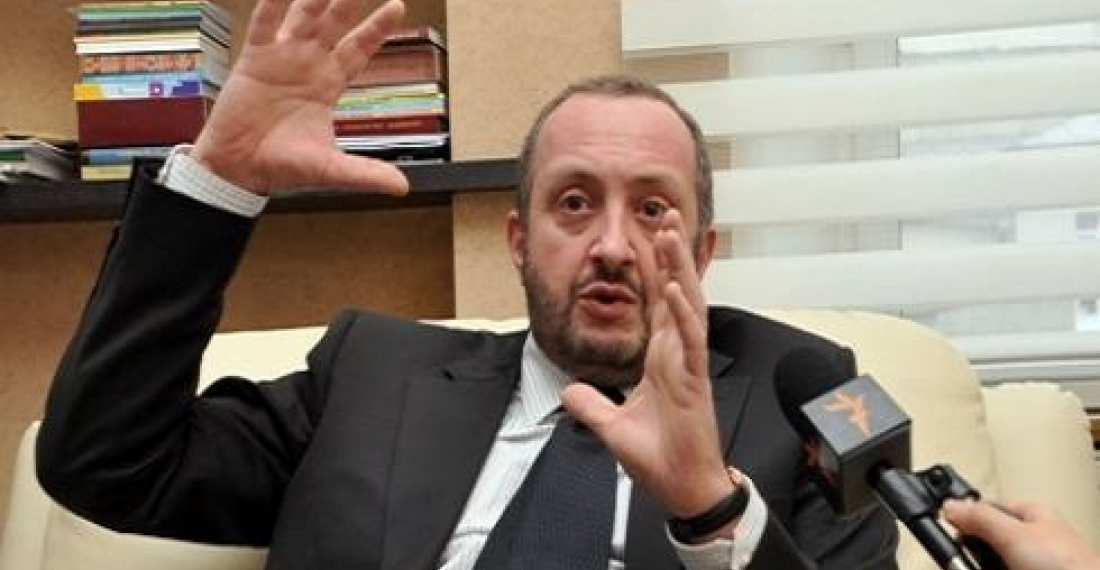
Is this Georgia's next President? Giorgi Margvelashvili has to work hard between now and October to secure the support of the Georgian public, and his election is not a done deal.

The Georgian Dream Coalition led by Prime Minister Bidhzina Ivanishvili has decided to nominate the Deputy Prime Minister and Minister of Education, Giorgi Margvelashvili as its candidate for the October Presidential elections.

Announcing the decision Ivanishvili told journalists that the choice was not only the best but "ideal".

The Georgian web portal civil.ge reports that the Prime Minister highly praised Margvelashvili's personal attributes

"He is very creative and he is unique in crisis situations; he is experienced in management; he is experienced in politics too; he is a good analyst, good expert; I don't know what else to list," Ivanishvili said, adding that Margvelashvili "is also a good team-player".

"Whenever I come across difficulties I always call Giorgi and ask him [for advice]; I have two or three such persons with whom I can sit down and talk about any issues and any problem," he added.  "I am happy that I know such a person and I think that especially at this stage, when our democracy is still fragile... and our team has an ambition to establish a genuine democracy, such a president would be very much acceptable," Ivanishvili said. "We should prove to the entire world in the shortest period of time that Georgians are Europeans and we deserve to become EU member state as soon as possible... and such persons like [Margvelashvili] and such president give us reason to have such an ambition."

Commonspace.eu political editor said in a comment:

"The announcement of the candidacy of Giorgi Margvelashvili as the Georgian Dream's candidate for the Presidency of Georgia was hardly a surprise since his name, together with that of a number of others, had been mentioned for some time. Regardless of the personal attributes of Margvelashvili the process of his selection however raises a number of questions.

The first is the somewhat clumsy way that the Georgian Dream coalition had chosen to select its candidate. This left the impression of internal intrigue and of Prime Minister Ivanishvili running roughshod over the opinion of his coalition. Even if not true, the lack of transparency and of public consultation in the selection process leaves much to be desired.

The second is the issue of the profile of the candidates that were being considered. Georgia is still getting used to the idea that Executive Power will not be with the President but with the Prime Minister and his government. In this case what is needed is a person who can be a unifying symbol of the country, who can rally the country and its politicians during time of crisis, and who otherwise keeps out of the way of the government. The example comes to mind of the role played by the veteran Presidents of Italy and Greece in recent years as their countries struggled with political and economic crisis. Italy's Georgio Napolitano is 89 years old whilst Karolos Papoulias of Greece is 84 years old. Both were active politicians but were elected with strong cross-party support.

All this means that 42 year old Margvelashvili is going to have to work very hard between now and October to convince the Georgian people that he is the right choice. Despite the fact that he has the support of the Georgian Dream coalition which is still basking in its victory of the October 2012 Parliamentary elections, and of Ivanishvili himself, who continues to score very high popularity ratings with the Georgian public Margvelashvili's election come October is not yet a done deal, particularly if another candidate emerges who can strike a chord with the Georgian electorate.

Another messy election is not what Georgia needs at the moment, and one has to ask therefore if this process could have been done differently and better."

source: commonspace.eu

photo: Giorgi Margvelashvili, the Georgian Dream candidate for next October's Presidential elections. (Picture courtesy of Radio Free Europe, radio Liberty.
Related articles

Editor's choice
News
Council of Europe launches new International Claims Commission for Ukraine

Council of Europe launches new International Claims Commission for Ukraine

Thirty-four countries and the European Union have signed a new convention establishing an International Claims Commission for Ukraine at a diplomatic conference co-hosted by the 46-nation Council of Europe and the Netherlands in the Hague. The diplomatic conference was attended by leaders and high-level representatives from over 50 states, including the President of Ukraine, Volodymyr Zelenskyy, the President of the Republic of Moldova, Maia Sandu, and the Prime Minister of the Netherlands, Dick Schoof.  “Today marks a major step forward in ensuring accountability for Ukraine. The International Claims Commission represents justice and hope for tens of thousands of victims—our determination that those who have suffered will not be forgotten. I call for quick ratifications so we can get the commission rapidly up and running for the people of Ukraine,” said Council of Europe Secretary General Alain Berset. Ukrainian President Volodymyr Zelenskyy said: “We expect that every mechanism for compensation from the Register of Damage and Claims Commission to the actual payments – will start working and receive strong and sufficient international support, so that people can truly feel that any kind of damage caused by the war can be compensated. This war, and Russia’s responsibility for it, MUST become a clear example – so that others learn not to choose aggression.” “Accountability is about creating the conditions for peace that endures. And therefore, accountability is a condition of security – today and for the future. But accountability is not only about Ukraine. And it is not only about one aggressor and one victim. Accountability is about Europe. About every country in Europe. It is about whether Europe, as a whole, is willing to defend its peace,” said Maia Sandu, President of the Republic of Moldova, which currently holds the Presidency of the Council of Europe’s Committee of Ministers. The Prime Minister of the Netherlands, Dick Schoof, said: “Every day Russia is deliberately bombarding homes, destroying businesses and damaging infrastructure in Ukraine. Russia must compensate Ukraine for the damage caused. That is why we have launched the International Claims Commission for Ukraine and we are honoured to host it.” The International Claims Commission will be the second part of a comprehensive compensation mechanism related to Russia’s war of aggression, building on the existing Register of Damage for Ukraine. The claims commission will be established within the framework of the Council of Europe and will also be open to other countries. The Register of Damage for Ukraine, created in 2023, collects and records compensation claims submitted by individuals, organisations and public bodies in Ukraine. Forty-four states and the European Union have so far joined the Register, which has already received 86,000 claims. The International Claims Commission will review, assess and decide upon claims submitted to the Register of Damage for Ukraine and determine the amount of compensation, if any, which is due in each case. The convention establishing the commission will enter into force once it has been ratified by 25 signatories, as long as sufficient funds have been secured to support its initial work.

Popular

Editor's choice
News
Council of Europe launches new International Claims Commission for Ukraine

Council of Europe launches new International Claims Commission for Ukraine

Thirty-four countries and the European Union have signed a new convention establishing an International Claims Commission for Ukraine at a diplomatic conference co-hosted by the 46-nation Council of Europe and the Netherlands in the Hague. The diplomatic conference was attended by leaders and high-level representatives from over 50 states, including the President of Ukraine, Volodymyr Zelenskyy, the President of the Republic of Moldova, Maia Sandu, and the Prime Minister of the Netherlands, Dick Schoof.  “Today marks a major step forward in ensuring accountability for Ukraine. The International Claims Commission represents justice and hope for tens of thousands of victims—our determination that those who have suffered will not be forgotten. I call for quick ratifications so we can get the commission rapidly up and running for the people of Ukraine,” said Council of Europe Secretary General Alain Berset. Ukrainian President Volodymyr Zelenskyy said: “We expect that every mechanism for compensation from the Register of Damage and Claims Commission to the actual payments – will start working and receive strong and sufficient international support, so that people can truly feel that any kind of damage caused by the war can be compensated. This war, and Russia’s responsibility for it, MUST become a clear example – so that others learn not to choose aggression.” “Accountability is about creating the conditions for peace that endures. And therefore, accountability is a condition of security – today and for the future. But accountability is not only about Ukraine. And it is not only about one aggressor and one victim. Accountability is about Europe. About every country in Europe. It is about whether Europe, as a whole, is willing to defend its peace,” said Maia Sandu, President of the Republic of Moldova, which currently holds the Presidency of the Council of Europe’s Committee of Ministers. The Prime Minister of the Netherlands, Dick Schoof, said: “Every day Russia is deliberately bombarding homes, destroying businesses and damaging infrastructure in Ukraine. Russia must compensate Ukraine for the damage caused. That is why we have launched the International Claims Commission for Ukraine and we are honoured to host it.” The International Claims Commission will be the second part of a comprehensive compensation mechanism related to Russia’s war of aggression, building on the existing Register of Damage for Ukraine. The claims commission will be established within the framework of the Council of Europe and will also be open to other countries. The Register of Damage for Ukraine, created in 2023, collects and records compensation claims submitted by individuals, organisations and public bodies in Ukraine. Forty-four states and the European Union have so far joined the Register, which has already received 86,000 claims. The International Claims Commission will review, assess and decide upon claims submitted to the Register of Damage for Ukraine and determine the amount of compensation, if any, which is due in each case. The convention establishing the commission will enter into force once it has been ratified by 25 signatories, as long as sufficient funds have been secured to support its initial work.

