


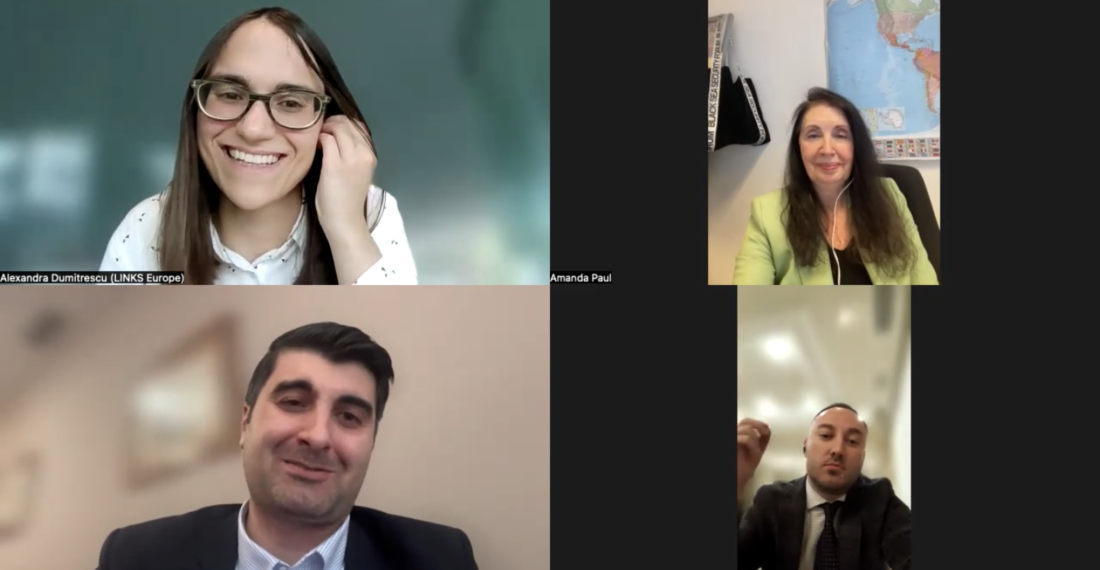
LINKS Europe panel discussion - 'Armenia between a historic summit and a crucial election'

See the webinar in full on YouTube.

On 6 May 2026, LINKS Europe Foundation hosted an online webinar titled “Armenia between a historic summit and a crucial election.” The event was chaired by Alexandra Dumitrescu, International Coordinator at LINKS Europe, and brought together experts from Yerevan and Brussels to discuss Armenia’s evolving election environment and broader geopolitical developments.

The panel featured Johnny Melikyan, Senior Fellow at the Orbeli Center; Narek Minasyan, Associate Expert at the Armenian Council Research Center; and Amanda Paul, Deputy Head of the Europe in the World Programme and Senior Policy Analyst at the European Policy Centre in Brussels.

The discussion opened with Armenia’s hosting of the 8th European Political Community Summit and the first EU-Armenia Summit in Yerevan. Speakers described these events as significant for Armenia’s visibility in Europe and for its ongoing foreign policy diversification. They discussed Armenia’s deepening cooperation with the European Union, including in areas such as transport, energy, digital connectivity, infrastructure investment, visa liberalisation, democratic reform, and regional connectivity.

The panel then turned to the parliamentary elections scheduled for 7 June 2026, which speakers framed as a decisive moment for Armenia’s democratic development and foreign policy direction. They discussed key electoral dilemmas, including Armenia’s European path versus a return to closer alignment with Russia, democracy versus authoritarian tendencies, and peace with Azerbaijan versus renewed confrontation.

The discussion also addressed external interference, disinformation, cyber threats, and the role of election observation missions. Speakers highlighted the importance of media literacy, institutional resilience, and international support in safeguarding the electoral process. The webinar concluded with a discussion on the Armenia-Azerbaijan peace process and the role of regional connectivity initiatives such as TRIPP, including their potential to support stability, economic cooperation, and wider international engagement in the South Caucasus.


Related articles

Editor's choice
News
NATO LEADERS GATHER IN ANKARA FOR  DEFINING SUMMIT

NATO LEADERS GATHER IN ANKARA FOR DEFINING SUMMIT

NATO leaders gathered in Ankara on Wednesday, for the main day of their annual summit. Ukraine is one of the main topics at the summit. Ukrainian President Volodymyr Zelensky used a speech at the summit on Tuesday to urge Ukraine's allies to deliver the air defence systems it urgently needs to protect it from escalating Russian attacks. Ukraine has been stepping up its own long-range drone and missile attacks against Russia, hitting oil refineries and military targets there and causing significant fuel shortages and power cuts. "Ukraine's Armed Forces have proved that the effective use of long-range systems can have game-changing impacts on the battlefield, giving the Armed Forces the ability to degrade enemy forces far behind the frontline," Number 10 said. "Ukrainian long-range strikes, such as those on key logistics hubs, have significantly impacted Russia's ability to sustain their offensives." Kremlin spokesman Dmitry Peskov said on Tuesday that Russia, which invaded Ukraine in 2022, would closely monitor the summit in Ankara..

Popular

Editor's choice
Interview
Thursday Interview: Murad Muradov

Thursday Interview: Murad Muradov

Today, commonspace.eu starts a new regular weekly series. THURSDAY INTERVIEW, conducted by Lauri Nikulainen, will host  persons who are thinkers, opinion shapers, and implementors in their countries and spheres. We start the series with an interview with Murad Muradov, a leading person in Azerbaijan's think tank community. He is also the first co-chair of the Action Committee for a new Armenian-Azerbaijani Dialogue. Last September he made history by being the first Azerbaijani civil society activist to visit Armenia after the 44 day war, and the start of the peace process. Speaking about this visit Murad Muradov said: "My experience was largely positive. My negative expectations luckily didn’t play out. The discussions were respectful, the panel format bringing together experts from Armenia, Azerbaijan, and Turkey was particularly valuable during the NATO Rose-Roth Seminar in Yerevan, and media coverage, while varied in tone, remained largely constructive. Some media outlets though attempted to represent me as more of a government mouthpiece than an independent expert, which was totally misleading.  Overall, I see these initiatives as important steps in rebuilding trust and normalising professional engagement. The fact that soon a larger Azerbaijani civil society visits to Armenia followed, reinforces the sense that this process is moving in the right direction." (click the image to read the interview in full)

