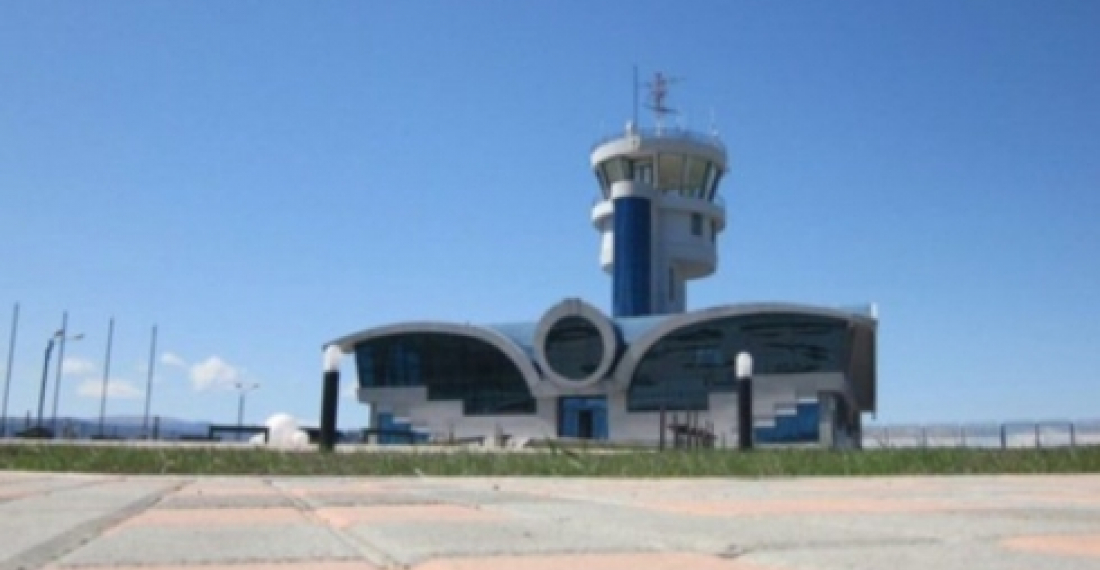
WAITING FOR A PLANE: Ara Harutyunyan says that Stepanakert Airport is ready but Baku insists use of the airport without its permission would be illegal.

The Prime Minister of the self declared Nagorno-Karabakh Republic Ara Harutyunyan said yesterday at a Press Conference in Stepanakert that Stepanakert Airport was ready and that all it needs to start operating was a plane. Harutyunyan said flights may start in March or April. Earlier reports had suggested that a company called "Air Artsakh will fly three SRJ-200 planes. A Stepanakert-Yerevan-Stepanakert ticket will cost around $50-60.

Stepanakert Airport, sometimes also called Khojaly Airport, is a Soviet era facility. Both terminal and airfield were fully refurbished in the last three years. The airport is at a height of 2,001 feet (610 m) above sea level. It has one runway with an asphalt surface measuring 2,178 by 37 metres (7,146 × 121 ft).

The issue of the opening of the airport caused great controversy when it was announced last year since Azerbaijan insists that no flights can be operated to and from the airport without its permission. Arif Mammadov, the director of Azerbaijan’s Civil Aviation Administration warned at the time that according to aviation law flights from Yerevan to Stepanakert are not authorized and may be shot down. Armenian President Serzh Sargsyan condemned the threat to shoot down civilian aircraft dismissing it as "nonsense". Sargsyan also said that he would be the first passenger on the inaugural Yerevan-Stepanakert flight.The Azerbaijani presidential administration condemned Sargsyan's statement as possible provocation on the part of Armenia. A few days later, the spokesman of the Azerbaijani Foreign Ministry, Elkhan Polukhov, declared that “Azerbaijan did not and will not use force against civil facilities.”

The international community would like to see the issue of the airport develop as a confidence building measure rather then a cause for escalation of tension. But this would only be possible if there is progress in the negotiations between Armenia and Azerbaijan  on the future of Nagorno-Karabakh and related issues. Media reports this week suggested that the Presidents of Armenia and Azerbaijan will meet in Sochi on 23 January at the invitation of the Russian President. There has been so far no official confirmation of this meeting.

Speaking to a group of Finnish MPs in the Azerbaijani Capital Baku yesterday, the Deputy Foreign Minister of Azerbaijan Khalaf Khalafov criticised the OSCE Minsk Process for its passivity in dealing with the resolution of the Karabakh conflict.

source: commonspace.eu with Arminfo News Agency and News.az

photo: The new terminal at Stepanakert Airport, sometimes known as Khojaly Airport, during its reconstruction last year (archive picture)
Related articles

Editor's choice
News
Borrell tells the European Parliament that the situation in Afghanistan was critical, but the EU will remain engaged

Borrell tells the European Parliament that the situation in Afghanistan was critical, but the EU will remain engaged

Borrell underlined that the European Union will make every effort to support the peace process and to remain a committed partner to the Afghan people. "Of course, we will have to take into account the evolving situation, but disengagement is not an option.  We are clear on that: there is no alternative to a negotiated political settlement, through inclusive peace talks.
Editor's choice
News
G7 foreign ministers issue wide ranging statement after their meeting in Canada

G7 foreign ministers issue wide ranging statement after their meeting in Canada

The Foreign Ministers of Canada, France, Germany, Italy, Japan, the United Kingdom, and the United States of America, and the High Representative of the European Union, met under Canada’s G7 Presidency, in Niagara, on November 11-12, 2025. The Foreign Ministers of Brazil, India, the Kingdom of Saudi Arabia, Mexico, the Republic of Korea, South Africa, and Ukraine, also joined the meeting for discussions on maritime security and prosperity, critical minerals, economic resilience and energy security. At the end of their meeting the G7 foreign ministers said: We reaffirmed our unwavering support for Ukraine in defending its territorial integrity and right to exist, and its freedom, sovereignty, and independence. We reiterated that an immediate ceasefire is urgently needed. We agreed that the current line of contact should be the starting point of negotiations. We remain committed to the principle that international borders must not be changed by force. We are increasing the economic costs to Russia, and exploring measures against countries and entities that are helping finance Russia’s war efforts. We condemned the provision to Russia of military assistance by DPRK and Iran, and the provision of weapons and dual-use components by China, a decisive enabler of Russia’s war. We acknowledged the ongoing discussions on a wide range of financing options, including further leveraging immobilised Russian Sovereign Assets in our jurisdictions in a coordinated way to support Ukraine. We strongly condemned Russia’s recent direct attacks on energy infrastructure and reaffirmed our support for Ukraine’s energy security. We reiterated our strong support for President Trump’s Comprehensive Plan to End the Gaza Conflict. We welcomed the ceasefire and the release of hostages. We stressed the urgency of returning the remains of deceased hostages. We also welcomed the increased flows of aid, but expressed concern about restrictions that remain in place. We called on all parties to allow for humanitarian assistance without interference at scale, through the United Nations and its agencies, and the Red Crescent, in addition to other international institutions and INGOs, as stipulated in President Trump’s plan. It is vital that all parties continue to engage constructively on the next steps outlined in the Comprehensive Plan, in pursuit of a political horizon for peaceful and prosperous co-existence for the Israeli and Palestinian peoples that advances comprehensive Middle East peace and stability. We will also continue to maintain attention on the situation in the West Bank. (click headline to read more)

Popular

Editor's choice
News
G7 foreign ministers issue wide ranging statement after their meeting in Canada

G7 foreign ministers issue wide ranging statement after their meeting in Canada

The Foreign Ministers of Canada, France, Germany, Italy, Japan, the United Kingdom, and the United States of America, and the High Representative of the European Union, met under Canada’s G7 Presidency, in Niagara, on November 11-12, 2025. The Foreign Ministers of Brazil, India, the Kingdom of Saudi Arabia, Mexico, the Republic of Korea, South Africa, and Ukraine, also joined the meeting for discussions on maritime security and prosperity, critical minerals, economic resilience and energy security. At the end of their meeting the G7 foreign ministers said: We reaffirmed our unwavering support for Ukraine in defending its territorial integrity and right to exist, and its freedom, sovereignty, and independence. We reiterated that an immediate ceasefire is urgently needed. We agreed that the current line of contact should be the starting point of negotiations. We remain committed to the principle that international borders must not be changed by force. We are increasing the economic costs to Russia, and exploring measures against countries and entities that are helping finance Russia’s war efforts. We condemned the provision to Russia of military assistance by DPRK and Iran, and the provision of weapons and dual-use components by China, a decisive enabler of Russia’s war. We acknowledged the ongoing discussions on a wide range of financing options, including further leveraging immobilised Russian Sovereign Assets in our jurisdictions in a coordinated way to support Ukraine. We strongly condemned Russia’s recent direct attacks on energy infrastructure and reaffirmed our support for Ukraine’s energy security. We reiterated our strong support for President Trump’s Comprehensive Plan to End the Gaza Conflict. We welcomed the ceasefire and the release of hostages. We stressed the urgency of returning the remains of deceased hostages. We also welcomed the increased flows of aid, but expressed concern about restrictions that remain in place. We called on all parties to allow for humanitarian assistance without interference at scale, through the United Nations and its agencies, and the Red Crescent, in addition to other international institutions and INGOs, as stipulated in President Trump’s plan. It is vital that all parties continue to engage constructively on the next steps outlined in the Comprehensive Plan, in pursuit of a political horizon for peaceful and prosperous co-existence for the Israeli and Palestinian peoples that advances comprehensive Middle East peace and stability. We will also continue to maintain attention on the situation in the West Bank. (click headline to read more)