


Turkish-Armenian Relations: one small step forward, one small step backward

The painful process of healing relations between Armenians and Turks made one small step forward yesterday. In the Turkish city of Diyarbakir the Armenian community has rung the bells of Surp Giragos Armenian Church for the first time in 98 years to celebrate the Easter holiday. A proper mass could not be held due to a lack of priests to take part.

Doğan news agency reported yesterday that the church had been out of service for almost a century now, and was recently restored with a $3.200.000 budget before it was re-opened. The community visited the grounds yesterday, Easter Sunday. The bronze bell, which was built in Russia, was rung for the first time in almost a century. The community failed to conduct a mass for Easter, however, since the Istanbul Patriarchate previously responded to a request to send priests to the church by telling the community that it would take a week for the religious official to arrive in Diyarbakır. As a result, no masses were held at the church, but the community prayed to celebrate the religious holiday nevertheless, before distributing colored eggs and pastries.

On the other hand Armenian and Turkish media over the weekend reported that flights from the Armenian capital Yerevan to the Turkish city of Van, which were due to start this week have been cancelled. It is not clear what the reasons are but it is known that Azerbaijan had protested to Turkey about the launch of the flights. Azerbaijan and Turkey have for the last two decades cut most links with Armenia in response to Armenia's occupation of Azerbaijani territory during the conflict around Nagorno-Karabakh. On Sunday some media outlets speculated that the air links between Yerevan and the Turkish city of Istanbul, one of the few remaining means of communications between Turkey and Armenia were also to be suspended but this information could not be confirmed.

Commonspace.eu political editor said in a comment that "the problem is that the already complex and bitter Turkish-Armenian relations have now got entangled in the equally difficult relations between Armenia and Azerbaijan and all three countries are having difficulties managing this. Armenia, and most of the international community, would prefer to keep the issues seperate, but in reality this is becoming increasingly unrealistic. Expectations that Turkey will take the lead and come up with positive gestures have not always been realised. The toll of the bells of the Armenian church in Diyarbakir gave out a positive sound yesterday, but as has happened often in recent years it has been one small step forward and one small step backward, at a time when what is needed is a determined push forward."

source: commonspace.eu with Hurriyet Daily News

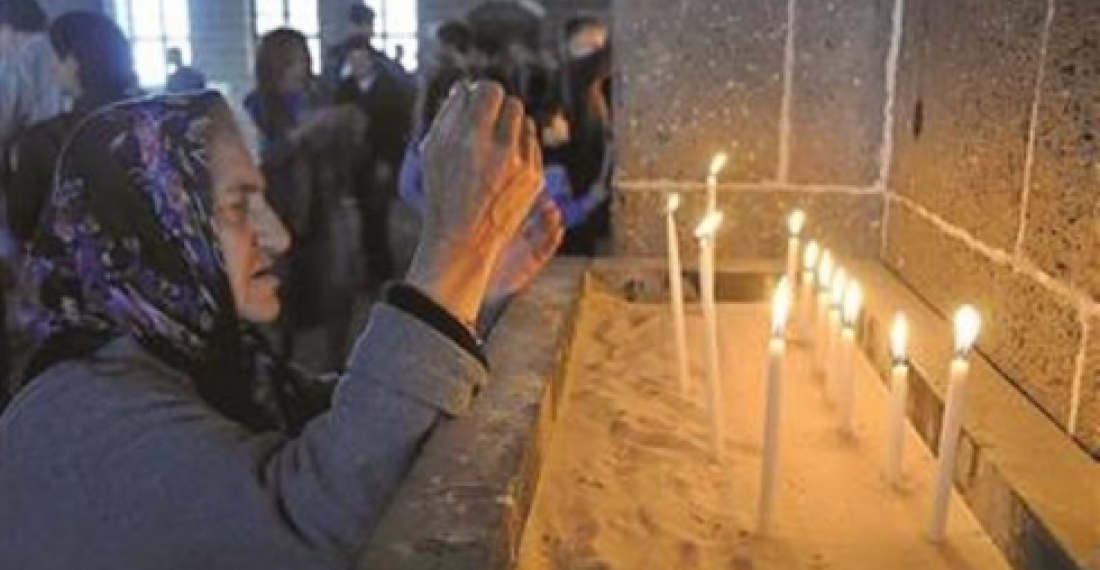
photo: A women lighting a candle at the Armenian Church in Diyarbakir on Easter Day (31 March 2013) where the church bell rang for the first time in ninety eight years. (photo courtesy of Hurriyet Daily news).
 

Related articles

Editor's choice
News
Council of Europe launches new International Claims Commission for Ukraine

Council of Europe launches new International Claims Commission for Ukraine

Thirty-four countries and the European Union have signed a new convention establishing an International Claims Commission for Ukraine at a diplomatic conference co-hosted by the 46-nation Council of Europe and the Netherlands in the Hague. The diplomatic conference was attended by leaders and high-level representatives from over 50 states, including the President of Ukraine, Volodymyr Zelenskyy, the President of the Republic of Moldova, Maia Sandu, and the Prime Minister of the Netherlands, Dick Schoof.  “Today marks a major step forward in ensuring accountability for Ukraine. The International Claims Commission represents justice and hope for tens of thousands of victims—our determination that those who have suffered will not be forgotten. I call for quick ratifications so we can get the commission rapidly up and running for the people of Ukraine,” said Council of Europe Secretary General Alain Berset. Ukrainian President Volodymyr Zelenskyy said: “We expect that every mechanism for compensation from the Register of Damage and Claims Commission to the actual payments – will start working and receive strong and sufficient international support, so that people can truly feel that any kind of damage caused by the war can be compensated. This war, and Russia’s responsibility for it, MUST become a clear example – so that others learn not to choose aggression.” “Accountability is about creating the conditions for peace that endures. And therefore, accountability is a condition of security – today and for the future. But accountability is not only about Ukraine. And it is not only about one aggressor and one victim. Accountability is about Europe. About every country in Europe. It is about whether Europe, as a whole, is willing to defend its peace,” said Maia Sandu, President of the Republic of Moldova, which currently holds the Presidency of the Council of Europe’s Committee of Ministers. The Prime Minister of the Netherlands, Dick Schoof, said: “Every day Russia is deliberately bombarding homes, destroying businesses and damaging infrastructure in Ukraine. Russia must compensate Ukraine for the damage caused. That is why we have launched the International Claims Commission for Ukraine and we are honoured to host it.” The International Claims Commission will be the second part of a comprehensive compensation mechanism related to Russia’s war of aggression, building on the existing Register of Damage for Ukraine. The claims commission will be established within the framework of the Council of Europe and will also be open to other countries. The Register of Damage for Ukraine, created in 2023, collects and records compensation claims submitted by individuals, organisations and public bodies in Ukraine. Forty-four states and the European Union have so far joined the Register, which has already received 86,000 claims. The International Claims Commission will review, assess and decide upon claims submitted to the Register of Damage for Ukraine and determine the amount of compensation, if any, which is due in each case. The convention establishing the commission will enter into force once it has been ratified by 25 signatories, as long as sufficient funds have been secured to support its initial work.

Popular

