This is a commentary prepared by the editorial team of commonspace.eu
Presidential elections were held in Uzbekistan on 24 October. Not that too many people outside the landlocked Central Asian country were paying too much attention. It was always seen as a one horse race, and incumbent president Shavkat Mirziyoyev was not facing opponents that could realistically challenge his grip on power. Uzbekistan remains a tightly run political ship, and observers from the OSCE and the European Parliament concluded that “despite recent welcome reforms, the lack of genuine pluralism and meaningful engagement between candidates or with citizens meant that Uzbekistan’s presidential election was not truly competitive, while significant procedural irregularities were noted on election day”.
“The recent and ongoing reforms are an encouraging sign,” said Heidi Hautala, Vice President of the European Parliament and Head of the EP delegation. “But the exclusion of opposition parties and the lack of genuine competition, as well as the high number of irregularities we saw on election day, remain substantial obstacles in the path of the democratisation process.”
So is this a case of a glass being half full or half empty, depending on how you want to look at it; or is Uzbekistan slowly but surely moving out of its autocratic past into a pluralistic political process. The answer is that it is too early to say, because there are contradictory signs.
With a turnout of more than 80%, and having secured 80.1% of the votes cast, Mirziyoyev was as expected, jubilant on Sunday, but his choice of words was interesting:
“My dear fellow countrymen. Of course, every person has such moments of excitement in life as I have now. I bow down and thank everyone for their trust in me,” he said. Mirziyoyev underscored that the over 80% turnout speaks of the fact that many are not indifferent to the future, and the elections were held in line with the Electoral Code, which is recognized in the world.
“Today's Uzbekistan is not an Uzbekistan of yesterday. Our people are not the same as they were five years ago. I have said before and will say now: there is no turning back. Uzbekistan will only go forward!”, the president said.
So no turning back to the dark days of Islam Karimov, the dictator who turned Uzbekistan into a pariah state in his 25 year rule of the country. But quite were Uzbekistan is going forward to under the more benign leadership of Mirziyoyev is not yet clear.
Uzbekistan has a population of over 35 million, one of the largest in Central Asia, but its economy was left in shambles leaving it with one of the lowed GDP’s per capita in the world. The need for modernization in all aspects of life is acutely clear, and Mirziyoyev appears to understand that.
Internally reforms have been taking place and everyone agrees that the legal framework has improved considerably. The application of that framework however remains problematic. This was also the case with the elections. In many ways the elections were a missed opportunity. A more competitive electoral environment would have done much to add to the credibility of the reform process that Mirizyoyev has initiated. The president now needs to make up for this with tangible action in areas such as personal freedoms, local governance, government accountability and the fight against corruption.
Externally, Uzbekistan is in a difficult situation. It is a double land-locked country, ie to reach the sea one has to go through not one, but two other countries. Like the rest of Central Asia it is sandwiched between the competing interests of Russia and China. And as the recent events in neighbouring Afghanistan has shown, the neighbourhood is difficult. There are genuine concerns that with the Taliban as next door neighbours problems of Islamic extremism and radicalisation, of which Uzbekistan has had its fair share in the past, may re-surface. Whoever sits in control in Tashkent must therefore manage with a strong hand. But that does not mean that there is not a huge amount that can and should be done in the immediate future for the country to start reclaiming the international respect it aspires to.
As for the international community, it must remain engaged with Uzbekistan. It must help it develop its potential, and it must help it manage the international context in which it finds itself. The process may be slower that many hope for, but for the moment at least Mirziyoyev remains the best option to help Uzbekistan come in from the cold.
source: This commentary was prepared by the editorial team of commonspace.eu
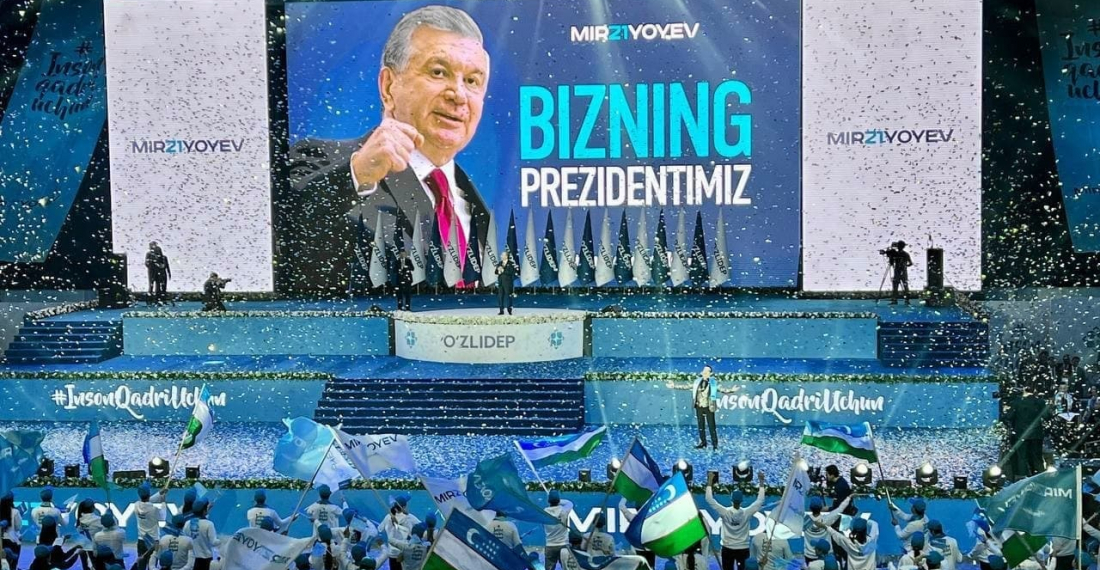
photo: Supporters of Shovket Mirzyoyev celebrate his election victory in Tashken on 24 October 2021 (picture courtesy of Tashkent Times)