


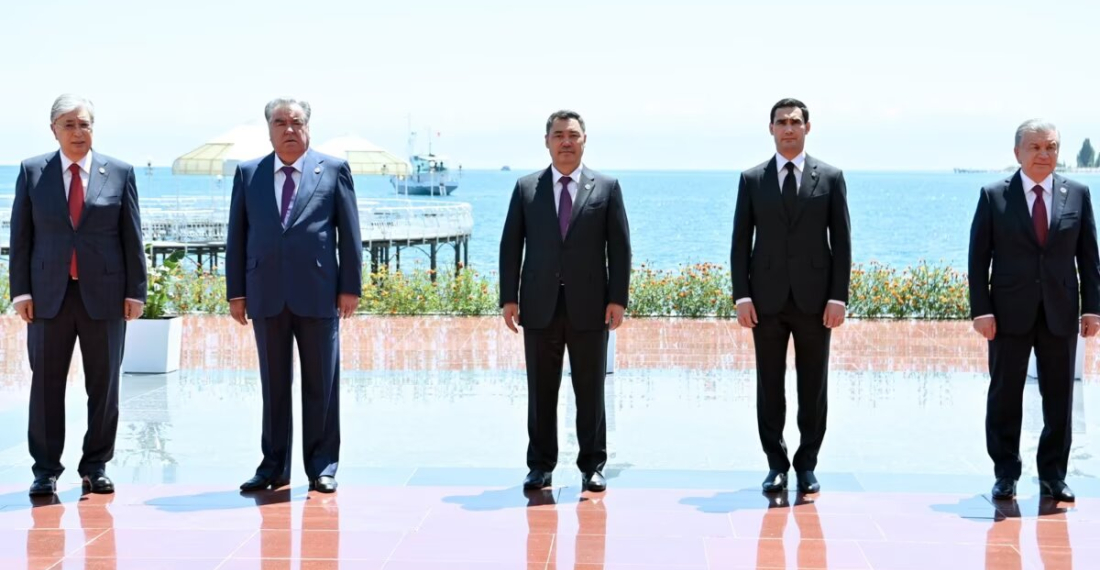
A new sense of purpose in Central Asia as leaders seek better relations between their countries and with the rest of the world

This is a commentary prepared by the editorial team of commonspace.eu.

For more than three decades after the collapse of the USSR the five Central Asia Republics continued to live largely in the shadow of Moscow. 

Neighbouring China made headway, particularly in the economic sphere, largely with Moscow’s acquiescence, and there were a few moments when the west appeared to be making a mark on the region too, especially after the 9/11 attacks, when the US was allowed facilities to help with its invasion of Afghanistan. But this moment did not last long. On everything else that mattered, and for most of the time, Moscow continued to call the shots.

The last five years have seen a seismic change in the region. A new generation of leaders are seeking better relations with the rest of the world: connectivity has become a buzzword, and there is a genuine effort to engage with the EU and the US, in most if not all the capitals. Ukraine, and the implications of the Russian invasion on future relations with all the post Soviet states, has focused minds, particularly in Tashkent and Astana.

Summits of the five have been held regularly in recent years, but a new sense of purpose could be seen in the more recent ones. There is now a better understanding of common threats as well as common opportunities.

Soviet collapse has left a problematic legacy on Central Asia

First though, the countries of Central Asia have had to manage relations between them, both bilaterally and multilaterally. The collapse of the Soviet Union left a thread of unfinished business, including undefined borders. This has in the past resulted in violent skirmishes between Kyrgyzstan and Tajikistan, and between Uzbekistan and Tajikistan. A few days ago the latter two finally agreed on a landmark agreement settling border issues. In a speech at the signing of the historic border agreement in Bishkek, Uzbek leader Shavkat Mirziyoev was profuse in his praise of his Kyrgyz counterpart, Sadyr Japarov.

"I want to tell you that we have no problematic issues. In the 31 years of the independent history of Kyrgyzstan and Uzbekistan, this is the first time there has been this level of mutual relations [...] I want to give special thanks to my respected colleague Sadyr.... If not for his political will, we would have not reached today's result. We could have said like we used to that we will solve these problems tomorrow or the day after. Well, tomorrow lasted 30 years, and the problems weren't solved", the Uzbek leader said.

Kyrgyzstan also has border problems with Tajikistan, and these may take longer to work out, but the Uzbek-Kyrgyz agreement may be an indication that the Central Asians are on the way to sorting out the problems between them as they look outwards to new challenges and opportunities.

In this, Kazakhstan and Uzbekistan – the two giants of the region – will need to lead the way. Mutual competition between them is historic, but it need not be rivalry, let alone enmity. Both Mirziyoev, and the Kazakh leader, Kassym-Jomart Tokayev, are products of the system that has been in power for the last three decades, but since assuming power both have also shown a capacity to embrace change, and importantly, to challenge Moscow in the process. On these two factors depends much of Central Asia’s future.

Central Asian regional and international engagement is increasing

Multilaterally a number of frameworks have evolved in Central Asia in the past three decades, largely in response to Central Asia’s peculiarities. The Conference on Confidence-building measures in Central Asia is one example. Another is a UN framework –  the United Nations Regional Centre for Preventive Diplomacy in Central Asia (UNRCCA), based in Ashgabat in Turkmenistan. Often seen as the odd one out, Turkmenistan has in the past tried to insulate itself from regional and global processes in the past, declaring itself a neutral country. In the process of doing so it has however embraced the UN as its international organisation of choice. This approach has obvious limitations, but there are signs that now even Turkmenistan is understanding the need for a more active international engagement.

Interesting initiatives are now emerging, particularly from Kazakhstan and Uzbekistan. The latest is the Kazakh initiative to host on June 8-9 in Astana, the Astana International Forum, an initiative of President Kassym-Jomart Tokayev, which aims to tackle global challenges on climate, food scarcity, and energy security.

The forum is expected to serve as a platform for eminent delegates from governments, international organisations, businesses, and academia and will address four key global challenges that include foreign policy, security and sustainability, energy and climate, and economy and finance.

Commenting on the launch of the new forum, the Kazakh president said, “Through the Astana International Forum, we hope to build new bridges and strengthen ties, as we come together to overcome the collective challenges we face, charting a new way forward – diplomatically, economically, and politically”.

This is an ambitious agenda. It reflects the new mood in Central Asia. The world needs to positively assess developments in this region that has been isolated for too long, and embrace these new initiatives and engage with them effectively.
source: commonspace.eu editorial team
photo: euractiv
The views expressed in opinion pieces and commentaries do not necessarily reflect the position of commonspace.eu or its partners

Related articles

Editor's choice
News
Council of Europe launches new International Claims Commission for Ukraine

Council of Europe launches new International Claims Commission for Ukraine

Thirty-four countries and the European Union have signed a new convention establishing an International Claims Commission for Ukraine at a diplomatic conference co-hosted by the 46-nation Council of Europe and the Netherlands in the Hague. The diplomatic conference was attended by leaders and high-level representatives from over 50 states, including the President of Ukraine, Volodymyr Zelenskyy, the President of the Republic of Moldova, Maia Sandu, and the Prime Minister of the Netherlands, Dick Schoof.  “Today marks a major step forward in ensuring accountability for Ukraine. The International Claims Commission represents justice and hope for tens of thousands of victims—our determination that those who have suffered will not be forgotten. I call for quick ratifications so we can get the commission rapidly up and running for the people of Ukraine,” said Council of Europe Secretary General Alain Berset. Ukrainian President Volodymyr Zelenskyy said: “We expect that every mechanism for compensation from the Register of Damage and Claims Commission to the actual payments – will start working and receive strong and sufficient international support, so that people can truly feel that any kind of damage caused by the war can be compensated. This war, and Russia’s responsibility for it, MUST become a clear example – so that others learn not to choose aggression.” “Accountability is about creating the conditions for peace that endures. And therefore, accountability is a condition of security – today and for the future. But accountability is not only about Ukraine. And it is not only about one aggressor and one victim. Accountability is about Europe. About every country in Europe. It is about whether Europe, as a whole, is willing to defend its peace,” said Maia Sandu, President of the Republic of Moldova, which currently holds the Presidency of the Council of Europe’s Committee of Ministers. The Prime Minister of the Netherlands, Dick Schoof, said: “Every day Russia is deliberately bombarding homes, destroying businesses and damaging infrastructure in Ukraine. Russia must compensate Ukraine for the damage caused. That is why we have launched the International Claims Commission for Ukraine and we are honoured to host it.” The International Claims Commission will be the second part of a comprehensive compensation mechanism related to Russia’s war of aggression, building on the existing Register of Damage for Ukraine. The claims commission will be established within the framework of the Council of Europe and will also be open to other countries. The Register of Damage for Ukraine, created in 2023, collects and records compensation claims submitted by individuals, organisations and public bodies in Ukraine. Forty-four states and the European Union have so far joined the Register, which has already received 86,000 claims. The International Claims Commission will review, assess and decide upon claims submitted to the Register of Damage for Ukraine and determine the amount of compensation, if any, which is due in each case. The convention establishing the commission will enter into force once it has been ratified by 25 signatories, as long as sufficient funds have been secured to support its initial work.

Popular

Editor's choice
News
Council of Europe launches new International Claims Commission for Ukraine

Council of Europe launches new International Claims Commission for Ukraine

Thirty-four countries and the European Union have signed a new convention establishing an International Claims Commission for Ukraine at a diplomatic conference co-hosted by the 46-nation Council of Europe and the Netherlands in the Hague. The diplomatic conference was attended by leaders and high-level representatives from over 50 states, including the President of Ukraine, Volodymyr Zelenskyy, the President of the Republic of Moldova, Maia Sandu, and the Prime Minister of the Netherlands, Dick Schoof.  “Today marks a major step forward in ensuring accountability for Ukraine. The International Claims Commission represents justice and hope for tens of thousands of victims—our determination that those who have suffered will not be forgotten. I call for quick ratifications so we can get the commission rapidly up and running for the people of Ukraine,” said Council of Europe Secretary General Alain Berset. Ukrainian President Volodymyr Zelenskyy said: “We expect that every mechanism for compensation from the Register of Damage and Claims Commission to the actual payments – will start working and receive strong and sufficient international support, so that people can truly feel that any kind of damage caused by the war can be compensated. This war, and Russia’s responsibility for it, MUST become a clear example – so that others learn not to choose aggression.” “Accountability is about creating the conditions for peace that endures. And therefore, accountability is a condition of security – today and for the future. But accountability is not only about Ukraine. And it is not only about one aggressor and one victim. Accountability is about Europe. About every country in Europe. It is about whether Europe, as a whole, is willing to defend its peace,” said Maia Sandu, President of the Republic of Moldova, which currently holds the Presidency of the Council of Europe’s Committee of Ministers. The Prime Minister of the Netherlands, Dick Schoof, said: “Every day Russia is deliberately bombarding homes, destroying businesses and damaging infrastructure in Ukraine. Russia must compensate Ukraine for the damage caused. That is why we have launched the International Claims Commission for Ukraine and we are honoured to host it.” The International Claims Commission will be the second part of a comprehensive compensation mechanism related to Russia’s war of aggression, building on the existing Register of Damage for Ukraine. The claims commission will be established within the framework of the Council of Europe and will also be open to other countries. The Register of Damage for Ukraine, created in 2023, collects and records compensation claims submitted by individuals, organisations and public bodies in Ukraine. Forty-four states and the European Union have so far joined the Register, which has already received 86,000 claims. The International Claims Commission will review, assess and decide upon claims submitted to the Register of Damage for Ukraine and determine the amount of compensation, if any, which is due in each case. The convention establishing the commission will enter into force once it has been ratified by 25 signatories, as long as sufficient funds have been secured to support its initial work.

