This year can be a game changer in the South Caucasus, however surprises, and failure to address long standing problems may turn out to be serious spoilers, argues Dennis Sammut in this Monday Commentary.
In the early years of the new century and millenium, ambitious officials and politicians in the South Caucasus used to talk confidently about 2020 - that being the year by which time their countries would have turned the corner and established themselves as successful, modern nations and societies. Was that optimism justified?
The leaders of Armenia, Azerbaijan and Georgia appear to think so, and said so much in their end of year messages in the last minutes of 2019. Nikol Pashinyan told Armenians "2020 will be year of economic, political, social and psychological take-off", and said it was now time "to make the impossible, possible". Giorgi Gaharia told the Georgians "2020 will be the year of hope and victory". Ilham Aliyev looked back rather than forward. He told Azerbaijanis 2019 "has been a successful year for our country. All the goals we set ourselves at the beginning of the year have been successfully fulfilled and Azerbaijan has successfully developed........ the Azerbaijani people lived, built and created in the conditions of security."
There is some cause to justify this optimism. The region has been largely peaceful in 2019, even if often tense. Economic growth continues in the three countries. And all three countries are now well integrated in the international community. But those with an interest in the region will do well to look out for black swans (surprises) and grey rhinos (highly probable but neglected threats). They have created havoc with the region before, and have the potential to do so again.
Many of the same old problems of a decade ago are still around - the unresolved conflicts in which the whole region is embroiled; the problems with governance, particularly the lack of checks and balances; the unfulfilled economic potential, and societies that in essence remain deeply conservative and sometimes appear to struggle in embracing modernity. And then ofcourse there is the region's very neighbourhood, flanked as it is by Russia, Turkey and Iran. I had hardly started writing this commentary before a black swan appeared - in the form of the killing in Baghdad of Iranian and Iraqi Shia leaders by the US. Immediately the clouds of war thickened, sending a shadow over the South Caucasus too.
There is an uneasy feeling in the air that the region may now be heading towards some kind of end game in 2020. Will 2020 be a game-changer after all? And if so in what ways?
Governance
Governance issues dominate the political debate in the three countries. The core problem is the lack of checks and balances. All three leaders can rely on a compliant parliamentary majority. Reforms and new appointments in the Judicial system in Armenia and Georgia in 2019 were seen as steps to consolidate the power of the ruling party. In Azerbaijan the judiciary have been compliant enough with the wishes of the executive. Lack of checks and balance results in lack of scrutiny, which oten leads to mismanagement and corruption. These are not new problems.
Georgia and Azerbaijan face parliamentary elections this year. These are very different affairs, but both are hugely significant in the current situation.
Parliamentary elections in Azerbaijan were brought forward to early February, ostensibly so that a new parliament can be elected that would support the reform agenda being pushed by the president. I cannot remember a single occasion in the last decade when the Azerbaijan parliament rejected or delayed a request of the president, so the problem was not parliament's compliance but its inertia. Hopefully the decision to call early elections also means that there is now better understanding in the Azerbaijani leadership of the value of having a broadly representative parliament with plurality of views, and with some teeth to enforce scrutiny on the executive. For this to happen the 9 February elections in Azerbaijan need to be much better than those held in the previous decade, all of which have been criticised for their shortcomings by international observers. If this is the case it will likely mean that a number of opposition parties will be represented in the new parliament. This will be a big step forward, and the credibility of the current reform package being pushed through by president Aliyev will be greatly enhanced.
In Georgia, elections scheduled for October, are crucial for the next stage of the country's development. Georgia has in recent years had a good track record of holding free and fair elections. The 2012 parliamentary elections saw for the first (and so far only) time in the South Caucasus a transition of power from one political force to another done exclusively through the ballot box. For outsiders Georgia often appears to be in a state of permanent political crisis. This may not be always the case. But there is at the moment a stand off between government and opposition which many believe only a free and fair election can resolve. If the election results are however contested, for good reason, a major political crisis appears inevitable, and may have all sorts of conseqeuneces. Ensuring a free and fair election must now be the top priority.
There are no elections anticipated in Armenia in 2020 (although some opposition forces are calling for one). Nikol Pashinyan will continue pushing for deeply rooted changes right across society, and in the process be faced by entrenched interests whose existence he threatens. He can expect a bumpy year ahead, he appears determined to see the process through, and so far appears to have maintained the popular support to do so.
Unresolved conflicts
Astonishingly, there are still those outside the region who think that they can engage with the South Caucasus whilst avoiding the issue of the unresolved conflicts - the Karabakh issue as regards Armenia and Azerbaijan; Abkhazia and South Ossetia as regards Georgia, and elements of all as regards all. This is naive. If there is one grey rhino in the South Caucasus it is the unresolved conflicts.
On Karabakh there is still hope that the new dynamic of the last eighteen months can kick-start proper peace talks. 2020 will tell. However, the risk of an upsurge in violence, remains.
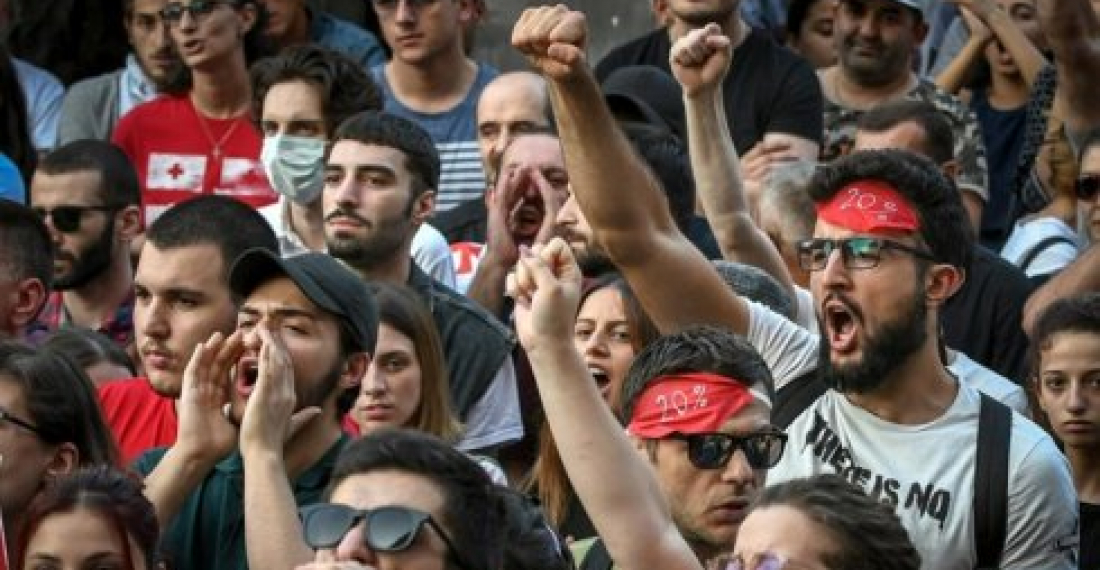
With regards to the Georgian conflicts, frustration is starting building up again in Tbilisi. Any incident can easily grow very quickly. Part of the problem is that there is here no peace process. The Geneva International Discussions are an important conflict management mechanism, but no more. The maxim that Russia holds all the cards was never truer than now. Frustration can quickly turn small incidents into a serious crisis, as was seen in June at the Georgian parliament. Incidents seen in 2019 are likely to happen again in 2020, each with the potential of escalation.
Those who say these conflicts are unsolvable are wrong. There will not be dramatic breakthroughs in 2020, but there is scope for a few dramatic gestures that may kick start the elusive peace processes. As long as these conflicts linger the future of the South Caucasus will always remain under a shadow.
Economy
In 2019 the economies of the three republics experienced respectable rates of growth, and this is likely to continue. Yet given the expectations of citizens in all the three countries for a better quality of life this may not be good enough. The region has been waiting for its big take off, and this has not happened yet. 2020 brings opportunities but also risks. Internal political turmoil has its economic costs. Georgia increasingly has an economy based on tourism and services, both of which require a calm political environment. This may be one argument why a spring election may be better since, hopefully, this would mean that things would have calmed down by the summer and the peak tourist season.
The South Caucasus still has huge untapped economic potential. Galvanising this potential and making it work to improve the quality of life of its people now appears to be in the vision of the leadership in all three countries. However buisness requires a sound political and legal framework and a peaceful environment. If in 2020 progress can be made on these fronts than this would be a truly remarkable year.
Spoilers
Those who anticipated that 2020 will be the long expected turning point in the South Caucasus may prove to have been too optimistic, but it may yet be a defining year in many ways. But beware of those black swans and grey rhinos. They are the spoilers that will need to be managed on the way.
source: Monday Commentary is prepared by Dennis Sammut, a member of the editorial team of commonspace.eu
photo: Young Georgians protesting against Russian's policy towards their country at a demonstration in Tbilisi in June 2019.
The views expressed in opinion pieces and commentaries do not necessarily reflect the position of commonspace.eu or its partners