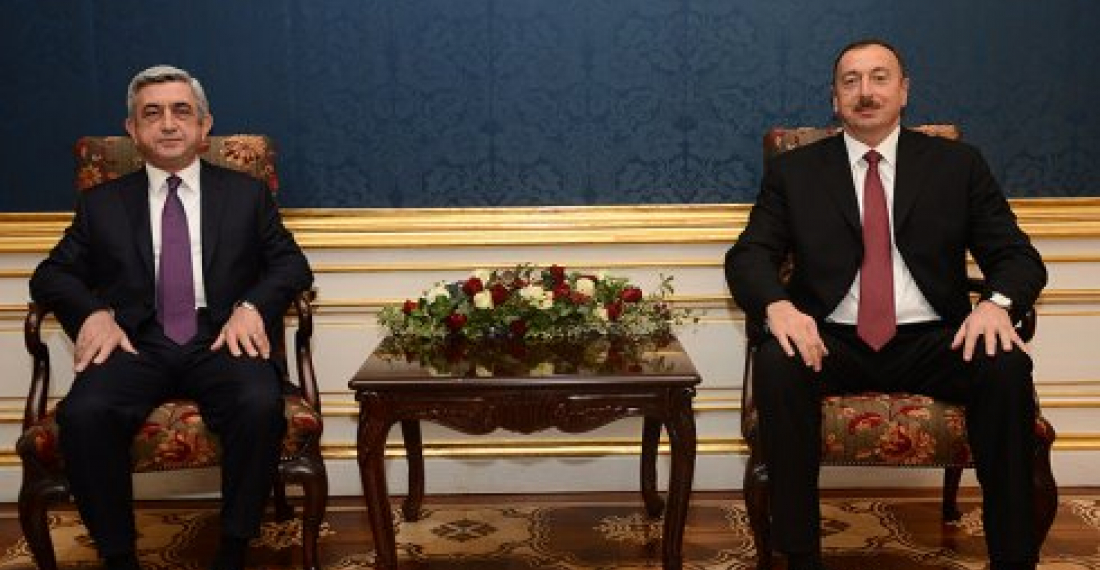
How, and for what purpose, will the newly empowered leaders of Armenia and Azerbaijan use their now nearly absolute powers? And more specifically how will they do so in the context of the Karabakh conflict and conflict resolution process, asks Dennis Sammut in this commentary.
This week marks a watershed moment in the modern political history of the South Caucasus. Almost at the same moment, two men, one in Armenia and one in Azerbaijan, assume in their countries more power than any other local leader could muster in the history of the region in modern times. The implications of this on the countries themselves, on the region, and on the dangerous and unresolved conflict in Nagorno-Karabakh, are still unclear.
In Azerbaijan President Ilham Aliyev will shortly start his fourth term of office following presidential elections last week. This time his term is extended from five to seven years. Constitutional changes approved last year also give him additional power over parliament. Recently he also appointed his wife, Mehraban Aliyeva, to the newly created post of 1st vice president.
In Armenia, Serzh Sargsyan will this week be appointed by parliament as prime minister of Armenia following a decision of the governing Republican Party, of which he is Chairman, to propose him for the post. He served as president from 2008 until last week, when his second term expired. Prior to that he pushed through constitutional changes which meant that as from last week the office of president has been stripped of all powers, and these have now been added to those of the prime minister.
There are no legal or constitutional impediments now stopping either man from remaining in power until they die, as long as they are re-elected or re-appointed. The two-term restriction was removed for the presidency in Azerbaijan some years back, and it never existed in the case of the prime minister in Armenia. On top of this, weak parliaments, compliant judiciaries and tamed media, means that there are hardly any of the tools for checks and balances. Ever since mediaeval times there have not been local leaders in the South Caucasus who held so much personal power as Serzj Sargsyan holds in Armenia, and Ilham Aliyev holds in Azerbaijan, at the moment.
Some are concerned. Demonstrators took to the streets of Yerevan over the weekend as part of a "Stop Serzh" campaign. In Baku an opposition rally called for the cancellation of the election results. Both are unlikely to succeed. The authorities in Armenia and Azerbaijan are well entrenched.
For many the situation is worrisome. For others, it is simply a reflection of the political will of the people, and foreigners should not interfere. I will leave discussion of this for another day. Presently however I would like to raise the question of how, and for what purpose, will the newly empowered leaders of Armenia and Azerbaijan use their nearly absolute powers, and more specifically how will they do so in the context of the Karabakh conflict and conflict resolution process?
A tough line on Karabakh has been part of the narrative of both Aliyev and Sargsyan as they navigated their way to the current peak of political power. Can they now use this power to broker a deal on Karabakh?
Often, the view of the international community - from the statements of the co-Chair of the Minsk process, to resolutions of international organisations, and the mutterings of analysts and think tanks - repeats ad nauseam that what has been lacking so far in the efforts to resolve the Nagorno Karabakh conflict is the political will of the leaders. This assumption is not quite accurate. For on and off this will has been there. It is more precise to say that what was lacking was the political strength. Compromise on Karabakh was considered too risky, requiring a political strength that neither leader has felt that he had in the past.
Do they consider that they have that political strength now that they have accumulated unmatchable political power? Can Ilham Aliyev and Serzh Sargsyan muster enough of their new political power to push a breakthrough in the negotiations? I think they will, at least try. Whether they succeed will depend on two factors. Internally it could be that this vision of political strength is illusionary, and that the internal dynamics within the ruling elites may be more complicated than meets the eye. In that case the leaders will be cautious. They will do what they have done in the past, namely dig in, both physically and metaphorically.
The second factor is Russia. Russia supports a deal on Karabakh, as long as it is a Russian deal. It has hardly allowed anyone else a chance to contribute to a solution, acting very much as the primus inter pares in the Minsk process.
But what if Armenia and Azerbaijan decide not to wait for Russia, and pull a surprise? For Moscow that may be very awkward indeed. President Aliyev and President Sargsyan have never been strong enough to do this. Until now!
There remains the outside chance that either or both of the two presidents may see their new power as a mandate for adventurism. In the future perhaps, but not now.
The remaining months of 2018 may be hugely important for the resolution of the Karabakh conflict, and as a consequence, for the entire South Caucasus region. The region is not currently at the top of the international agenda since there are too many other pressing issues elsewhere. Yet this may be the proverbial window of opportunity that president Aliyev and president Sargsyan need, and they may decide to seize the moment to settle the Karabakh problem, and move their countries and the region to a better place.
source: Dennis Sammut is the Director of LINKS (Dialogue, Analysis and Research) His Monday Commentary is published weekly on commonspace.eu.
The views expressed in opinion pieces and commentaries do not necessarily reflect the position of commonspace.eu or its partners