


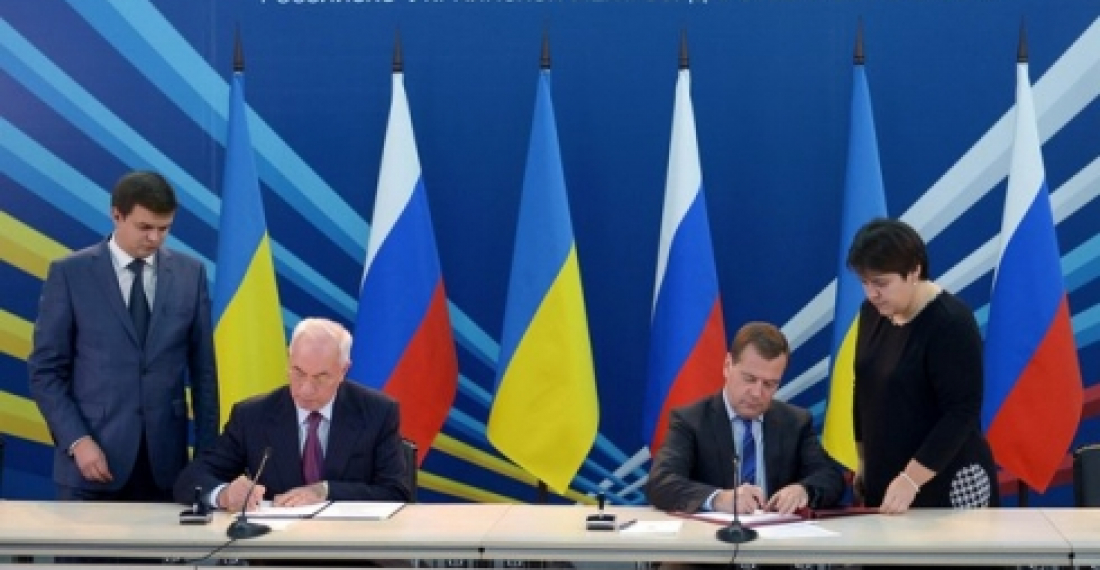
Medvedev does not understand why Ukraine wants association with EU. As Russian pressure on neighbours continues Putin's adviser says Armenia was nearly dragged by the EU "into a conveyor belt".

Russian Prime Minister Dimitri Medvedev has again questioned Ukraine's wish to enter into an Association Agreement with the European Union. Speaking at a press Conference with his Ukrainian counterpart Mykola Azarov, after a meeting of the Russia-Ukraine Intergovernmental Commission, Medvedev said that he did not know why Ukraine wanted to sign an association agreement with the European Union and that he could not see any particular benefits for Ukraine in doing so.

"One thing is clear: Of course, after an association agreement is signed - and this is our open, simple and sincere position - it will be very difficult for Ukraine to join the Customs Union if it wants to," he said. "I believe [its] chances for full-fledged membership will be practically zero," the Russian Prime Minister said, according to RIA Novosti. Medvedev reiterated that Moscow wanted to build an "economic union, not some amorphous association," so the "Russia-Kazakhstan-Belarus plus Ukraine" formula was unacceptable.

Russian officials have been very active in recent weeks in an effort to derail plans of the European Union to sign Association Agreements with those Eastern neighbours who wanted to do so and who satisified the EU stringent criteria. Most of the Russian arms twisting has been taking place behind the scenes, but one senior Russian official has apparently been given the role of wielding the knife in the open. President Putin's Adviser Sergey Glazyev has given several interviews aimed at adding pressure on the leadership of those countries that continue to reject the Russian "customs union" option.

Speaking on the popular Radio Station "Echo of Moscow" on 10 October Glazyev said that European officials impose their standard text worked out over dozens of years upon their Eastern partners. Glazyev said that Armenia was almost dragged into a conveyor but "with the support of our experts, we helped our Armenian counterparts analyse the text of the agreement with the EU".

"One can't get associated with the EU and sign the Agreement on Common Economic Space with Russia simultaneously. Obviously, it's not possible from a legal point of view. The Armenian government got confused in its choices. They thought they could simultaneously sign the Agreement with the EU and remain part of the CSTO, for instance. And there is a political component there as well which reads that the side concluding an Association Agreement with the EU is committed to following the lead of  European policy and take part in the settlement of the regional conflicts under the EU guidance. And then the President as a person responsible for the country's security was asked the question: "How is it possible to be involved in the settlement of NK conflict with Azerbaijan under the EU leadership?" That's an interesting question. When such simple questions are asked it's obvious that the draft Association Agreement deprives the country of sovereignty, independence and makes it EU's colony", said Sergey Glazyev.

According to him, expert consultations are currently being held and "by 2015, both Kyrgyzstan and Armenia will join simultaneously the Customs Union, Common Economic Space and Eurasian Union".

The Russian President's Advisor said that as a part of a single customs territory, Armenia will technically have the same customs regime as Kaliningrad region of Russian Federation.

Answering a question about Ukraine, Sergey Glazyev said: "I am sure common sense will prevail".

You can listen to the interview of Sergei Glazyev (in Russian) on "Echo of Moscow", in full here.

source: Commonspace.eu with Echo of Moscow, Ria Novosti and Mediamax.

photo: Russian Prime Minister Medvedev with Ukrainian Prime Minister at the meeting of the Russia-Ukraine Inter-Governmental Commission (picture courtesy of the Press Service of the Prime Minister of Russia)


Related articles

Editor's choice
News
Armenia and EU agree on strategic co-operation, but the 7 June elections will define the future

Armenia and EU agree on strategic co-operation, but the 7 June elections will define the future

This article is part of the Armenia Season on commonspace.eu between 1 May and 15 June 2026. The first Armenia-EU summit was held in Yerevan on 5 May 2026. Alex Verge, was commonspace.eu special correspondent at the summit in Yerevan, and he filed this report: In a landmark diplomatic moment, Armenian Prime Minister Nikol Pashinyan hosted the first-ever bilateral summit between Armenia and the European Union at the presidential residence in Yerevan on 5 May. While it did not deliver any major announcements, the summit reflected the ongoing deepening of the bilateral  relation and a show of support from Europe for Pashinyan, who is seeking re-election in parliamentary elections in June. EU Commission President Ursual von der Leyen and European Council President Antonio Costa were representing Europe at the summit. Both gave significant credit to Pashinyan personally for his role in bringing Armenia closer to the EU, underlining shared values and commitments to democracy, rule of law, peace and stability.  The current prime minister has indeed overseen a significant rapprochement. In 2025, the Armenian parliament adopted a law that officially mandated the government to pursue EU integration. Accession remains a very distant prospect however. Pashinyan himself commented at the summit that Armenia faced a long road before it could align itself to EU standards, including regarding judiciary independence, and that there was no guarantee that the EU wanted to expand further. He added that a deeper bilateral relationship was highly valuable in and of itself. Alongside the European Political Community gathering that took place the day before, the EU summit will have contributed to the international credibility of Pashinyan and may therefore serve his re-election prospects well. Domestically, it remains to be seen whether Pashinyan will receive similar support from the Armenian electorate come the June parliamentary elections. Outside the presidential palace, a crowd was gathered to call for the release of Armenian prisoners of war held by Azerbaijan - one of the number of issues where large parts of Armenian society have been critical of their current government. Much more than this weekend’s summits, it will be the elections in June that will shape the trajectory of Armenia’s foreign policy. This article is part of the Armenia Season on commonspace.eu between 1 May and 15 June 2026. The first Armenia-EU summit was held in Yerevan on 5 May 2026. Alex Verge, was commonspace.eu special correspondent at the summit in Yerevan, and he filed this report. Press the image to read the full report.
Editor's choice
News
First Armenia-EU summit held in Yerevan - important agreements signed

First Armenia-EU summit held in Yerevan - important agreements signed

The first Armenia–EU Summit was held in Yerevan on Tuesday, 5 May 2026. It marked a historic milestone in bilateral relations, featuring the signing of a number of strategic documents and new initiatives aimed at deepening cooperation. Armenian Prime Minister Nikol Pashinyan, European Commission President Ursula von der Leyen, and European Council President António Costa, together with other participants, witnessed the signing of the EU–Armenia Connectivity Partnership — a major step forward in strengthening transport, energy, and digital links. Fully aligned with the EU’s Cross-Regional Connectivity Agenda and Armenia’s Crossroads of Peace initiative, it will boost trade, create jobs, reinforce resilience, and support regional stability. The partnership will be institutionalised through a High-Level Dialogue on Connectivity, alongside a High-Level Transport Dialogue, also launched at the summit. Additionally, the EU is boosting economic growth in the country by launching a Call for Expressions of Interest, inviting companies in the EU, the European Economic Area, and Armenia to develop strategic investment projects in Armenia. The signing of the first Letters of Intent with selected private sector partners in the fields of digital infrastructure, semiconductor skills, innovation ecosystems, and private investment mobilisation aims to bring a tangible positive impact to Armenia. The first progress report on Armenia’s implementation of the visa liberalisation action plan was formally handed to the Armenian side. This first report acknowledges good progress and provides recommendations on the next steps in its implementation. In addition, leaders witnessed the initialling of a working arrangement between the European Border and Coast Guard Agency (Frontex) and the Armenian Ministry of Internal Affairs, which will enhance cooperation on border and migration management, supporting Armenia in the implementation of the visa liberalisation action plan. On security and defence, leaders welcomed the establishment of an EU Partnership Mission in Armenia. (This article is part of the Armenia Season on commonspace.eu)

Popular

Editor's choice
Interview
Thursday Interview: Murad Muradov

Thursday Interview: Murad Muradov

Today, commonspace.eu starts a new regular weekly series. THURSDAY INTERVIEW, conducted by Lauri Nikulainen, will host  persons who are thinkers, opinion shapers, and implementors in their countries and spheres. We start the series with an interview with Murad Muradov, a leading person in Azerbaijan's think tank community. He is also the first co-chair of the Action Committee for a new Armenian-Azerbaijani Dialogue. Last September he made history by being the first Azerbaijani civil society activist to visit Armenia after the 44 day war, and the start of the peace process. Speaking about this visit Murad Muradov said: "My experience was largely positive. My negative expectations luckily didn’t play out. The discussions were respectful, the panel format bringing together experts from Armenia, Azerbaijan, and Turkey was particularly valuable during the NATO Rose-Roth Seminar in Yerevan, and media coverage, while varied in tone, remained largely constructive. Some media outlets though attempted to represent me as more of a government mouthpiece than an independent expert, which was totally misleading.  Overall, I see these initiatives as important steps in rebuilding trust and normalising professional engagement. The fact that soon a larger Azerbaijani civil society visits to Armenia followed, reinforces the sense that this process is moving in the right direction." (click the image to read the interview in full)

