


DONE! Georgia, Moldova and Ukraine are now associate member states of the EU and partners in a free trade area.

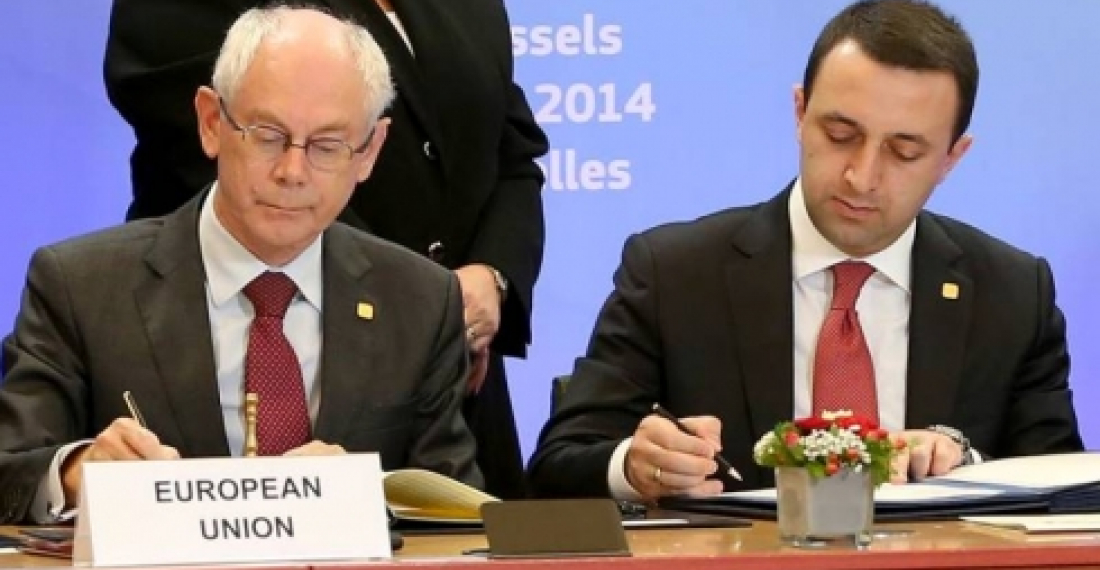
At a ceremony in Brussels the leaders of the 28 member states of the European Union and heads of the European institutions, and the leaders of Georgia, Moldova and Ukraine, today signed the documents enabling the three countries to become Associate members of the EU and to be part of a deep and comprehensive free trade area.

Speaking at the signing ceremony, European Commission President Jose Manoel Barroso said:

For our three partners, it is a recognition of the significant progress made over recent years and of their strong political determination to come closer to the European Union; their shared outlook on a prosperous economic model; and their desire to live by the European spirit and with European values.

For the European Union, it is a solemn commitment to support Georgia, the Republic of Moldova and Ukraine, each step of the way, along the road of transforming their countries into stable, prosperous democracies.

These Association Agreements are the logical and natural outcome of a path started more than 20 years ago when these countries became independent sovereign states.

These Agreements are also a landmark in our Eastern Partnership policy that set the objective of achieving political association and economic integration with our partners, who were willing and ready to do so.

The Agreements we are signing today are the most ambitious the European Union has entered into so far. They will enable our partner countries to drive reforms, to consolidate the rule of law and good governance; and to give an impetus to economic growth in the region by granting access to the world's largest internal market and by encouraging cooperation across a wide range of sectors.

Georgian Prime Minister Irakli Garibashvili, speaking in English and Georgian referred to Georgia's European dreams and asspirations which he said goes back centuries. He reached out to the populations in the secessionist regions of Abkhazia and South Ossetia and appealed to them to join  the rest of the country on this European journey. Garibashvili indicated Georgia's wish to build on the agrreement being signed today in the process of seeking full EU membership.

This theme was also picked up by President Poroshenko of Ukraine who used his speech to formally request full EU membership under the provisions of the EU treaties. Poroshenko referred to the painful process that Ukraine had to undergo in recent months. He emphasised that Ukraine was entering the Association relationship with the EU with all its terriytory, including Crimea.

source: commonspace.eu with agencies

photo: The Prime Minister of Georgia, iIakli Garibashvili signing the documents through which Georgia became an Associate member of the European union at a ceremony at the Council Building in Brussels on 27 June 2014. (picture courtesy of the Press Service of the European Union).

 

Related articles

Editor's choice
News
Borrell tells the European Parliament that the situation in Afghanistan was critical, but the EU will remain engaged

Borrell tells the European Parliament that the situation in Afghanistan was critical, but the EU will remain engaged

Borrell underlined that the European Union will make every effort to support the peace process and to remain a committed partner to the Afghan people. "Of course, we will have to take into account the evolving situation, but disengagement is not an option.  We are clear on that: there is no alternative to a negotiated political settlement, through inclusive peace talks.
Editor's choice
News
Pope's visit to Türkiye and Lebanon has a strong ecumenical character, and places interreligious dialogue at its centre

Pope's visit to Türkiye and Lebanon has a strong ecumenical character, and places interreligious dialogue at its centre

Pope Leo XIV has begun the first overseas trip of his pontificate, a six-day visit to Türkiye and Lebanon, which started yesterday (27 November) and ends on Tuesday (2 December). According to Vatican Radio, the visit "carries a strong ecumenical character and places interreligious dialogue at its centre. It will also be a moment of closeness to Christian communities and local populations across the region".   During nearly a week in the region, Pope Leo XIV will meet civil and religious authorities, visit mosques and ancient churches, pray at Beirut’s port in memory of the victims of the 2020 explosion, and hold private meetings with Presidents Recep Tayyip Erdoğan and Joseph Aoun.   A highlight of the visit will be a visit to Nicaea, where the Pope will mark the anniversary of the Council of Nicaea. Christians of many traditions recognise the Council of Nicaea as a foundation of shared faith. One of the most anticipated moments will be the Pope’s encounter with Lebanese youth in Bkerké, at the Maronite Patriarchate, a meeting expected to carry strong messages of hope in the Jubilee Year. A central event will be the ecumenical celebration in İznik, where the Pope and Ecumenical Patriarch Bartholomew will walk together toward the ruins of the Basilica of St Neophytos. The prayer, held before icons of Christ and the Council, will conclude with the lighting of a candle—a symbolic gesture of unity. The journey will also highlight interreligious engagement.   Memorable moments are expected throughout the trip: a wreath at Atatürk’s mausoleum, prayer inside the Blue Mosque, Mass at Istanbul’s Volkswagen Arena, the planting of a cedar at the presidential palace in Beirut, and prayer at the tomb of St Charbel in Lebanon. The Vatican said that "Pope Leo XIV’s pilgrimage to Türkiye and Lebanon aims to offer a voice of peace, unity, and hope at the heart of the Middle East."

Popular

Editor's choice
News
Pope's visit to Türkiye and Lebanon has a strong ecumenical character, and places interreligious dialogue at its centre

Pope's visit to Türkiye and Lebanon has a strong ecumenical character, and places interreligious dialogue at its centre

Pope Leo XIV has begun the first overseas trip of his pontificate, a six-day visit to Türkiye and Lebanon, which started yesterday (27 November) and ends on Tuesday (2 December). According to Vatican Radio, the visit "carries a strong ecumenical character and places interreligious dialogue at its centre. It will also be a moment of closeness to Christian communities and local populations across the region".   During nearly a week in the region, Pope Leo XIV will meet civil and religious authorities, visit mosques and ancient churches, pray at Beirut’s port in memory of the victims of the 2020 explosion, and hold private meetings with Presidents Recep Tayyip Erdoğan and Joseph Aoun.   A highlight of the visit will be a visit to Nicaea, where the Pope will mark the anniversary of the Council of Nicaea. Christians of many traditions recognise the Council of Nicaea as a foundation of shared faith. One of the most anticipated moments will be the Pope’s encounter with Lebanese youth in Bkerké, at the Maronite Patriarchate, a meeting expected to carry strong messages of hope in the Jubilee Year. A central event will be the ecumenical celebration in İznik, where the Pope and Ecumenical Patriarch Bartholomew will walk together toward the ruins of the Basilica of St Neophytos. The prayer, held before icons of Christ and the Council, will conclude with the lighting of a candle—a symbolic gesture of unity. The journey will also highlight interreligious engagement.   Memorable moments are expected throughout the trip: a wreath at Atatürk’s mausoleum, prayer inside the Blue Mosque, Mass at Istanbul’s Volkswagen Arena, the planting of a cedar at the presidential palace in Beirut, and prayer at the tomb of St Charbel in Lebanon. The Vatican said that "Pope Leo XIV’s pilgrimage to Türkiye and Lebanon aims to offer a voice of peace, unity, and hope at the heart of the Middle East."
