This is a commentary prepared by the editorial team of commonspace.eu
NATO heads of state gather in Warsaw this weekend for a two-day summit, an event which takes place only once every two years. Once more the people of Georgia will be watching events in Georgia and waiting to see how these will affect the future of their country. While full NATO membership for Georgia is not immediately on the agenda, the two have shown in multiple ways that they are reliable partners. The summit in the Polish capital will further seal this trust, but the summit needs also to send an unambiguous message of support to Georgia and its people.
Georgia came close to full membership at a NATO summit in Bucharest in April 2008. However, this did not happen and four months later, Russian tanks rolled into South Ossetia and, after a five day war which killed hundreds, Georgia’s jurisdiction over Abkhazia and South Ossetia was further eroded when Russia decided to recognised the two de facto separatist entities as independent states.
NATO’s famous Article Five of the North Atlantic Treaty says an attack on one is an attack on all, meaning if Georgia had been a member at the time of the war, American and European allies would have been obliged to support Georgia militarily.
For some in NATO in 2008, the August war justified NATO’s scepticism in April. This was a country which clearly could not be defended without the risk of getting embroiled in war with Russia But for others, the war could have been prevented if Georgia had joined at the Bucharest summit.
This dilemma remains unresolved eight years later, even though Georgia has been a model partner for NATO over the years. At the height of the Afghan war, Georgia had almost 2,000 soldiers in the country’s dangerous south, making it the largest per capita troop-contributing nation in the NATO alliance.
Georgia also routinely conducts military drills with NATO allies such as the USA, UK and Turkey. The government spends 2% of GDP on its military, a NATO demand which only five members meet. There is also widespread support for NATO membership within Georgia, to a far greater extent than in many candidates for accession, or indeed existing member states. Georgia’s problem is geo-politics, and a perception, well fed by Kremlin apologists, that inviting Georgia into NATO would be a provocative act against Russia. In a time of uncertainty in Europe many NATO member states, especially France and Germany, are cautious about further increasing tensions with Moscow.
Some NATO members are concerned Georgia would use membership of the alliance to secure military support for the restoration of its authority on Abkhazia and South Ossetia, however Georgia says some kind of compromise arrangement could be possible, such as by excluding the two territories from the Article 5 guarantee. Georgia, unlike Russia has made a ‘non-use of force’ pledge regarding the occupied region, and the Georgian Dream government has since 2012 adopted, with the encouragement of western countries, a policy of dialogue with Russia.
Whilst many NATO leaders consistently speak warmly of Georgia, and are grateful for its tangible contributions to the alliance, ‘MAP’ – a Membership Action Plan – does not seem to be on the agenda for the moment. This is galling to some Georgians because Montenegro, only independent for a decade and with a population whose enthusiasm for NATO membership is much more tepid, is becoming NATO’s 29th member, despite being a far less active contributor.
Georgian Prime Minister Giorgi Kvirikashvili has said Montenegro’s accession is a good thing, because it means the door of the alliance is still open. “We don’t see any alternative for ensuring long-term stability for Georgia to joining this Euro-Atlantic family of countries,” he said recently.
Georgia is heading to parliamentary elections in October and some populist politicians are trying to use the issue to score political points. Among them are Nino Burjanadze and Gogi Topadze, both of who have made anti-NATO statements. Burjanadze has made the adoption of a non-aligned status for Georgia as part of her political platform ahead of the elections. Moscow still has some possibility of influencing public opinion in Georgia and pro-Moscow parties, whilst still on the margins of the political spectrum, have tried to capitalise on disappointment in Georgia on the speed of euro-atlantic integration. They will all be seeking to secure representation in the new Parliament after October.
Conscious of this NATO leaders have been seeking ways of increasing co-operation with Georgia, short of membership through schemes such as the Annual National Program, the NATO–Georgia Commission, and the Substantial NATO–Georgia Package. “At the Warsaw Summit next month, we will further strengthen our package of support for Georgia,” NATO’s Secretary General Jens Stoltenberg said in June.
To some diplomats, the case of the Former Yugoslav Republic of Macedonia (FYROM) is a warning. It did not receive an invitation to join NATO when one was expected in 1998, and subsequently backslid in terms of corruption and political reform. Now, NATO membership is firmly off the cards.
At the Warsaw Summit Georgia will be a side issue to the bigger question of the relations of the alliance with Russia, relations that have reached their lowest point since the end of the cold-war. The NATO-Russia Council met recently for the first time in two years, and a further meeting is scheduled shortly after the Warsaw summit. "Our discussions will focus on the crisis in and around Ukraine and the need to fully implement the Minsk Agreements," Stoltenberg said in a statement.
Britain’s vote to leave the European Union, confirmed in a referendum two weeks ago, shocked diplomats and allies. It is likely to be a major source of discussion, and distraction, in Warsaw. “The UK is one of the strongest members of NATO, and I have no doubt that its participation and cooperation in the alliance will continue at least at the same level,” Polish president Andrzej Duda told journalists. Yet the Brexit will add considerably to the uncertaintly within Europe and its institutions at present.
NATO leaders are meeting in Warsaw this weekend at a very unpredictable time for security on the European continent. This notwithstanding, Georgians should be optimistic and patient. Their country is a comparative success story and its commitment to the North Atlantic alliance is already proven and without doubt. Eventually this will be recognised and Georgia will be part of the security umbrella which it seeks, and which it deserves. The NATO Warsaw summit needs to send this message clearly to the Georgian people.
source: This is a commentary prepared by the editorial team of commonspace.eu
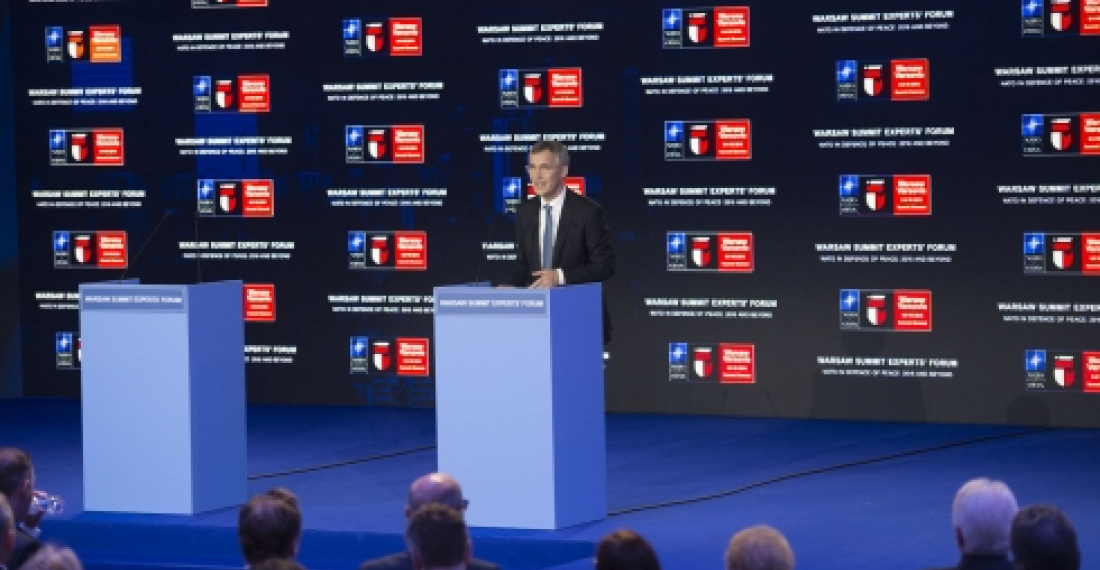
photo: NATO Secretary General Jens Stoltenberg addressing experts ahead of the NATO Summit in Warsaw in July 2016. (picture courtesy of NATO Press Service).