


Azerbaijan celebrates twenty-year journey to prosperity

Azerbaijan celebrated the 20th anniversary of the signing of the "Contract of the Century" - an agreement that opened the way for the country's increased prosperity as an energy produc er and supplier. The Contract of the Century was signed in Baku in 1994 by the then President Heidar Aliev and representatives of seven other countries and thirteen international companies. The first oil was extracted in 1997. The contract eventually led to the construction of the Baku-Tbilisi-Ceyhan Pipeline (BTC) and to a number of other ancillary projects.

A ceremony to mark the occasion was held in Baku yesterday. Azerbaijan's current President, Ilham Aliev, welcomed a number of Presidents, Prime Ministers and other senior officials from partner countries. In his speech President Aliev spoke about Azerbaijan's past achievements and future plans. He said the Contract of the Century was implemented successfully for twenty years and gave back huge profits.

"BTC has united the Caspian Sea and Mediterranean Sea, this is a historical achievement. The construction of the Trans Anatolian Gas Pipeline (TANAP) was agreed in 2012. Moreover, the choice of TANAP's route is also a historical event. Agreements on gas export were signed last year. Today all horizons are open before us. We must together ensure the construction of the Southern Gas Corridor", President Aliyev said.

The president said this project would bring additional dividends to Azerbaijan's economy, adding that in recent years the budget expenditures of Azerbaijan increased by 20 times and the unemployment rate fell below 5 percent. Azerbaijan ranks 38th place for economic competitiveness.

"Azerbaijan is a major shareholder in TANAP and will assume the financial responsability for it. Azerbaijan itself finances its share in the projects of Shah Deniz, TANAP and TAP. There will be no losers following the implementation of this project. This project will play a key role in Europe's energy supply. Azerbaijan plays an important role in ensuring Europe's energy security and this role will only grow in the future", the President noted.

President Aliyev noted that the proven gas reserves in Azerbaijan are 2.5 trillion cubic meters, undiscovered - 4 trillion cubic meters.

"Azerbaijan, Georgia and Turkey have participated in oil-gas projects up to now. We are going to enhance our cooperation from today. Italy, Greece, Bulgaria, Montenegro and other countries can join this project in the future. A new international team is being created in oil-gas field. I'm confident that our team will  be successful", he said.

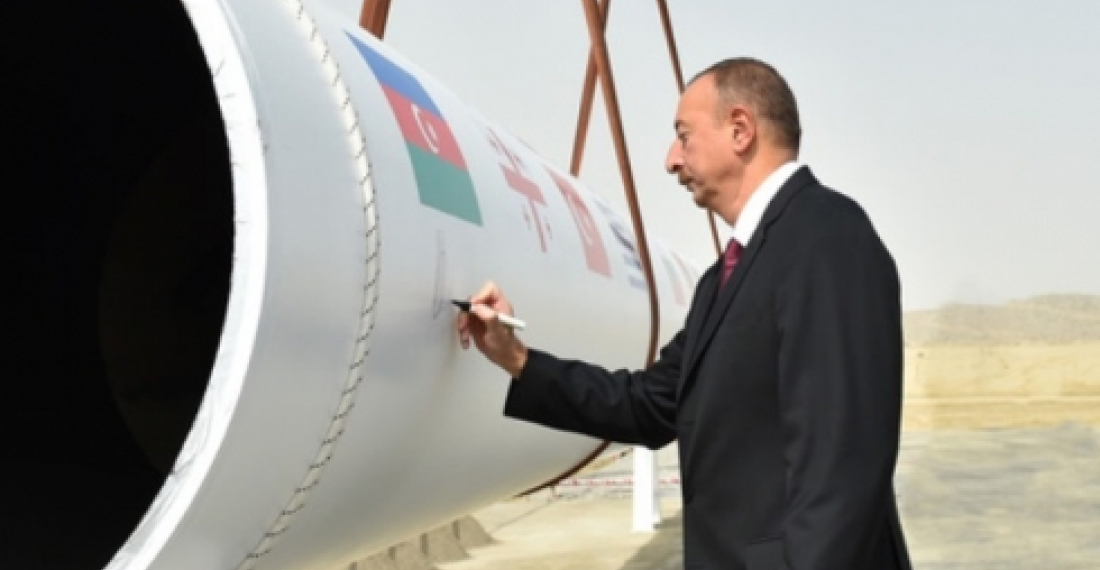
The President, accompanied by the foreign guests, later attended a ground breaking ceremony for the new Southern Gas Corridor -  a project that will contribute toward European energy security and which is also expected to give a further economic boost to the region.

source: commonspace.eu with APA News Agency.

photo: President Ilham Aliev puts his signature on the first part of the new Southern Gas Corridor pipeline in Baku on 20 September 2014. (Picture courtesy of the Press Office of the President of Azerbaijan.
Related articles

Editor's choice
News
Finland hosts European Arctic Summit

Finland hosts European Arctic Summit

The Arctic summit of European leaders will be held in Rovaniemi, a municipality in Northern Finland on 13–14 September. Prime Minister Petteri Orpo has invited a group of EU leaders to the summit. The aim of the summit is to strengthen the EU’s common strategic approach to the Arctic region as its geopolitical significance continues to grow rapidly. “The Arctic region is an increasingly important part of Europe's security environment. The European Union has direct interests in its stability, security and sustainable development. It is very valuable to be able to discuss these issues together with a comprehensive group of EU leaders,” said Orpo. The summit will be attended by German Chancellor Friedrich Merz, Prime Minister of Poland Donald Tusk, Prime Minister of Denmark Mette Frederiksen, Prime Minister of Estonia Kristen Michal, Prime Minister of Latvia Andris Kulbergs, President of Lithuania Gitanas Nausėda and President of Romania Nicușor Dan. President of the European Council António Costa and High Representative of the Union for Foreign Affairs and Security Policy Kaja Kallas will also take part in the summit. The summit is taking place against an extremely dynamic backdrop. In the face of accelerating climate change and geopolitical tensions in the Strait of Hormuz, the economic importance of the northeast passage is growing. For 2026, more than forty million tonnes of freight are expected to pass through the Northern Sea Route for the first time, primarily due to expanded trade between Russia and China. Furthermore, in August, China launched its first regular container service through the Arctic. Finally, the EU’s Arctic policy itself is set for a reorientation: the Commission intends to present an updated Arctic strategy this autumn, in which security is to play a central role for the first time. Kaja Kallas had already advocated for this at the Arctic Frontiers conference in Tromsø earlier this year, stating that the Arctic needed more attention, more resources, and more hard power. The summit in Rovaniemi can therefore also be seen as a dress rehearsal for the new strategy. Finland brings a unique perspective to this debate: over 95 per cent of Finland’s foreign trade in goods is conducted by sea, and its ports freeze over almost every winter. This structural peculiarity has given rise to a strong export sector in the field of icebreakers: Finnish companies have designed around 80 per cent of all icebreakers worldwide and built around 60 per cent; even the US Coast Guard is having the first vessels of its new Arctic Security Cutter class built in Finland because the domestic alternative could not meet the schedule. The fact that this leverage can also be utilised geopolitically has already been successfully demonstrated. At the end of September 2022, the Finnish Ministry of Foreign Affairs refused to grant an export licence for an LNG icebreaker ordered by the Russian mining group Norilsk Nickel, thereby bringing to an end a project that would have created around 2,100 person-years of employment. (click the image to read more).

Popular

Editor's choice
Interview
Thursday Interview: Murad Muradov

Thursday Interview: Murad Muradov

Today, commonspace.eu starts a new regular weekly series. THURSDAY INTERVIEW, conducted by Lauri Nikulainen, will host  persons who are thinkers, opinion shapers, and implementors in their countries and spheres. We start the series with an interview with Murad Muradov, a leading person in Azerbaijan's think tank community. He is also the first co-chair of the Action Committee for a new Armenian-Azerbaijani Dialogue. Last September he made history by being the first Azerbaijani civil society activist to visit Armenia after the 44 day war, and the start of the peace process. Speaking about this visit Murad Muradov said: "My experience was largely positive. My negative expectations luckily didn’t play out. The discussions were respectful, the panel format bringing together experts from Armenia, Azerbaijan, and Turkey was particularly valuable during the NATO Rose-Roth Seminar in Yerevan, and media coverage, while varied in tone, remained largely constructive. Some media outlets though attempted to represent me as more of a government mouthpiece than an independent expert, which was totally misleading.  Overall, I see these initiatives as important steps in rebuilding trust and normalising professional engagement. The fact that soon a larger Azerbaijani civil society visits to Armenia followed, reinforces the sense that this process is moving in the right direction." (click the image to read the interview in full)

