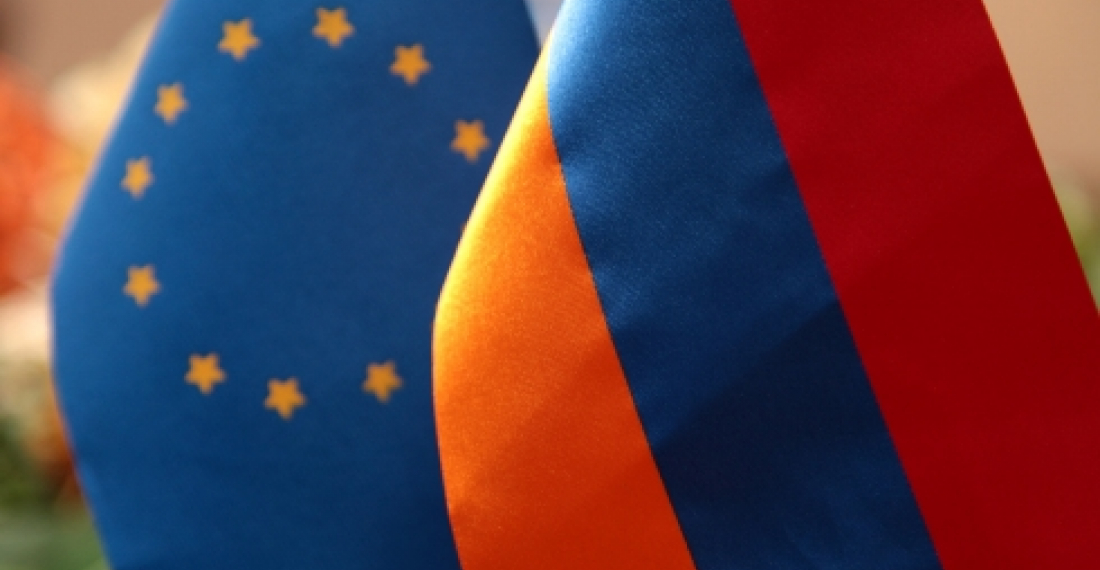
Armenian diplomats and their European Union counterparts have started the process of identifying the basis on which to build their future relations after Armenia formally joins the Russia-led Eurasian Union.
At a press conference on Friday, Germany's ambassador to Armenia, said a meeting is planned for November.
"The talks will continue, and formats of cooperation between Armenia and EU will be clarified. The format of interaction with EU will become clearer following October 10 when Armenia will join the Eurasian Union," said Reiner Morell.
EU officials will raise the delicate topic of its relationship with Armenia after the country joins Belarus, Kazakhstan and Vladimir Putin's Russia in the EEU, which will officially come into effect on 1 January 2015.
Putin ratified the EEU treaty on Friday (October 3). This coming Friday (October 10) he will meet in Minsk with President Lukashenko of Belarus and President Nazarbayev of Kazakhstan to exchange ratification documents.
Russian Deputy Prime Minister Igor Shuvalov said last week "the treaty stipulating the Republic of Armenia's joining the Eurasian Economic Union has already been worked out."
FALSE DICHOTOMY?
In a speech in New York on September 26, Armenia's president rejected the idea that Armenia faces a binary choice between the EU and the EEU:
"Today when inter-state borders are becoming more and more transparent and intercontinental unified economic zones are formed, it is senseless to speak about conflicting systems and to build a foreign policy based on those contradictions", Serzh Sargsyan said.
"We are trying to develop such mechanisms of cooperation with our partners that correlate rather than confront. It is not mere words. It is the way we think, it is our everyday efforts, our vision, and we came to it based on our own experience."
Last summer, Armenia was engaged in major negotiations over a Deep and Comprehensive Free Trade Agreement (DCFTA) with the European Union. However, a free trade agreement with Russia eventually proved more attractive. EU officials are this time proceeding very cautiously. Opinion in Brussels is that Armenia had a choice to make and once it made that choice it must live with its consequences. The EU is however still interested in good relations with the country, as well as in promoting principles of good goverenance.
"The discussions are in the preparatory stage, and we are working with our Armenian partners," Traian Hristea, head of the EU delegation in Armenia, told reporters. "Very soon we will have a bilateral meeting aimed at preparing a new package of proposals."
source: commonspace.eu with agencies