Commentary:
The Presidents of Armenia and Azerbaijan were amongst the first foreign leaders to send congratulatory messages to the new President of Georgia, Giorgi Margvelashvili after his election on Sunday. Both are likely to move quickly to build a relationship with the new Georgian leadership once the new Prime Minister is named at the end of this week. The new political situation in Georgia takes the region into uncharted waters, and both neighbours want to know how this is going to affect them.
The same unease could be seen ten years ago after Saakashvili's Rose revolution. But swiftly Saakashvili found an understanding with his neighbours. Those who feared he will try to export Georgia's revolution were proved wrong. There are of course tangible reasons for this. Despite all claims to the contrary the three countries are interlinked and inter connected. Both Armenia and Azerbaijan depend to some extent on Georgia for their links to the outside world. Georgians on their part are aware of the large Armenian and Azerbaijani ethnic minorities in their country. For Tbilisi, a good relationship with Baku and Yerevan is a must. It is true that Saakashvili for most of his time as President abandoned the Caucasian vocation and focused on relations with the west. But even he, later in his administration, realised that Georgia's regional standing is also good for its relations with Europe.
Both Ilham Aliev in Azerbaijan and Serzh Sargsyan in Armenia managed to build a good personal relationship with Saakashvili and had got used to him. They are now trying to figure out the new leadership that is emerging in Tbilisi. The set-up of this leadership is in itself unusual. The increased power of the Prime Minister creates a different hierarchy. Both countries have noted the praise heaped on Georgia after last Sunday's presidential election by western leaders and media for the way it conducted the poll. The sight of a President leaving office without much ado may set a pattern. This creates a certain discomfort with the two neighbours who see politics as a managed process. Georgia can be a much more effective model than far away western countries can ever hope to be.
Margvelashvili, and whoever becomes Prime Minister when Ivanishvili resigns shortly, will certainly move swiftly to establish good relations with the neighbours. Yet there will always remain for Georgia the temptation to abandon a regional role and aim instead to play on the grander world stage. This should not be. Georgia needs to offer its neighbours both leadership and friendship and should work harder to try to defuse the problems between Armenia and Azerbaijan. Regional initiatives are difficult to put together, but Georgia needs to promote them. It must also continue to work closely with the two countries bilaterally. In the end Margvelashvili's election and the smooth political transfer of power in Georgia, which started one year ago and will finish next month, are good news for Armenia and Azerbaijan too. It is time each country sees the success of another as its victory and not its loss. At the moment the time when the three can work together in harmony may seem like a distant fairy tale. In reality it could happen sooner than some may think.
This commentary was prepared by the political editor of commonspace.eu.
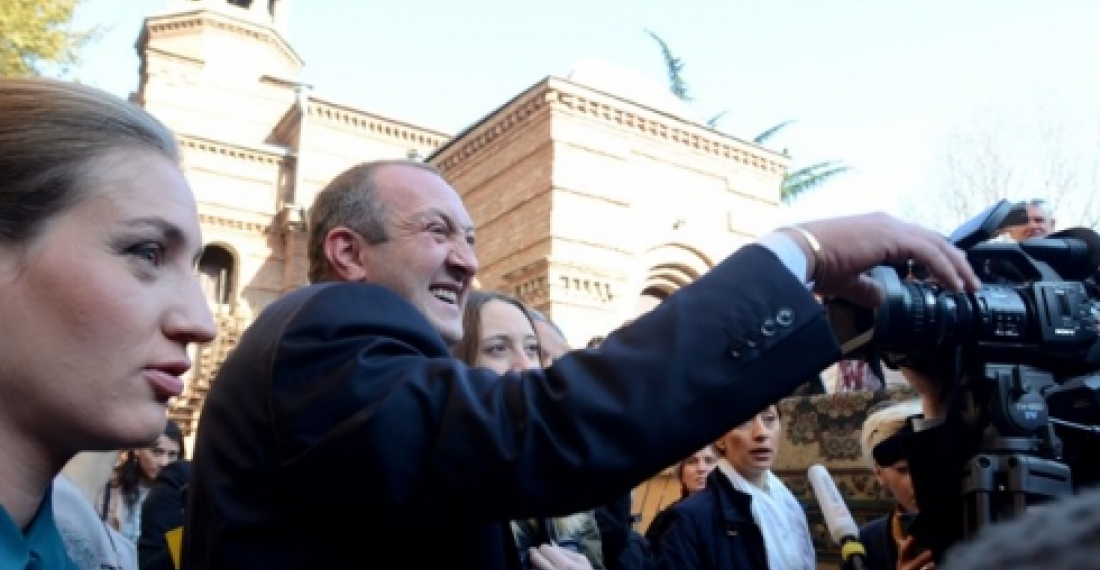
photo: Giorgi Margvelashvili on the campaign trail before last Sunday's poll. (picture by Molly Corso (c) commonspace.eu)