Analysis: New Syrian Government moves to end years of isolation by emphasising inclusivity

The new Syrian government may have come to power last month brandishing a jihadist label, but its leader Ahmad al-Sharaa, also known as Abu Mohammed al Jilani is determined to emphasise its inclusive approach, particularly as regards the country’s large Christian population. The Baathist regime of al-Assad had for long instilled a fear within this community in case there is an Islamist victory.

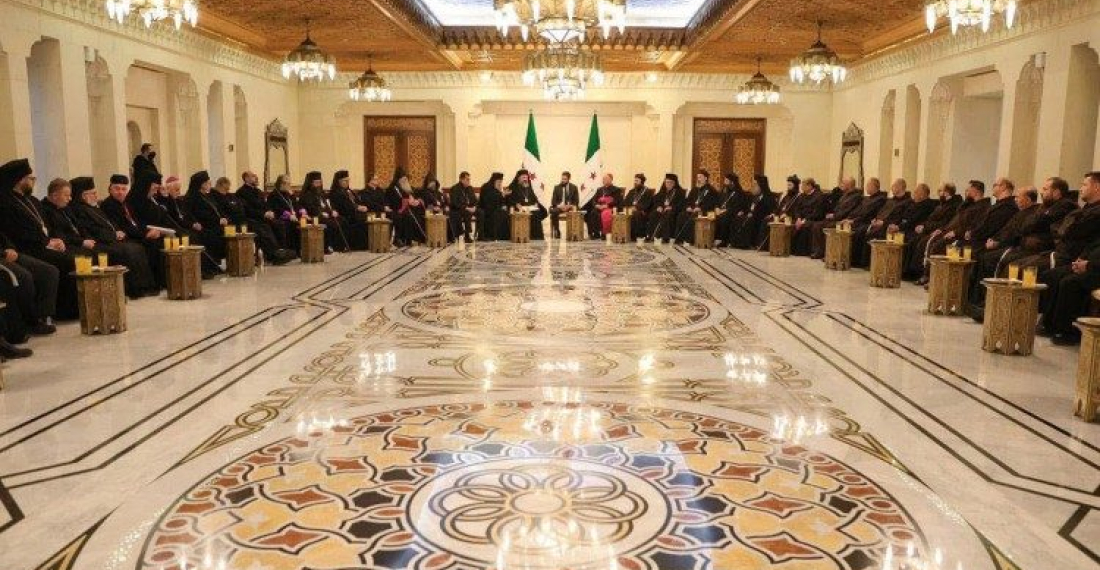
Moving to quash this fear, which had also been predominant in Western circles, Ahmed al-Sharaa met on New Year's Eve with leaders from the Christian communities, to wish them a merry Christmas and a peaceful New Year and to assure them that the new Syria will be inclusive. Among those present were leaders from the Franciscan Friars of the Holy Land who under an old catholic tradition lead Christians across the Levant.

The Vatican “cautiously optimistic”

The Vatican, which watches events in Syria closely has expressed itself to be cautiously optimistic. The Apostolic Nuncio of the Holy See to Syria, Cardinal Mario Zenari, told Vatican Radio,

“this event would have been unimaginable only three weeks ago, and the bishops and priests present at the meeting  left with  a sense of hope for Syria’s future.”

Cardinal Zenari added “it remains to be seen if words will  translate into action

Inclusivity is high on the agenda of the EU also

Recent weeks have also witnessed a flurry of high-level diplomatic engagement on the situation in Syria. Several countries, including Western and Gulf nations, have opened diplomatic channels and dispatched high-level diplomatic contingents to engage with the caretaker authorities. Most recently, on 3 January, the foreign ministers of France and Germany visited Damascus and held discussions with Sharaa. In her remarks following the meeting, German Foreign Minister Annalena Baerbock said that the relationship of the European Union (EU) with the Syrian caretaker authorities hinges on ensuring that individuals of all ethnic and religious backgrounds have a role in the country’s political system and are adequately protected.

New  government seeks to widen its legitimacy through a national dialogue

In late December 2024, the new authorities announced plans to convene a national dialogue conference to bring together Syria’s different political and sectarian groups to discuss the political transition; however, some opposition groups had expressed reservations about the lack of transparency and limited representation. Although media reports had suggested that the conference might occur in early January, on Tuesday (7 January) the foreign minister of the Syrian caretaker government, Asaad Hassan al-Shibani, said that more preparation time is needed and announced plans to establish an expanded preparatory committee to ensure broader representation from all segments and governorates of Syria.

UN Security Council will hold a meeting starting Wednesday morning

On Wednesday (8 January), the UN Security Council will hold a briefing on the political and humanitarian situations in Syria. Special Envoy for Syria Geir O. Pedersen and Under-Secretary-General for Humanitarian Affairs Tom Fletcher will brief on political and humanitarian developments, respectively. Egypt, Iran, Kuwait, and Türkiye are expected to participate under rule 37 of the Council’s provisional rules of procedure. Closed consultations are scheduled to follow the open briefing.

The meeting takes place one month after the ousting of former Syrian President Bashar al-Assad following a major offensive launched by rebel forces, involving Security Council-listed terrorist group Hayat Tahrir al-Sham (HTS) and the Syrian National Army (SNA), a coalition of armed groups allegedly backed by Türkiye.  

Relations with other Arab countries will remain a priority

After assuming the role of foreign minister, Shibani embarked on a series of diplomatic visits. On 1 January, he visited Saudi Arabia with Syria’s Defense Minister, Murhaf Abu Qasra. This was followed by visits to Qatar, the United Arab Emirates, and Jordan. In a post on X (formerly Twitter), Shibani said that these visits aim to build support for Syria’s “stability, security, economic recovery, and building distinguished partnerships”.

Dire humanitarian situation

The Meeting of the UN Security Council is likely to focus on the dire humanitarian situation in the country and efforts by humanitarian agencies to deliver aid across the country.  According to a flash update from the Office for the Coordination of Humanitarian Affairs (OCHA), released earlier today, hostilities and insecurity remain a challenge across Syria, resulting in movement restrictions and damage to vital infrastructure. It notes that humanitarian access remains difficult in parts of north-east Syria due to the ongoing closure of internal border crossings and bridges damaged by recent fighting, restricting the movement of goods and people, including aid workers. The number of people displaced because of the recent military campaign peaked at 1.1 million in mid-December 2024. The number has decreased to 627,000, most of whom currently reside in Idlib. In addition to insecurity and ongoing displacement, the economic situation remains dire across Syria and is compounded by declining public services, according to the OCHA update.

Several UN Security Council members are likely to stress the urgent need to protect civilians and civilian infrastructure as well as humanitarian aid workers. They may call on the parties to adhere to international humanitarian law and emphasise the need for unhindered humanitarian access throughout the country. Denmark has taken on the role of the penholder on the Syria humanitarian file, replacing Switzerland, which completed its two-year Council term at the end of 2024.

Syria’s 2024 Humanitarian Response Plan, which required $4.07 billion, was only 33.3 per cent funded.
Source: This briefing was prepared by the editorial team  of commonspace.eu with reporting from Euro News Vatican Radio and Security Council Report
Photo: Syria's de facto leader Ahmed al Sharaa met Christian religious leaders in Damascus on 31 December 2024 (picture courtesy of Radio Vaticana).

Related articles

Editor's choice
News
Council of Europe launches new International Claims Commission for Ukraine

Council of Europe launches new International Claims Commission for Ukraine

Thirty-four countries and the European Union have signed a new convention establishing an International Claims Commission for Ukraine at a diplomatic conference co-hosted by the 46-nation Council of Europe and the Netherlands in the Hague. The diplomatic conference was attended by leaders and high-level representatives from over 50 states, including the President of Ukraine, Volodymyr Zelenskyy, the President of the Republic of Moldova, Maia Sandu, and the Prime Minister of the Netherlands, Dick Schoof.  “Today marks a major step forward in ensuring accountability for Ukraine. The International Claims Commission represents justice and hope for tens of thousands of victims—our determination that those who have suffered will not be forgotten. I call for quick ratifications so we can get the commission rapidly up and running for the people of Ukraine,” said Council of Europe Secretary General Alain Berset. Ukrainian President Volodymyr Zelenskyy said: “We expect that every mechanism for compensation from the Register of Damage and Claims Commission to the actual payments – will start working and receive strong and sufficient international support, so that people can truly feel that any kind of damage caused by the war can be compensated. This war, and Russia’s responsibility for it, MUST become a clear example – so that others learn not to choose aggression.” “Accountability is about creating the conditions for peace that endures. And therefore, accountability is a condition of security – today and for the future. But accountability is not only about Ukraine. And it is not only about one aggressor and one victim. Accountability is about Europe. About every country in Europe. It is about whether Europe, as a whole, is willing to defend its peace,” said Maia Sandu, President of the Republic of Moldova, which currently holds the Presidency of the Council of Europe’s Committee of Ministers. The Prime Minister of the Netherlands, Dick Schoof, said: “Every day Russia is deliberately bombarding homes, destroying businesses and damaging infrastructure in Ukraine. Russia must compensate Ukraine for the damage caused. That is why we have launched the International Claims Commission for Ukraine and we are honoured to host it.” The International Claims Commission will be the second part of a comprehensive compensation mechanism related to Russia’s war of aggression, building on the existing Register of Damage for Ukraine. The claims commission will be established within the framework of the Council of Europe and will also be open to other countries. The Register of Damage for Ukraine, created in 2023, collects and records compensation claims submitted by individuals, organisations and public bodies in Ukraine. Forty-four states and the European Union have so far joined the Register, which has already received 86,000 claims. The International Claims Commission will review, assess and decide upon claims submitted to the Register of Damage for Ukraine and determine the amount of compensation, if any, which is due in each case. The convention establishing the commission will enter into force once it has been ratified by 25 signatories, as long as sufficient funds have been secured to support its initial work.

Popular

Editor's choice
News
Council of Europe launches new International Claims Commission for Ukraine

Council of Europe launches new International Claims Commission for Ukraine

Thirty-four countries and the European Union have signed a new convention establishing an International Claims Commission for Ukraine at a diplomatic conference co-hosted by the 46-nation Council of Europe and the Netherlands in the Hague. The diplomatic conference was attended by leaders and high-level representatives from over 50 states, including the President of Ukraine, Volodymyr Zelenskyy, the President of the Republic of Moldova, Maia Sandu, and the Prime Minister of the Netherlands, Dick Schoof.  “Today marks a major step forward in ensuring accountability for Ukraine. The International Claims Commission represents justice and hope for tens of thousands of victims—our determination that those who have suffered will not be forgotten. I call for quick ratifications so we can get the commission rapidly up and running for the people of Ukraine,” said Council of Europe Secretary General Alain Berset. Ukrainian President Volodymyr Zelenskyy said: “We expect that every mechanism for compensation from the Register of Damage and Claims Commission to the actual payments – will start working and receive strong and sufficient international support, so that people can truly feel that any kind of damage caused by the war can be compensated. This war, and Russia’s responsibility for it, MUST become a clear example – so that others learn not to choose aggression.” “Accountability is about creating the conditions for peace that endures. And therefore, accountability is a condition of security – today and for the future. But accountability is not only about Ukraine. And it is not only about one aggressor and one victim. Accountability is about Europe. About every country in Europe. It is about whether Europe, as a whole, is willing to defend its peace,” said Maia Sandu, President of the Republic of Moldova, which currently holds the Presidency of the Council of Europe’s Committee of Ministers. The Prime Minister of the Netherlands, Dick Schoof, said: “Every day Russia is deliberately bombarding homes, destroying businesses and damaging infrastructure in Ukraine. Russia must compensate Ukraine for the damage caused. That is why we have launched the International Claims Commission for Ukraine and we are honoured to host it.” The International Claims Commission will be the second part of a comprehensive compensation mechanism related to Russia’s war of aggression, building on the existing Register of Damage for Ukraine. The claims commission will be established within the framework of the Council of Europe and will also be open to other countries. The Register of Damage for Ukraine, created in 2023, collects and records compensation claims submitted by individuals, organisations and public bodies in Ukraine. Forty-four states and the European Union have so far joined the Register, which has already received 86,000 claims. The International Claims Commission will review, assess and decide upon claims submitted to the Register of Damage for Ukraine and determine the amount of compensation, if any, which is due in each case. The convention establishing the commission will enter into force once it has been ratified by 25 signatories, as long as sufficient funds have been secured to support its initial work.