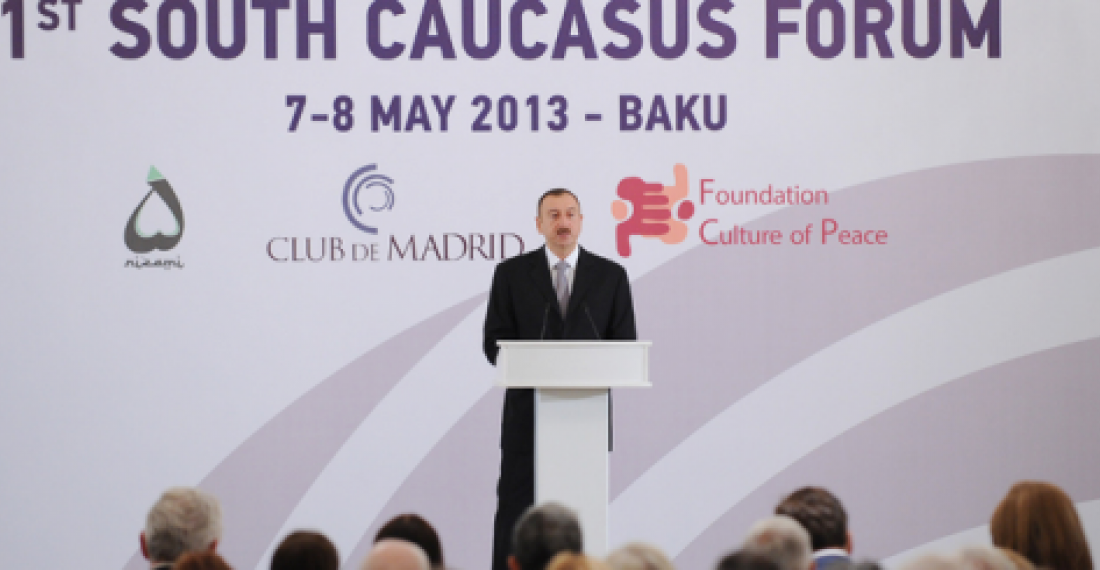
ALIEV: "Democratisation of our society is a priority for us". President of Azerbaijan makes a rare reference to democratic reforms.

Azerbaijani President Ilham Aliev, whose government has over the last months come under increasing criticism for its crackdown on dissent and opposition activism has made a rare reference to democratic reforms in his country whilst addressing the opening session of the Caucasus Forum in Baku. "We are carrying out political reforms. Democratisation of our society is a priority for us," he told participants. 

The President said that political and economic reforms should be carried out in parallel so that they support each other and the goals are achieved: "We achieved a great progress since independence, especially over the last 10 years. GDP growth made 300%, this is a record figure in the world. At the same time, we reduced poverty to 6% from 50%. The economic achievements of Azerbaijan are in the focus of attention of international institutions. The opinions of the leading international financial institutions on this are positive. According to Davos Forum indicators, competitiveness rating of Azerbaijan increased. We were able to carry out the main economic reforms in the country. In terms of economic development, transition period is over. Currently, 83% of our economic investment is provided by the private sector. Our private sector is strong enough."

In terms of economy, the future development of Azerbaijan is also attractive. Now we give much attention to the non-energy sector. Great achievements were made in non-energy sector, more than 11% growth was recorded in the first three months of 2013. This shows once again that our economy is more attractive. We want to diversify our economy and are making efforts for this, because if we do not diversify our economy, we can not gain greater achievements."

Ilham Aliev said that Azerbaijan is investing more in the modern technologies: "This year we witnessed a very important event. For the first time we launched Azerbaijan's satellite "Azerispace -1". It proves that Azerbaijan has an aerospace industry. Following this, Azerispace-2 and Azerispace-3 will be launched. Together with our international partners we intend to create a strong aerospace industry in Azerbaijan."

President Ilham Aliyev said energy is the major part for Azerbaijan's economy. "Throughout the centuries Azerbaijan has been known as an oil country. Now we are also known as a gas producing country. The investments made in the energy sector have allowed us to create a very positive investment climate. We are in the first place in the region in terms of the direct foreign investments. We have established a mechanism like State Oil Fund in order not to repeat heavy consequences, the problems faced by some countries. The State Oil Fund is known as one of the most transparent funds in the world. With this we have insured ourselves from hard conditions. We avoided the situation when the poor become poorer and the rich become richer," he said.

President Aliev added that investments are made in human capital, especially in education. "Education is a criterion preconditioning success. The history and experience of various countries show that not only economic growth, but also intellectual potential is important. 10 years ago we stated that we intended to turn the "black gold" into human capital. Diversification of economy, implementation of social projects, infrastructure projects and changes observed in Azerbaijan show that we have good experience in the field of transition - transition from the totalitarian society to the democratic society, from the state economy to the private economy," he said.

President Ilham Aliyev noted that Azerbaijan is today a country with its own resource and strong financial capacity.

"It means that economic crisis has not affected us. Of course, all this will play a role in the country's future development. We are doing this with the European countries, our neighbours so that we can enjoy more our energy potential," he said. The Azerbaijani leader said that Azerbaijan's energy resources will be sufficient for 100 more years.

source:commonspace.eu with APA news Agency

photo: Ilham Aliyev (archive picture).
Related articles

Editor's choice
News
Uzbekistan strengthens its relations with China and US

Uzbekistan strengthens its relations with China and US

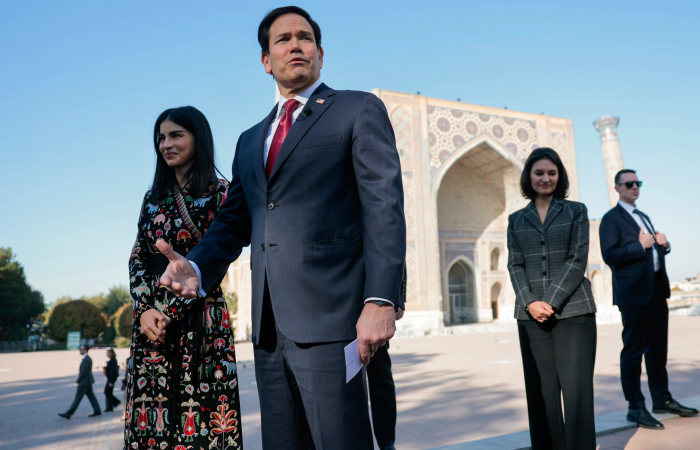
In recent days, Uzbekistan welcomed the Chinese and American governments in quick succession. During Chinese Premier Li Qiang’s visit on 17-18 October, the Uzbek presidential administration said that joint projects backed by firm agreements had reached nearly $60 billion. US Secretary of State Marco Rubio then arrived in Samarkand for C5+1 talks, accompanied at the time by American business leaders seeking contracts, particularly in critical minerals. During the visit, Uzbekistan announced 54 agreements covering trade, investment, and technology. The agreements are said to be worth a total of $12 billion, according to Uzbekistan’s Ministry of Investment, Industry and Trade. However, China still accounts for 23% of Uzbekistan’s foreign trade in January-August 2026, while US goods trade with Uzbekistan totalled at $1.05 billion in 2025, which is less than a fifteenth of the value of its trade with China. Rubio said Washington was not asking Central Asian countries to stop cooperating with other partners, but would instead compete for investment. Tashkent is likely to welcome investment from both sides, but the trade gap shows how challenging it will be if it were to decrease its dependence on Beijing. “Chinese Premier Li Qiang visited Uzbekistan on October 17–18, just ahead of United States Secretary of State Marco Rubio, who arrived in Samarkand on October 18 with a delegation of American business leaders seeking new contracts. While China already has a substantial presence in Uzbek manufacturing and energy, Washington is seeking to expand American involvement in critical minerals and technology. The visits highlight the growing competition between the world’s two largest economies for influence in Central Asia. On October 17, President Shavkat Mirziyoyev received Li Qiang. According to the Uzbek presidential administration, the portfolio of joint projects backed by firm agreements has reached nearly $60 billion. More than 6,000 joint ventures with Chinese participation have been established in Uzbekistan. (...) Construction of the China–Kyrgyzstan–Uzbekistan railway was another topic of discussion. Work officially began in December 2024. The route will cross mountainous areas of Kyrgyzstan and connect the railway networks of China and Uzbekistan. The 304-kilometer section through Kyrgyzstan alone is estimated to cost $4.7 billion and will require 50 bridges and 29 tunnels. (...) On October 19, Rubio attended talks in Samarkand under the C5+1 format, bringing together the U.S. and Kazakhstan, Kyrgyzstan, Tajikistan, Turkmenistan, and Uzbekistan. Rubio said nearly 300 American businesses were represented in Samarkand. Companies were discussing agreements potentially worth billions of dollars, with concrete announcements expected following the meetings. Among Washington’s priorities are critical minerals used in advanced technologies, including electronics and batteries.”

Popular

Editor's choice
Interview
Thursday Interview: Murad Muradov

Thursday Interview: Murad Muradov

Today, commonspace.eu starts a new regular weekly series. THURSDAY INTERVIEW, conducted by Lauri Nikulainen, will host  persons who are thinkers, opinion shapers, and implementors in their countries and spheres. We start the series with an interview with Murad Muradov, a leading person in Azerbaijan's think tank community. He is also the first co-chair of the Action Committee for a new Armenian-Azerbaijani Dialogue. Last September he made history by being the first Azerbaijani civil society activist to visit Armenia after the 44 day war, and the start of the peace process. Speaking about this visit Murad Muradov said: "My experience was largely positive. My negative expectations luckily didn’t play out. The discussions were respectful, the panel format bringing together experts from Armenia, Azerbaijan, and Turkey was particularly valuable during the NATO Rose-Roth Seminar in Yerevan, and media coverage, while varied in tone, remained largely constructive. Some media outlets though attempted to represent me as more of a government mouthpiece than an independent expert, which was totally misleading.  Overall, I see these initiatives as important steps in rebuilding trust and normalising professional engagement. The fact that soon a larger Azerbaijani civil society visits to Armenia followed, reinforces the sense that this process is moving in the right direction." (click the image to read the interview in full)