


Unexpected guests arrive in Baku.

The tense relations between Armenia and Azerbaijan took a new twist on Thursday (17 September) with the arrival in Baku of a young Armenian couple and their baby son. The couple asked Azerbaijan for political asylum, and on Friday made their reasons known to an excited group of journalists gathered at the International Press Club in the centre of Baku. According to the Azerbaijani News Agency Trend the asylum seeker is Vahan Martirossian who describes himself as the Head of Armenian Intra-National Liberation Movement. According to the Azerbaijani News Agency TREND Martirossian told the journalists that "his public and political work against Serzh Sargsyan's criminal regime and corruption in Armenia led to pressures on him by that country's government".

Referring to the conflict between Armenia and Azerbaijan Martirossian said that "No one wants a resumption of war in Armenia. That would be the greatest tragedy for our two peoples". Martirosyan said this would be beneficial to those who make profit from such a situation.

Martirossian also said that in its current state Armenia's army is unable to fight not only against the Azerbaijani army but even against a third world army in Africa. "No one will tell the truth about Sargsyan's criminal regime better than the Azerbaijani media," said Martirosyan. "This is one of the reasons why I am here." "But I wasn't expecting a hundredth of the hospitality that I have met with here. The attitude towards me is excellent, at the highest level. I think if the borders are opened, a huge stream of refugees from Armenia will rush to Azerbaijan,"  Trend quoted Martirossian as saying.

Martirossian said that he appealed to the offices of the United Nations and International Red Cross Society in Azerbaijan: “I want them to contact with Armenia in any form. I left my mother there. My wife’s family is also there. I don’t know how the government will treat them. I would like them to check their conditions,” he added.

In the first reaction to the political defection Vahan Baghdasaryan, the head of faction of the governing Republican Party in the Armenian Parliament, told News.am “One should not rely on the Azerbaijani media reports. Let's wait for formal information. We will issue a statement then,” The Parliamentarian added that Martirosyan,  had chosen the wrong country to seek asylum in since Azerbaijan  had a bad human rights record and decided to withdraw from the Euronest Parliamentary Assembly  because it was not able to accept the constructive criticism by the European Parliament that slammed Baku for crackdown on human rights. Some media are also reporting that the Armenian authorities are saying that there is a criminal case against Martirossian in Armenia for stealing 4000 US$ from a relative.

Commonspace.eu political editor said that "regardless of the exact details of the case, some of which are yet to emerge, the defection adds a further strain in relations between Armenia and Azerbaijan. It comes at an awkward moment for Armenia when talks are going on on sensitve constitutional amendments, whilst in Baku it is seen as an opportunity, given that Azerbaijan has recently been under great pressure from the international community because of its human rights record. The arrival of a young Armenian family in Baku claiming political asylum, and the fact that Martirossian is able to articulate his views well, are seen as a a great propaganda triumph.

Beyond that however it would simply complicate further relations between the two countries,. and make the possibility of contacts between civil society activists even more difficult than it recently has become"

souce; commonspace.eu with agencies

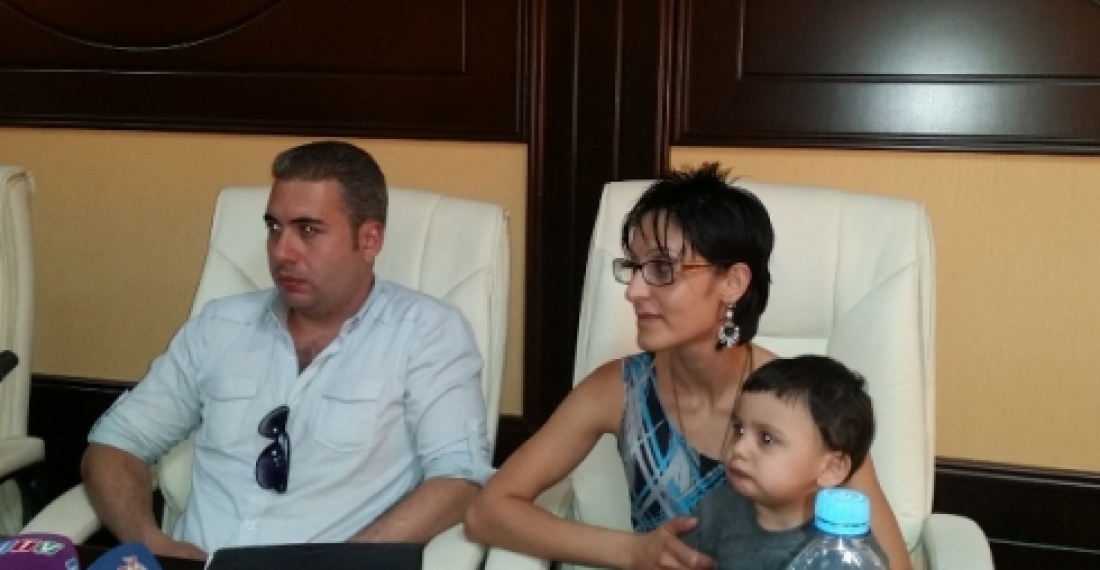
photo: Vahan Martirossian with his wife and baby son speaking at the International Press Club in Baku on Friday, 18 September 2015, a day after the couiple defected to Azerbaijan seeking political saylum (picture courtesy of Trend News Agency).


Related articles

Editor's choice
News
Borrell tells the European Parliament that the situation in Afghanistan was critical, but the EU will remain engaged

Borrell tells the European Parliament that the situation in Afghanistan was critical, but the EU will remain engaged

Borrell underlined that the European Union will make every effort to support the peace process and to remain a committed partner to the Afghan people. "Of course, we will have to take into account the evolving situation, but disengagement is not an option.  We are clear on that: there is no alternative to a negotiated political settlement, through inclusive peace talks.
Editor's choice
News
NATO Chief says war is on Europe's doorstep, and warns against complacency

NATO Chief says war is on Europe's doorstep, and warns against complacency

Russia could attack a Nato country within the next five years, the Secretary General of NATO, Mark Rutte, said in a stark new warning. "Nato's own defences can hold for now," Rutte warned in Berlin, but conflict was "next door" to Europe and he feared "too many are quietly complacent, and too many don't feel the urgency, too many believe that time is on our side. "Russia is already escalating its covert campaign against our societies," Rutte said in a speech in Germany. "We must be prepared for the scale of war our grandparents or great-grandparents endured." Earlier this month, Russia's President Vladimir Putin said his country was not planning to go to war with Europe, but it was ready "right now" if Europe wanted to - or started a war. But similar reassurances were given by Moscow in 2022, just before 200,000 Russian troops crossed the border and invaded Ukraine. Putin has accused European countries of hindering US efforts to bring peace in Ukraine - a reference to the role Ukraine's European allies have recently played in trying to change a US peace plan to end the war, whose initial draft was seen as favouring Russia. But Putin was not sincere, Nato's secretary-general said in the German capital, Berlin. Supporting Ukraine, he added, was a guarantee for European security. "Just imagine if Putin got his way; Ukraine under the boot of Russian occupation, his forces pressing against a longer border with Nato, and the significantly increased risk of an armed attack against us." Russia's economy has been on a war footing for more than three years now - its factories churn out ever more supplies of drones, missiles and artillery shells. According to a recent report by the Kiel Institute for the World Economy, Russia has been producing each month around 150 tanks, 550 infantry fighting vehicles, 120 Lancet drones and more than 50 artillery pieces. The UK, and most of its Western allies, are simply not anywhere near this point. Analysts say it would take years for Western Europe's factories to come close to matching Russia's mass-production of weapons. "Allied defence spending and production must rise rapidly, our armed forces must have what they need to keep us safe," the Nato chief said.

Popular

Editor's choice
News
NATO Chief says war is on Europe's doorstep, and warns against complacency

NATO Chief says war is on Europe's doorstep, and warns against complacency

Russia could attack a Nato country within the next five years, the Secretary General of NATO, Mark Rutte, said in a stark new warning. "Nato's own defences can hold for now," Rutte warned in Berlin, but conflict was "next door" to Europe and he feared "too many are quietly complacent, and too many don't feel the urgency, too many believe that time is on our side. "Russia is already escalating its covert campaign against our societies," Rutte said in a speech in Germany. "We must be prepared for the scale of war our grandparents or great-grandparents endured." Earlier this month, Russia's President Vladimir Putin said his country was not planning to go to war with Europe, but it was ready "right now" if Europe wanted to - or started a war. But similar reassurances were given by Moscow in 2022, just before 200,000 Russian troops crossed the border and invaded Ukraine. Putin has accused European countries of hindering US efforts to bring peace in Ukraine - a reference to the role Ukraine's European allies have recently played in trying to change a US peace plan to end the war, whose initial draft was seen as favouring Russia. But Putin was not sincere, Nato's secretary-general said in the German capital, Berlin. Supporting Ukraine, he added, was a guarantee for European security. "Just imagine if Putin got his way; Ukraine under the boot of Russian occupation, his forces pressing against a longer border with Nato, and the significantly increased risk of an armed attack against us." Russia's economy has been on a war footing for more than three years now - its factories churn out ever more supplies of drones, missiles and artillery shells. According to a recent report by the Kiel Institute for the World Economy, Russia has been producing each month around 150 tanks, 550 infantry fighting vehicles, 120 Lancet drones and more than 50 artillery pieces. The UK, and most of its Western allies, are simply not anywhere near this point. Analysts say it would take years for Western Europe's factories to come close to matching Russia's mass-production of weapons. "Allied defence spending and production must rise rapidly, our armed forces must have what they need to keep us safe," the Nato chief said.

