Theme

Connectivity

Stories related to telecommunications and transport links. 

Editor's choice
Opinion
Opinion: The European Union must recognise that the C5 have now become the C6

Opinion: The European Union must recognise that the C5 have now become the C6

In recent years, Eurasia has undergone a structural transformation in how regions connect, trade, and cooperate. The combination of geopolitical shocks, disrupted supply chains, and the search for secure east–west routes has elevated the importance of the Trans-Caspian space. The states of Central Asia, once constrained by geography, have taken unprecedented steps to strengthen regional coordination, modernize infrastructure, and integrate more closely with Europe. Meanwhile, Azerbaijan has rapidly emerged as an indispensable connector linking Central Asia with the South Caucasus, Türkiye, and European markets. This new reality was formally acknowledged in November 2025 when Azerbaijan was unanimously welcomed as a full participant in the Consultative Meeting of Central Asian Heads of State in Tashkent. What had long been a C5 grouping transformed into a C6, marking a historic moment: the Caspian was no longer a frontier separating two regions but the center of a unified geopolitical and geo-economic space. President Ilham Aliyev described this alignment as the emergence of “a single geopolitical and geo-economic region,” while President Shavkat Mirziyoyev called Azerbaijan’s inclusion “historic” and proposed transforming the consultative platform into a structured regional institution capable of shaping security, economic, environmental, and digital policy. The Caspian is no longer a boundary; it is the heart of an integrated region. The transformation of the EU and U.S. C5+1 formats into C6+1 is the logical next step to ensure that both sides of the Caspian advance together – coherently, strategically, and with shared purpose. (click the image to read the full op-ed).
Editor's choice
Commentary
Central Asia on the march, but challenges ahead

Central Asia on the march, but challenges ahead

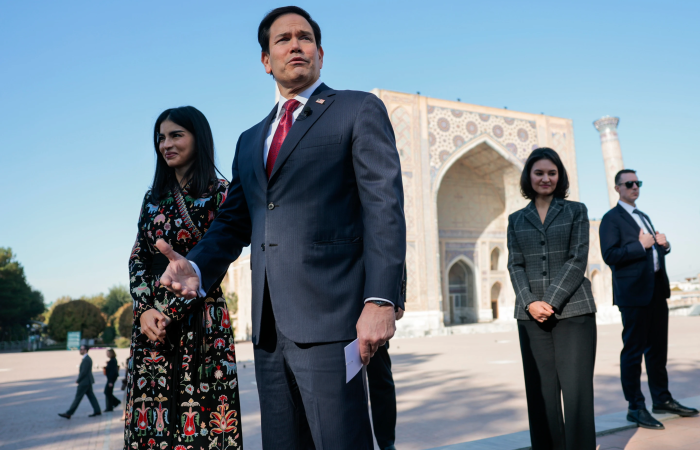
Central Asian leaders have been busy the last month, forging new ties in a changing geopolitical landscape. The presidents of Kazakhstan, Kyrgyzstan, Tajikistan, Turkmenistan, and Uzbekistan travelled to the White House to meet with U.S. President Donald Trump in the C5+1 format. The format, established in 2015, aims to deepen U.S. collaboration with Central Asia, emphasising security and economic cooperation. The U.S. is not the only power looking to maintain its influence in the region. The European Union, Russia, China, and increasingly, India, have all shown their interest in securing economic cooperation and inking energy and trade deals, recognising Central Asia’s strategic position as a key energy and transfer hub situated between East and West. Central Asian states are keenly aware of their leverage and have not only engaged in multi-lateral diplomacy with all of the aforementioned external actors but also adopted a pragmatic regional approach to increase cooperation amongst themselves and taken concrete steps to foster a more unified ‘Central Asian Community’. This was evident by last weekend’s Seventh Consultative Meeting of Heads of State, also known as the C5, where Central Asian leaders officially admitted Azerbaijan as a full member, effectively transforming it into the C6. However, although Central Asia has the unique opportunity to multilaterally engage with all of the world’s biggest economic and security powers, while continuing to shape regional politics and cooperation on its own terms, new security and economic issues are arising that may well reshape Central Asian states’ connections to external actors and potentially strain intra-regional relations. (Read the full commentary by clicking on the picture).

Filter archive

Publication date
Editor's choice
Opinion
Opinion: On perception and interpretation, and the prospect of the Kaliningradisation of Armenia

Opinion: On perception and interpretation, and the prospect of the Kaliningradisation of Armenia

"When playing on Armenian vulnerabilities, both Azerbaijan and Turkey should take into account that each step aimed at increasing fears in Armenia leads to a new level of dependence on Russia", writes Alexander Petrosyan in this op-ed. "In the end, everything is a matter of interpretation and perception", he argues.
Editor's choice
Commentary
Commentary: The debate about the “Corridors War” is not based on reality

Commentary: The debate about the “Corridors War” is not based on reality

The "corridors war", currently being hotly debated among experts, pundits, and policy-making circles in the South Caucasus, is largely based on wishful thinking rather than hard facts. In reality the options are rather limited, argues Benyamin Poghosyan in this op-ed.
Editor's choice
Analysis
Analysis: Central Asian countries need to remain focused on reforms despite new security threats

Analysis: Central Asian countries need to remain focused on reforms despite new security threats

The countries of Central Asia are at an important crossroads. The events in Afghanistan are not going to make their choices either more simple or more easy. Kazakhstan and Uzbekistan have taken very important steps in the last few years on the path to reform. It is important that they stay the course, and it is important for the EU and other western countries to help them in this task. If possible this should be done without adversarial engagement with either Russia or China, even though are likely to put obstacles in the way. Central Asia does not need another "great game". It needs support so it can develop and evolve for the benefit of its people, and so that the radical elements that have been successful in Afghanistan can be stopped in their stride. 
Editor's choice
Opinion
Opinion: China may end up being the biggest beneficiary of the Taliban power-grab in Afghanistan

Opinion: China may end up being the biggest beneficiary of the Taliban power-grab in Afghanistan

Beijing can turn the situation in Afghanistan to its own advantage, argues Benyamin Poghosyan in this op-ed. Afghanistan has significant minerals, including rare earth metals, which China will be glad to import. Beijing  could also include Afghanistan in the “Belt and Road initiative” and use it as another land route towards Iran and the Central Asian republics via Pakistan, and through Iran via Turkey or via Armenia-Georgia-Black Sea route to Europe.