Theme

Conflict and Peace

Stories related to violent conflicts, diplomatic tensions, and conflict prevention, mediation and resolution.

Editor's choice
News
NATO Chief says war is on Europe's doorstep, and warns against complacency

NATO Chief says war is on Europe's doorstep, and warns against complacency

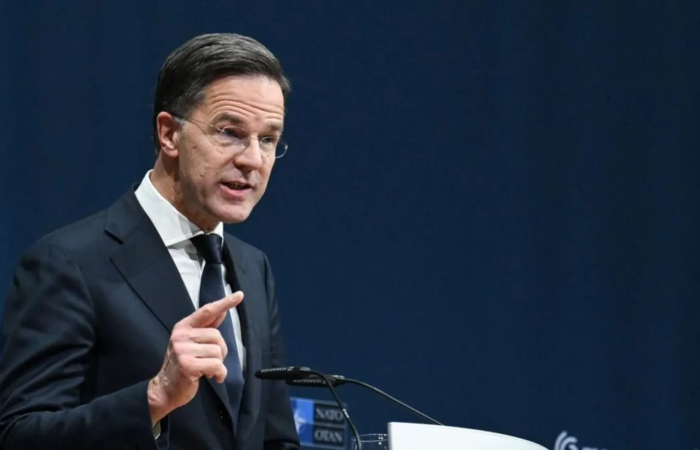
Russia could attack a NATO country within the next five years, the Secretary General of NATO, Mark Rutte, said in a stark new warning. "NATO's own defences can hold for now," Rutte warned in Berlin, but conflict was "next door" to Europe, and he feared "too many are quietly complacent, and too many don't feel the urgency, too many believe that time is on our side. "Russia is already escalating its covert campaign against our societies," Rutte said in a speech in Germany. "We must be prepared for the scale of war our grandparents or great-grandparents endured." Earlier this month, Russia's President Vladimir Putin said his country was not planning to go to war with Europe, but it was ready "right now" if Europe wanted to - or started a war. But similar reassurances were given by Moscow in 2022, just before 200,000 Russian troops crossed the border and invaded Ukraine. Putin has accused European countries of hindering US efforts to bring peace in Ukraine - a reference to the role Ukraine's European allies have recently played in trying to change a US peace plan to end the war, whose initial draft was seen as favouring Russia. But Putin was not sincere, Nato's secretary-general said in the German capital, Berlin. Supporting Ukraine, he added, was a guarantee for European security. "Just imagine if Putin got his way; Ukraine under the boot of Russian occupation, his forces pressing against a longer border with Nato, and the significantly increased risk of an armed attack against us." Russia's economy has been on a war footing for more than three years now - its factories churn out ever more supplies of drones, missiles and artillery shells. According to a recent report by the Kiel Institute for the World Economy, Russia has been producing each month around 150 tanks, 550 infantry fighting vehicles, 120 Lancet drones and more than 50 artillery pieces. The UK, and most of its Western allies, are simply not anywhere near this point. Analysts say it would take years for Western Europe's factories to come close to matching Russia's mass-production of weapons. "Allied defence spending and production must rise rapidly, our armed forces must have what they need to keep us safe," the Nato chief said.
Editor's choice
News
Thai-Cambodia border clashes enter fourth day

Thai-Cambodia border clashes enter fourth day

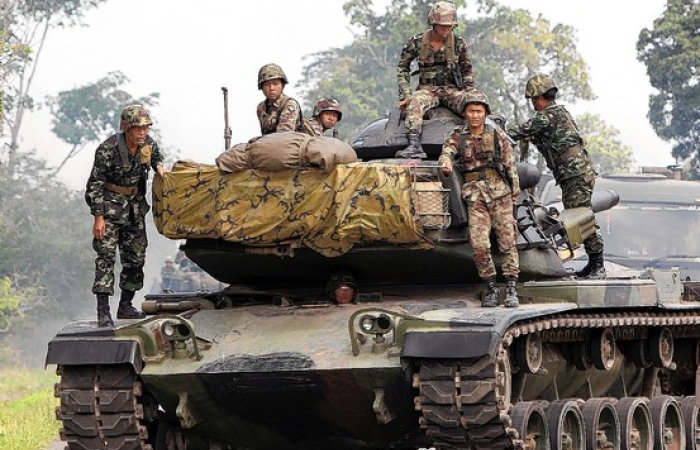
Renewed fighting between Thailand and Cambodia has entered its fourth day, with both sides accusing one another of violating international law, as they await a promised phone call from United States President Donald Trump. Cambodia’s Ministry of Defence accused Thailand’s military of carrying out numerous attacks within the country in the early hours of Thursday morning, including deploying tanks and artillery to strike targets in the country’s Pursat, Banteay Meanchey, and Oddar Meanchey provinces. In one such attack, Cambodia accused Thai soldiers of violating international humanitarian law by firing on civilians in Prey Chan village in Banteay Meanchey province. In another, it accused Thai forces of shelling “into Khnar Temple area”, and said Thai forces had also “fired artillery and support fire into the O’Smach area”. “Cambodia urges that Thailand immediately stop all hostile activities and withdraw its forces from Cambodia’s territorial integrity, and avoid acts of aggression that threaten peace and stability in the region,” the Defence Ministry said. Clashes took place on Wednesday at more than a dozen locations along the contested colonial-era demarcated 817-kilometre (508-mile) Thai-Cambodian border, with some of the most intense fighting being reported since a five-day battle in July, which saw dozens killed on both sides. Cambodia’s Ministry of the Interior said homes, schools, roads, Buddhist pagodas and ancient temples had been damaged by “Thailand’s intensified shelling and F-16 air strikes targeting villages and civilian population centres up to 30km [18.6 miles] inside Cambodian territory”. (click the image to read the full story).

Filter archive

Publication date
Editor's choice
News
UN General Assembly overwhelmingly votes for a humanitarian truce in Gaza leading to a cessation of hostilities

UN General Assembly overwhelmingly votes for a humanitarian truce in Gaza leading to a cessation of hostilities

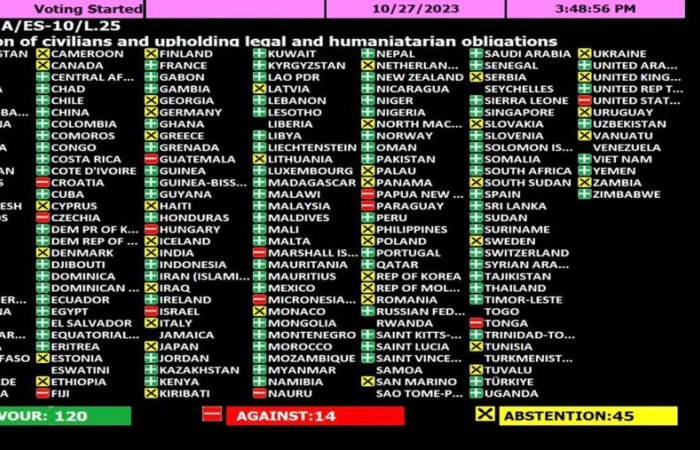
The United Nations General Assembly on Friday (27 October), voted overwhelmingly, with 120 countries in favour, 14 against and 45 abstentions, to a resolution calling for an end of hostilities in Gaza and for humanitarian relief to the Palestinian people of Gaza. The resolution calls for an “immediate, durable and sustained humanitarian truce leading to a cessation of hostilities.” The vote, whilst not binding, gives moral support to efforts to get a similar resolution passed in the Security Council. As decided by the General Assembly earlier, the resolution required a two-thirds majority of the members present and voting to be adopted. There are 193 members of the United Nations. Most members of the Non-Aligned Movement, eight members of the European Union, and UN Security Council members France, China  and Russia were amongst those voting for the resolution. There could be noted however divisions in the voting patterns of EU members: Several of the EU 27 member states voted for the resolution, including: Belgium, France, Ireland, Luxembourg, Malta, Portugal, Spain and Slovenia. Five, joined the United States and Israel to vote against, namely Austria, Croatia, Czechia, Hungary Most EU countries abstained, including Bulgaria, Cyprus, Denmark, Estonia, Finland, Germany, Greece, Italy, Latvia, Lithuania, The Netherlands, Poland and Romania, Slovakia and Sweden. Of the three South Caucasus countries, Armenia and Azerbaijan voted for the resolution, Georgia abstained. Ukraine and Moldova also abstained.
Editor's choice
News
Toivo Klaar: "We are moving slowly in the right direction"

Toivo Klaar: "We are moving slowly in the right direction"

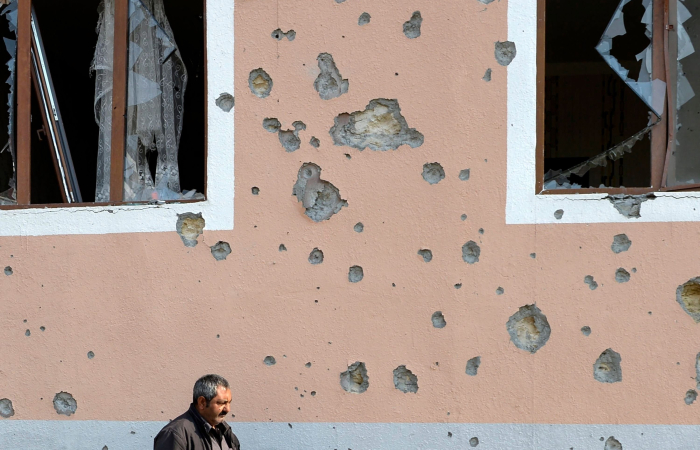
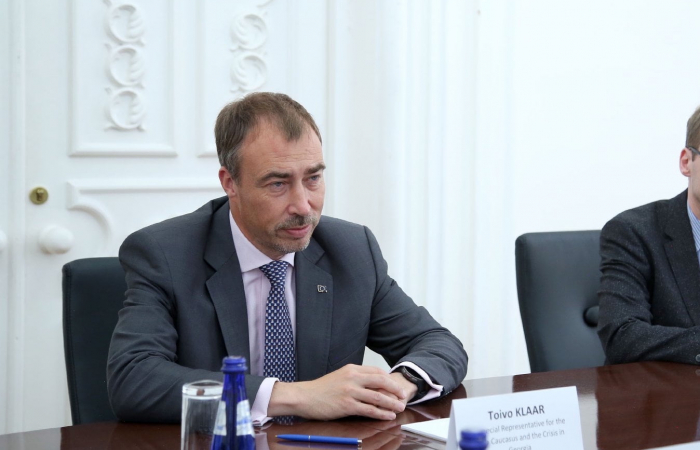
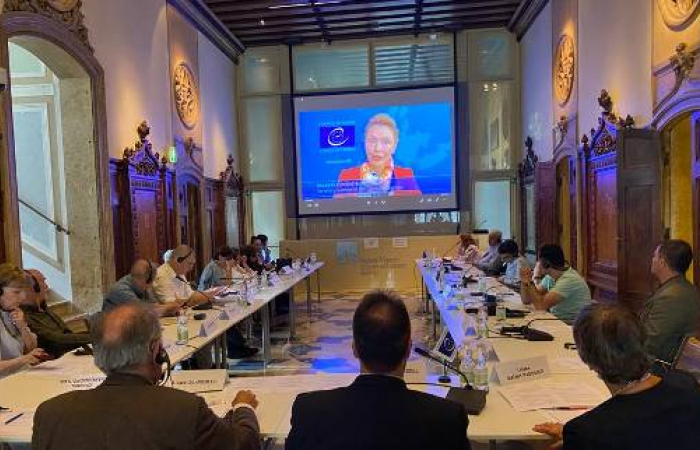
A meeting with the leaders of Armenia and Azerbaijan will be held in Brussels in the very near future, but it will not be held before the end of this month as had been previously hoped. This was stated by the EU Special Representative for the South Caucasus, Toivo Klaar. Speaking about the state of Armenia-Azerbaijan negotiations that are being facilitated by the European Union, Klaar said "We are moving slowly in the right direction". The EUSR for the South Caucasus addressed the forum "Making Progress in time of uncertainty" organised in Yerevan by the Applied Policy Research Institute, Armenia. Klaar spoke to participants on-line from Brussels. In his address Klaar spoke about the reaction of the European Union to events in Nagorno-Karabakh in September and said that the EU had taken a clear position , which was robustly communicated to interested parties. The EU is now calling for conditions to be created for the safe return of Armenians displaced from Nagorno-Karabakh. As regards on-going negotiations, Toivo Klaar said that the situation now is qualitatively different. The objective is the normalisation of relations between the sovereign state of Azerbaijan and the sovereign state of Armenia. There is now a window of opportunity to move forward with the objective of normalising relations between Armenia and Azerbaijan. The signing of a peace treaty is not an aim in itself, but simply an expression of this objective. Klaar said that peace between Armenia and Azerbaijan will have benefit for the whole region, and the aim of the EU was to see the South Caucasus as a place where all countries have normal diplomatic relations, there is movement of people and goods, and the whole region is opened up for economic co-operation. Speaking about Russia, EUSR Klaar said that the EU is not in the business of including and excluding anyone from the South Caucasus. Russia was an important close neighbour of the region and has its interests, as have the EU and the US. Klaar criticised the negative rhetoric coming from Moscow. Toivo Klaar said the EU will continue to support civil society initiatives aimed at promoting trust and confidence across the South Caucasus. He however emphasised that this can never be an alternative to political will on the part of the governments who need to lead by changing official narratives.
Editor's choice
News
Pashinyan:  "Armenia is ready to be closer to the European Union, as much as the European Union considers it possible." 

Pashinyan: "Armenia is ready to be closer to the European Union, as much as the European Union considers it possible." 

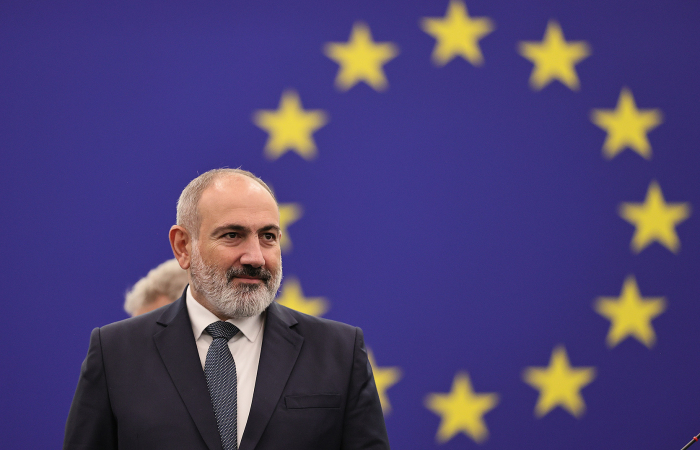
Armenian prime minister Nikol Pashinyan on Tuesday, 17 October spoke to the European Parliament meeting in Strasbourg addressing important issues of Armenia-EU relations, peace between Armenia and Azerbaijan, and South Caucasus regional co-operation. commonspace.eu political editor said in a comment that this was one of Pashinyan's most important speeches since he took office as leader of Armenia in 2018. Throughout his speech Pashinyan made reference to "common values" and to "democracy", saying that for Armenia this was a strategic choice, and not a choice dictated by circumstances. Pashinyan said that "Armenia is ready to be closer to the European Union, as much as the European Union considers it possible."  But Pashinyan focused most in his speech on peace in  the South Caucasus and Armenia-Azerbaijan relations. He spoke in detail about the issues under consideration, stating "we are ready to sign a peace and relations settlement agreement with Azerbaijan by the end of the year."
Editor's choice
News
Gutteres insists two-state solution is only way forward in the Middle East

Gutteres insists two-state solution is only way forward in the Middle East

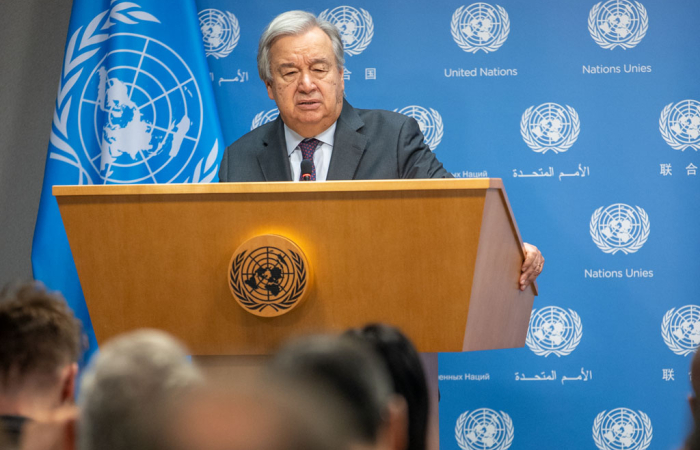
UN Secretary-General Antonio Gutteres, on Monday, 9 October, made a passionate call for a return to negotiations between the sides in the Middle East, and said that "only a negotiated peace that fulfills the legitimate national aspirations of Palestinians and Israelis, together with their security alike – the long-held vision of a two-State solution, in line with United Nations resolutions, international law and previous agreements – can bring long-term stability to the people of this land and the wider Middle East region." Gutteres was speaking as the most serious crisis in the middle East in half a century unfolded following the Saturday morning raids by Hamas militants on towns and settlements in the south of Israel. Whilst unequivocally condemning the attacks, Gutteres said that "this most recent violence does not come in a vacuum. The reality is that it grows out of a long-standing conflict, with a 56-year long occupation and no political end in sight." "It’s time to end this vicious circle of bloodshed, hatred and polarization", the UN Secretary General said in the press briefing, which he held in New York following a meeting with other senior UN officials. Clearly, the UN sees the crisis as one of the most significant in recent years and is brazing itself for a humanitarian catastrophy as Israel launches a large scale punitive action in Gaza with the aim of eradicating completely Hamas, and its political and military capacity. In his statement, Gutteres said that "Civilians must be respected and protected at all times".